
The Relationship Between Bourbon and Whiskey
One of the most common questions in the spirits world is deceptively simple: what's the difference between bourbon and whiskey? The answer is that bourbon is a type of whiskey — like how a golden retriever is a type of dog. All bourbon is whiskey, but not all whiskey qualifies as bourbon.
Whiskey is the broad category. It covers any spirit distilled from fermented grain mash and aged in wooden barrels. That includes Scotch, Irish whiskey, Japanese whisky, Canadian whisky, rye whiskey, and bourbon. Each has its own set of rules, traditions, and flavor characteristics. (If the two spellings in that sentence caught your eye, that's a regional convention rather than a difference in the liquid — we cover whiskey vs. whisky separately.)
Bourbon is a specifically defined subset of whiskey with strict legal requirements established by the U.S. federal government.
The Legal Definition of Bourbon
The U.S. Code of Federal Regulations (27 CFR 5.143) lays out the exact requirements. For a whiskey to be called bourbon, it must meet all of the following:
1. Made in the United States
Bourbon must be produced in the U.S. — but contrary to popular belief, it does not have to be made in Kentucky. Our bourbons are proudly made in Marquette, Kansas, and they meet every legal requirement. Kansas corn, Kansas water from the Kiowa Aquifer, Kansas craftsmanship.
That myth is stubborn enough to deserve its own page: does bourbon have to be made in Kentucky? covers the 1964 resolution behind the U.S.-only rule, what the word "Kentucky" on a label legally guarantees, and what actually changes when bourbon is made somewhere else.
2. At Least 51% Corn
The grain mixture — the mash bill — must contain a minimum of 51% corn. This is what gives bourbon its signature sweetness. Most bourbon mash bills use 60-80% corn, with the remainder split between rye (or wheat) and malted barley.
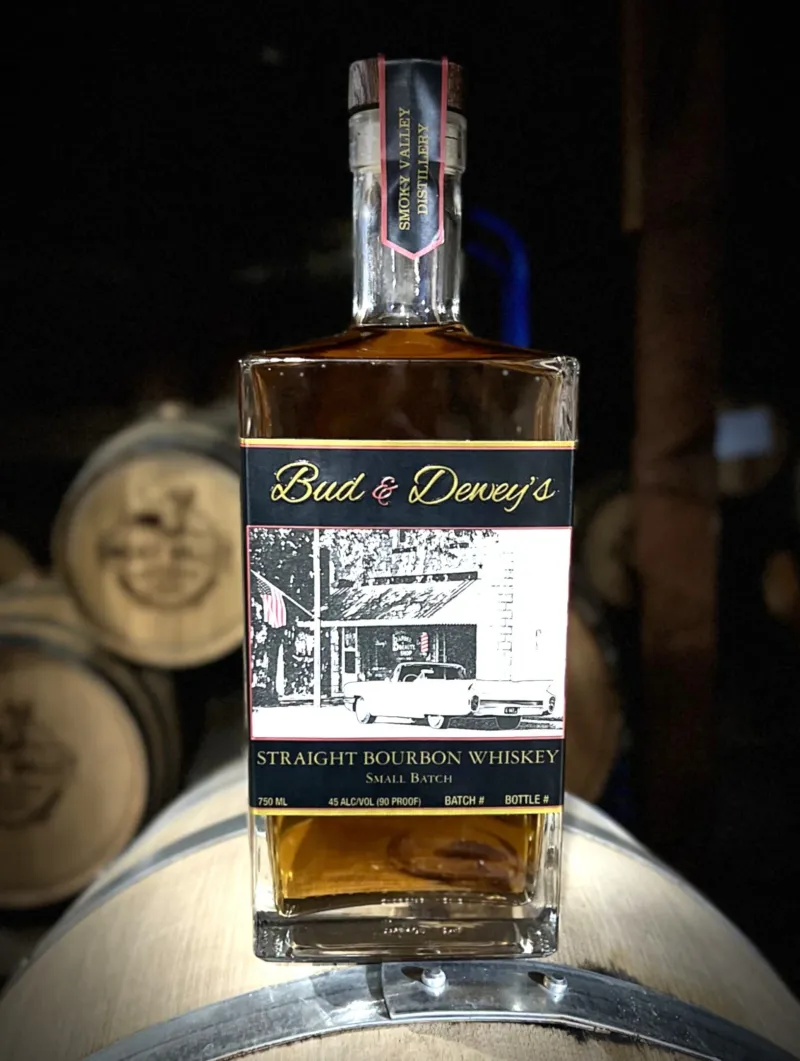
Our Straight Bourbon uses a traditional mash bill with rye for spice, while Bud & Dewey's uses wheat for a softer, sweeter profile. Both are 100% bourbon.
3. Distilled to No More Than 160 Proof
The spirit coming off the still cannot exceed 160 proof (80% ABV). This limit ensures the spirit retains the flavor characteristics of the grain. Distilling to higher proofs would strip away those flavors, producing something closer to neutral grain spirit.
4. Entered Into New Charred Oak Barrels at No More Than 125 Proof
This is one of bourbon's most distinctive rules. The barrels must be new (never previously used) and charred (the inside is burned with an open flame). The charring caramelizes the wood sugars and creates a layer of carbon that filters the spirit as it ages.
The "new barrel" requirement is what makes bourbon so different from Scotch (which uses used bourbon barrels) and other whiskeys. It's also why bourbon gets so much of its flavor from the wood — vanilla, caramel, toffee, and baking spices.
5. Bottled at a Minimum of 80 Proof
The final product must be at least 80 proof (40% ABV). Our bourbons are bottled at 90 proof (45% ABV), which preserves more of the barrel-aged flavor and complexity.
6. No Added Coloring or Flavoring
What comes out of the barrel is what goes in the bottle. No caramel coloring, no flavoring additives, no sugar. This rule ensures the color, flavor, and aroma of bourbon come entirely from the grain, the fermentation, the distillation, and the barrel.
Bourbon vs. Other Whiskeys
| Bourbon | Scotch | Irish Whiskey | Rye | |
|---|---|---|---|---|
| Country | USA | Scotland | Ireland | USA/Canada |
| Primary Grain | 51%+ corn | Malted barley | Barley | 51%+ rye |
| Barrel | New charred oak | Used oak | Used oak | New charred oak |
| Flavor | Sweet, caramel | Smoky, peaty | Smooth, light | Spicy, bold |
| Min. Aging | None (2yr for straight) | 3 years | 3 years | None (2yr for straight) |
Tennessee whiskey is missing from that table on purpose: by recipe it meets every bourbon requirement above, then adds a maple charcoal filtering step before the barrel. Bourbon vs. Tennessee whiskey covers that one step, the Tennessee statute behind it, and why a trade treaty classifies Tennessee whiskey as straight bourbon anyway.
Straight Bourbon: An Extra Distinction
"Straight bourbon" adds two more requirements on top of regular bourbon:
- Must be aged for at least two years
- If aged less than four years, the age must be stated on the label
All three of our bourbons — Straight Bourbon, Bud & Dewey's, and Smoked Straight Bourbon — carry the "straight" designation.
Pour It in Something Worthy
However you take your bourbon — neat, on the rocks, or in a cocktail — it tastes better from a glass made for it. Our hand-etched logo tasting glass and Old Fashioned glass are available in our online shop, each carrying the Smoky Valley crest. They come straight from our family-run distillery in the small town of Marquette, Kansas, where Stan and Michele Von Strohe and their son Shane still make every batch by hand. When you buy from us, you're getting something authentic from real people — not a mass-produced label off a big-box shelf.
Taste the Difference Yourself
Understanding the rules is one thing. Tasting is another. Our guided tours cover the legal and practical differences between bourbon and other whiskeys, and you'll taste three distinct bourbons plus our Kernza Whiskey and Rye Whiskey — all in one session.
Book a tasting and discover what makes bourbon uniquely American.