
Brunch for twenty is the one hosting job that defeats people who are otherwise good at it. The food is easy — it can sit in a warm oven. The drink is the problem, because a Bloody Mary takes six or seven decisions per glass and every one of them is a matter of opinion.
A Bloody Mary bar is not a decoration. It is the only practical way to serve one drink to a room that disagrees about heat, and once you see it that way, the setup more or less designs itself.
Why the Bar Beats Making Them to Order
Two things go wrong when one person builds Bloody Marys at the kitchen counter.
The first is labor, which is the same problem we go through in batching bourbon cocktails for a crowd: the host disappears, and the twentieth drink is nothing like the first.
The second problem is specific to this drink, and it is worse. Heat tolerance is not a spectrum people meet in the middle on. One guest wants it hot enough to be a dare, another wants tomato juice with a shadow of pepper, and a third cannot have horseradish at all. Average those three together in a pitcher and you have made a drink that nobody at the table asked for.
So the bar is not about abundance. It is about pushing exactly the decisions that vary out of the pitcher and onto the table.
Build the Base Mix Unspiced
This is the whole idea, and it is the part most Bloody Mary bar setups get backwards.
Your pitcher should carry only the things everyone agrees on:
- Tomato juice
- Fresh lemon juice
- Worcestershire sauce
- Celery salt
- Fresh black pepper
That is it. No hot sauce, no horseradish, no extra brine in the pitcher. Those three are the variables, and they go on the table in their own bottles where each guest can add them a dash at a time.
Season the base for tomato, salt, and acid, and taste it cold rather than at room temperature — a mix tasted warm always reads flatter than it will over ice, which is how hosts end up over-salting. Our own Bloody Mary recipe is the single-glass version of the same build, and it scales honestly: the proportions are the proportions.
One more reason to leave the heat out: an unspiced base means the non-alcoholic lane costs you nothing, which we come back to below.
The Shopping Math
Work from two drinks per guest. That is the figure event planners use for the first stretch of a party, and a two-hour brunch lands near it.
Per drink, our build is 2 oz vodka, 4 oz tomato juice, and a half ounce of lemon juice — so roughly 4.5 oz of base mix per glass.
| Guests | Drinks | Tomato juice | Vodka (750 mL bottles) |
|---|---|---|---|
| 12 | 24 | 96 oz — three 46 oz cans | 2 |
| 24 | 48 | 192 oz — five cans | 4 |
| 40 | 80 | 320 oz — seven cans | 7 |
The vodka figure is arithmetic: a 750 mL bottle holds 25.4 fl oz, which is twelve 2 oz pours with a splash left over. Round up on both, and round up harder on juice — a pitcher running dry mid-brunch is far more disruptive than a leftover can.
Lemons are the line item people underestimate. A half ounce per drink means 12 oz of juice for twenty-four drinks, and a lemon gives up an ounce or a little more. That is ten lemons for a party of twelve, before the wedges you want on the garnish tray. Buy a bag.
Two Vodkas, Not One
Here is where this drink gets interesting for us, and where a station built around our shelf looks different from a generic one.
The standard Bloody Mary bar hands the guest a neutral vodka and then asks them to build flavor out of condiments — pickle juice from a jar, hot sauce, maybe a smoked salt somebody bought for the occasion. Put the flavor in the bottle instead and the guest makes one decision rather than five.
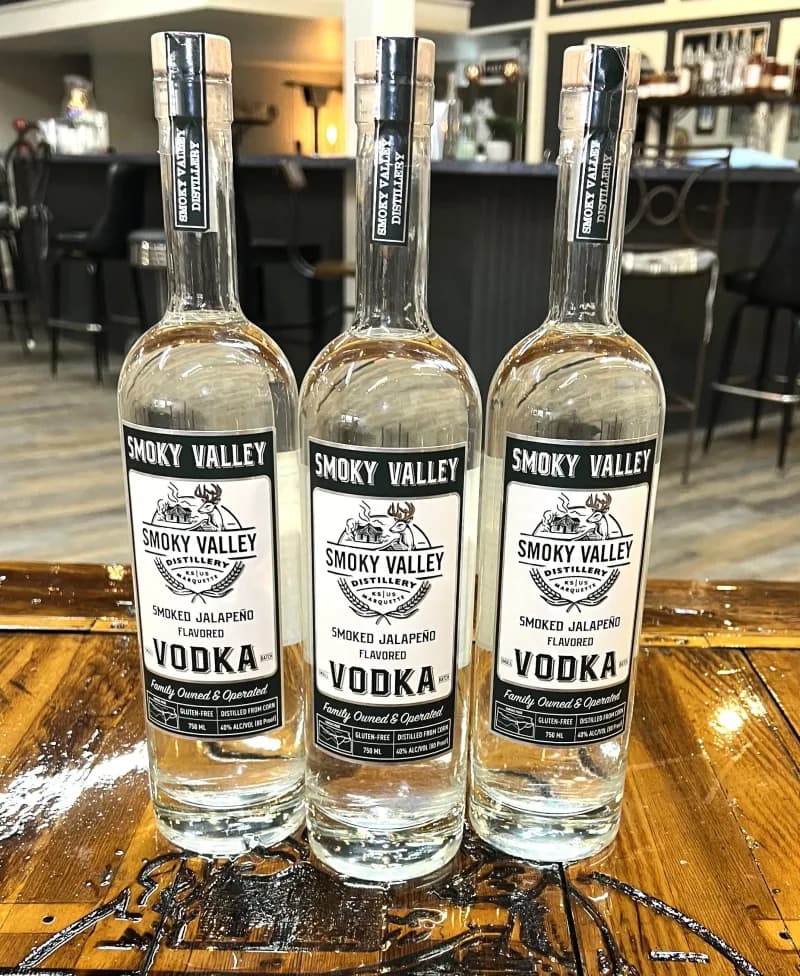
- Smoked Jalapeno Vodka — hickory smoke and a slow jalapeno heat, already in the spirit. This is the bottle that empties first.
- Pickle Vodka — dill and brine on a smooth corn base, which takes the jar of pickle juice off your table entirely.
- Premium Vodka — the third bottle, for the guest who wants to build from zero.
All three are 40% ABV, so they pour interchangeably and nobody's glass comes out stronger than their neighbor's. Why a flavored vodka behaves like a replacement ingredient rather than an additive is the subject of flavored vodka vs. infused vodka, and the rest of the shelf is on the vodka collection page.
Label the bottles with a tent card. At a self-serve station, a guest who cannot tell what is in a bottle pours the one they recognize.
The Station, In Order
Layout is not styling. People move down a table in one direction and they will not go back, so the order has to match the order of the build.
- Glasses and ice. First, because an empty hand is the only hand that can salt a rim.
- Rim plates. Lemon wedges for adhesion, then the salt.
- The base mix pitcher. Fill to about two-thirds.
- The vodkas. With a jigger.
- Heat and acid. Hot sauce, horseradish, Worcestershire, lemon and lime wedges, a pepper grinder.
- The garnish tray. Last, because garnish goes in a finished drink.
Put the ice in a tub rather than a bowl and give it a real scoop. And keep the line one-directional — a bar that forces people to reach back across each other is the one that ends with tomato juice on your floor.
Rims
A rim is the cheapest upgrade on the table and the easiest one to botch.
Use a shallow plate wider than the mouth of your glass, with a quarter inch of seasoning in it. Wet the rim with a lemon wedge rather than dipping the glass in juice, which floods the salt and turns the plate into paste halfway through the party.
Three that cover almost everybody:
- Celery salt. The classic, and the one that belongs in the base mix too.
- Old Bay. The best single-jar answer if you only want one plate out.
- Smoked salt with cracked pepper. Worth having beside the Smoked Jalapeno bottle, because it doubles down on the same note.
Make the plates in the morning and cover them. They do not need refrigeration and they do not improve with sitting out in humidity.
Garnishes That Survive Two Hours — and Those That Don't
This is the part of a Bloody Mary bar that photographs well and the part most likely to make somebody sick, so it is worth sorting properly. Split the spread onto two trays by whether the item is perishable.
Sits out all morning without concern:
- Pickle spears and pickled green beans
- Olives and cocktail onions
- Pickled asparagus and okra
- Pepperoncini and pickled jalapenos
- Celery stalks, lemon and lime wedges
Needs to stay cold:
- Bacon
- Cubed cheese
- Cooked shrimp
- Sliders or any cooked meat
- Hard-boiled eggs
Set the second tray into a bed of ice, and put out half of it at a time while the rest stays in the refrigerator. FoodSafety.gov's guidance is to refrigerate perishable food within two hours, and a brunch that starts at ten and drifts to one has blown past that without anyone noticing. Swapping a half-tray is easier than explaining why the shrimp was out for three hours.
Bamboo picks and a jar for the used ones. Skewers walk off; a jar keeps the table from turning into a graveyard of them.
Glassware and Ice
A Bloody Mary wants a tall glass — a pint glass or a highball, 12 to 16 oz, so there is room for ice, six and a half ounces of drink, and a celery stalk standing up in it.
That makes glassware the one place our own merchandise shelf only half-fits, and we would rather say so than pretend otherwise. The Logo Tasting Glass is a 1.5 oz nosing glass for whiskey neat, and the Copper Mule Mug belongs to the Moscow Mule it was engraved for. What does earn a place on this table is the heavy rocks glass, for the half-pour:
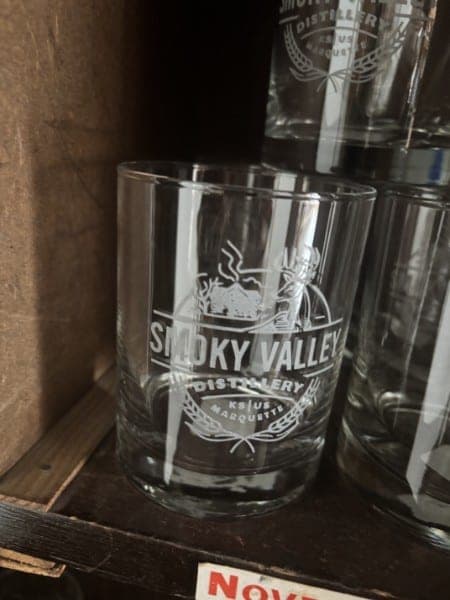
Old Fashioned Glass
$19.95A heavy-bottomed rocks glass etched with our crest — built for an Old Fashioned, a bourbon on the rocks, or a neat pour.
View in the shopThe half-pour is worth building into the station deliberately. With two flavored vodkas out, plenty of guests want to try both, and a short three-ounce build in a rocks glass lets them do that without committing to two full drinks. It is the same logic as a tasting flight, which is how we pour everything in the tasting room.
On ice: buy more than you think, and buy a separate bag for the perishable tray. That bag is not drink ice — it will sit in a tub absorbing whatever drips into it all morning.
The Non-Alcoholic Lane
Because the base mix is unspiced, a Virgin Mary is the same drink minus one ingredient. No second pitcher, no second shopping list, no guest standing at a bar with nothing to do.
Say so out loud, on a card at the front of the table. The design of an unspiced base is what makes this free, and it matters more than it sounds: the people who are not drinking are exactly the ones who notice whether a host thought about them. The same courtesy applies to a tasting, as we cover in what to serve at a whiskey tasting party.
A Make-Ahead Timeline
The night before: mix the base and refrigerate it. This is not a convenience step — the salt and spices need hours to hydrate, and a mix made an hour ahead tastes like celery salt sitting in tomato juice rather than a seasoned drink. Leave the horseradish out; it fades in the cold and belongs on the table anyway.
That morning: make the rim plates, cut the celery and the citrus, open the jars onto the shelf-stable tray, and cook the bacon. Stage the perishable tray in the refrigerator over its ice.
Thirty minutes out: ice in the tub, glasses on the table, pitcher out after a hard stir — tomato juice settles, and the first glass poured from an unstirred pitcher is thin.
One thing you do not do: add water. If you have batched cocktails before, the water step is drilled into you, and for good reason — a stirred drink picks up a fifth to a quarter of its final volume as melt, which is why batched bourbon cocktails need it added back. A Bloody Mary is built over ice in the glass and never stirred to temperature, so that dilution happens in front of your guest. Add it to the pitcher and you have made weak tomato juice.
The Arithmetic of a Self-Serve Table
A station hands the pour to the guest, which is the point and also the one thing worth watching.
The NIAAA counts 0.6 fl oz of pure alcohol as one standard drink — 1.5 oz of 80-proof spirits. Our vodkas are 40% ABV, so the 2 oz pour in this build is about one and a third standard drinks, in a tall glass full of tomato juice that does not taste strong at all. Two of those is nearly three standard drinks before anyone has thought about it.
The jigger on the table fixes most of that, and it fixes the flavor too: a free-poured four-ounce Bloody Mary is not a stronger drink so much as a worse-balanced one. Put out food, keep water on the table, and if people are driving home, know roughly what they have had.
Or Let Us Set It Up
If you would rather not run the table yourself, we have two rooms in Marquette — a 60-seat tasting room and a 140-seat event room in the adjoining 1901 building — and we handle the bar for private parties, showers, and brunches. The Bloody Marys are made with the vodkas they are named after, which is the version our tasting room guests keep coming back for.
Building it at home instead? Our bottles are stocked at retail locations across Kansas, and a tasting and tour — $10 per person, 30 to 45 minutes, Thursday through Saturday by appointment at 105 N. Washington — is the fastest way to decide which of the two vodkas belongs on your table. Most people leave with both.