
Nobody Needs a Chart
Bourbon pairs with food better than most people expect and worse than the internet promises.
There is no master grid where you look up "brisket" and find your bottle. There are three or four things that actually decide whether a bite and a sip improve each other, and once you have those, you can pair any bourbon with anything on the table without looking anything up.
We pour five bourbons in the tasting room, and after "what's your best seller," the question we get most is some version of what do I drink this with? Here is the longer answer than a 30-minute tour has room for.
Rule One: Match Weight Before Flavor
Weight is intensity — how much room something takes up in your mouth and how long it stays there. It is the one variable that can wreck a pairing all by itself, before flavor ever gets a vote.
A bourbon at 45% alcohol by volume is a heavy thing. It arrives warm, it coats, and it lingers. Put it beside poached fish or a green salad and the food simply disappears; you taste bourbon, then you taste bourbon again. Put the same pour beside a ribeye, short ribs, aged cheddar, or anything that spent time on a grill, and neither one gives ground.
So before you think about flavor at all, ask whether the dish can hold its own for the length of a bourbon finish. Grilled, roasted, smoked, braised, fried, and cured food usually can. Raw, poached, and steamed food usually cannot.
Proof is the lever here. Our High Rye Single Barrel bottles at 35% ABV, noticeably lighter than the rest of the shelf, and it will sit with food the others steamroll. If the number itself is new to you, start with what proof in whiskey means.
Rule Two: Decide Whether You're Echoing or Cutting
Every good pairing does one of two jobs, and they are opposites. Pick one on purpose.
Echoing means the drink repeats something the plate is already doing. This is the easy win with bourbon, and there is a reason for it. Charring an oak barrel breaks the wood down, and the chemistry of that breakdown is well documented: lignin degradation yields vanillin and related phenols, hemicellulose yields furfural and its relatives — caramel and toasted-almond character — and the oak itself contributes lactones that read as coconut and sweet wood. Searing a steak or smoking a pork shoulder produces its own browned, caramelized flavors. The two families of aroma are close cousins. Set them next to each other and both get louder.
Cutting means the drink does something the plate is not. Fat and salt dull the palate over the course of a meal; a dry, peppery, high-rye pour resets it between bites the way a squeeze of lemon does. That is why spice-forward bourbon works with fatty barbecue even though nothing about the two is similar.
What fails is doing neither — a bourbon that is merely near the food, neither agreeing with it nor clearing it.
Rule Three: The Food Should Be Less Sweet Than the Glass
This one costs people more pairings than anything else.
Sweetness on your palate resets what counts as sweet. Eat something sugary and then sip bourbon, and the bourbon reads thin, sharp, and bitter — the caramel gone, nothing left but oak and alcohol. The reverse order works fine.
Practical version: bourbon beats most desserts, so keep the dessert restrained. Dark chocolate at 70% cacao or higher, pecan pie, bread pudding, creme brulee with a real burnt top. Not frosting, not candy, not a milk chocolate bar.
The Proof Problem, and Spicy Food
Bourbon and chili heat is the pairing people most want to work and the one that most reliably does not.
The reason is receptor-level. Capsaicin — the compound that makes peppers hot — acts on TRPV1, a heat-gated ion channel in your sensory nerves. Ethanol acts on the same channel. In a 2002 Nature Neuroscience paper, Ethanol elicits and potentiates nociceptor responses via the vanilloid receptor-1, Trevisani and colleagues found that ethanol both activates TRPV1 directly and lowers its heat-activation threshold from about 42 degrees Celsius to about 34 — below body temperature. That is the mechanism behind the warmth of a neat pour, and it is also why 90 proof on top of a hot wing adds fuel instead of putting anything out.
The intuitive fix is wrong too. Capsaicin is hydrophobic and fat-soluble, so water spreads it around your mouth rather than removing it — and while alcohol dissolves capsaicin in a beaker, a mouthful of 45% spirit is not a rinse. When Penn State researchers tested this directly — Nolden, Lenart, and Hayes, Physiology & Behavior 2019 — milk came out on top across 72 participants, whole or skim alike, which points at protein rather than fat doing the work.
None of that means skip the bourbon. It means change the format. Over genuinely spicy food, build a highball: two ounces over ice, topped with ginger beer or soda. You keep the caramel and grain and lose most of the burn that was fighting the plate.
Our Five Bourbons, and What We'd Put Next to Them
Everything below is bourbon under the federal definition — a mash of at least 51% corn, aged in charred new oak — and the differences between them come almost entirely from the grain recipe. If that is unfamiliar ground, what a mash bill is covers it in one read.
| Bourbon | Character | Pair it with | Job |
|---|---|---|---|
| Straight Bourbon | Caramel and vanilla, rye spice, toasted oak | Ribeye, roast chicken with crisp skin, sharp cheddar, pecans | Echo |
| Bud & Dewey's | Soft wheat, vanilla custard, caramel | Pulled pork, glazed ham, aged gouda, bread pudding | Echo |
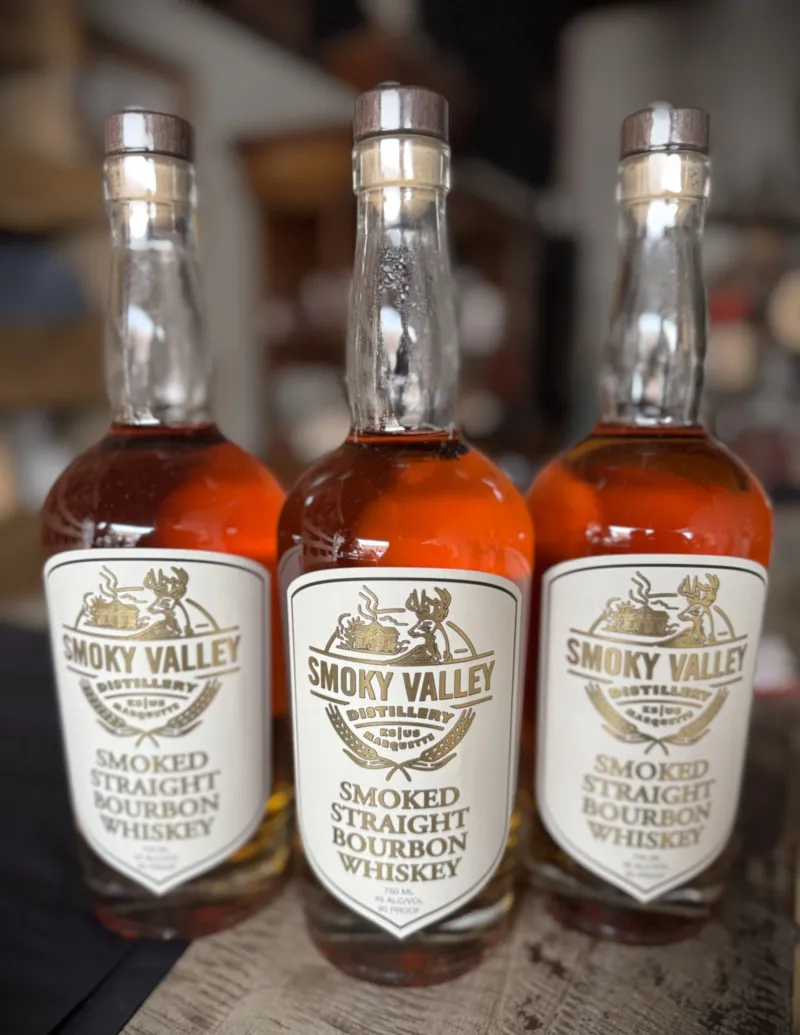
| Smoked Straight Bourbon | Hickory smoke over classic bourbon sweetness | Brisket, smoked sausage, grilled ribs, smoked almonds | Echo |
| High Rye Single Barrel | Peppery and dry, lighter at 35% ABV | Charcuterie, rye bread and mustard, roast pork, parmesan | Cut |
| High Wheat Single Barrel | Honey and butterscotch, 37% wheat in the mash | Caramel desserts, salted nuts, aged cheddar, apple pie | Echo |
Two of those deserve a note.
The Smoked Straight Bourbon is hand-smoked with hickory in a culinary smoker, bottle by bottle. It is the most food-friendly thing we make, and it is barely a pairing decision at all — hickory smoke in the glass and hickory smoke on the meat are the same conversation. If you would rather have it in a cocktail alongside the plate, our smoked bourbon cocktails are built for that.
Bud & Dewey's is our best seller and the softest of the five, because wheat takes rye's place in the mash bill and removes the pepper along with it. That softness is what lets it sit under sweet, rich pork without a fight, and it is also the bottle we hand to somebody who says they do not like whiskey. More on the grain behind it in what wheated bourbon is.
Cheese Is the Easiest Pairing There Is
If you want one pairing that works the first time, buy a wedge of aged gouda.
Aged hard cheeses concentrate salt, fat, and nutty depth as they lose moisture, which gives them the weight to stand next to 90 proof. The fat also coats your palate, which softens the alcohol on the way through. Aged gouda, sharp cheddar, parmesan, and a good aged manchego all work. Fresh mozzarella and mild havarti get erased.
Blue cheese is the wild card. Against a sweet wheated bourbon it can be excellent; against a dry high-rye pour it usually turns metallic. Try it before you serve it to guests.
How to Run a Pairing at Home
- Pour small. Half an ounce per pairing. This is tasting, not drinking.
- Taste the bourbon first, neat, so you know its baseline. Our step-by-step tasting method takes about two minutes.
- Then the food. Then the bourbon again. The second sip is the one that tells you whether it worked — if the whiskey tastes better after the bite, you are done.
- Add water for the long haul. After that first neat taste, a splash of water or a large cube keeps your palate alive through a full meal and brings aroma forward.
- Reset with plain bread or water, not seasoned crackers.
Four bourbons and four foods is plenty for one evening. Past that, everything starts tasting like oak.
Come Do It Here
We do not have a kitchen. What we have is a tasting room where you can put all five bourbons side by side and find out which one your dinner wants — and Kitchen 64, made-from-scratch comfort food, a short walk down Washington Street.
A tasting and tour is $10 per person, runs 30 to 45 minutes, and is available Thursday through Saturday by appointment. Bring the pairing questions; we will pour the full bourbon lineup and you can settle the argument in about twenty minutes.
Hosting the dinner yourself? Our bottles are stocked at retail locations across Kansas, and if the guest list has outgrown your dining room, the venue seats up to 140 and welcomes outside catering.