
Tasting Is a Skill, Not a Talent
We taste every barrel before it gets bottled. Not as a ceremony — because a barrel is a decision. Is this one ready, does it go into the single barrel program, does it need another season. Nobody on our floor was born able to pick butterscotch out of a rye. That comes from doing it the same way, in the same order, enough times that the differences start announcing themselves.
The vocabulary is the last part to arrive, and it's the part everyone assumes comes first. What actually comes first is a sequence — about ten minutes of method that separates "it tastes like whiskey" from being able to say what's in the glass and why. Below is the sequence we use on the production floor, and the same one we walk visitors through during a tasting and tour.
Before You Pour: Glass, Pour Size, Temperature
The glass does more work than people expect
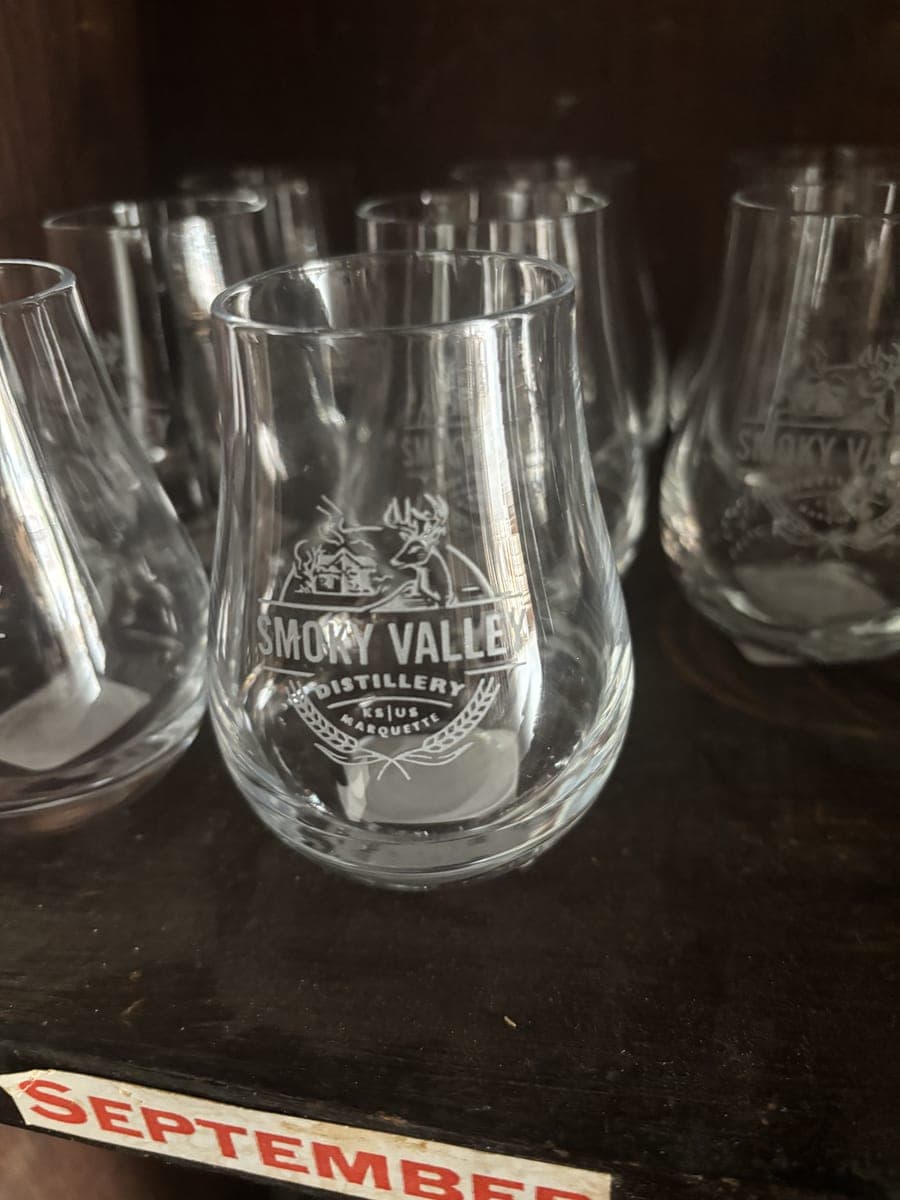
You want a wide bowl that tapers to a narrower rim — the tulip, copita, or Glencairn family of shapes. The taper collects aroma in the headspace above the liquid and funnels it toward your nose instead of letting it drift off across an open surface. Our etched logo tasting glass is that shape for exactly this reason.
A white wine glass is a perfectly good substitute. A straight-sided rocks glass is built for ice and a mixer and lets aroma escape in every direction — fine for drinking, wrong for evaluating. A shot glass is the worst of the options, because it puts your nose down into concentrated alcohol vapor before you've smelled anything else. If you're deciding what to actually buy, our whiskey glassware guide goes through the shapes, the crystal question, and ice size in full.
Pour less than you think
Half an ounce to an ounce. Filling past the widest part of the bowl kills the headspace the glass shape exists to create, and it wrecks your pacing on a flight. For reference, the NIAAA counts 1.5 fl oz of 80-proof spirits as one standard drink, and our whiskeys are bottled at 90 proof — so a generous pour is already more than that. Four small pours is a tasting. Four full pours is an afternoon.
Let it rest, and mind the room
Serve at room temperature. Cold suppresses the volatility of the aroma compounds you're trying to smell, which is the whole reason chilled whiskey tastes simpler. After pouring, give it five minutes — the sharpest ethanol blows off the surface and what's underneath becomes readable.
Also: don't do this in a room that smells like something else. Fresh coffee, a scented candle, someone's dinner. Your nose will fold those into the whiskey and you'll never know it happened.
Step 1: Look
Hold the glass against a white background or up to the light. Color tells you about time in wood, char level, and barrel size — but it is not a quality grade, and plenty of pale whiskey outclasses darker whiskey. What it does tell you is honest, at least here: the federal standards of identity don't permit added coloring in straight bourbon, so what you're looking at came out of the wood.
We age in ten-gallon barrels rather than the industry-standard fifty-three, which means far more wood contact per gallon of spirit and noticeably faster color development. If our four-year-old bourbon looks older than you expected, small barrel aging is why.
Tilt the glass and let the liquid run back down. Slow, thick legs suggest higher proof and more body. It's a hint, not a verdict — don't build an opinion on it.
Step 2: Nose It — the Step Everyone Rushes
Most of what you'll call "taste" is smell. This is the step that rewards technique, and there are four things worth getting right.
Keep your mouth slightly open. This is the single biggest improvement most people can make. An open mouth draws vapor across your palate and up the retronasal passage instead of sending a concentrated column straight up your nostrils. Nose a 90-proof whiskey with your mouth clamped shut and mostly what you'll register is burn.
Don't put your nose in the glass. Start three or four inches above the rim and work down. The volatile alcohol sits highest and thickest right at the surface.
Take short sniffs, not a deep inhale. One long pull of 90-proof vapor will numb your olfactory receptors for a minute or two, and everything after it reads flat.
Nose it at two heights. High above the glass you'll catch the light, fast-evaporating notes — fruit, grain, florals. Down near the rim you'll find the heavy end — oak, caramel, char, leather.
Then put words to it, even clumsy ones. Our Rye Single Barrel Whiskey noses as black pepper and fresh rye bread with caramel sitting underneath. Our Kernza Whiskey is nutty and toasted-grain, unusual enough that people usually stop and go back to it a second time before they ever sip it.
One habit to drop: swirling. That's a wine move. Whiskey carries more than twice the alcohol, and swirling mostly throws ethanol at your face.
Step 3: The First Sip Doesn't Count
Take a small sip and more or less discard it. Its job is to coat your palate and acclimate it to the alcohol — the first sip of anything at 90 proof reads hotter and simpler than the whiskey actually is. Wait fifteen seconds. The second sip is the one you evaluate.
On that second sip, don't swallow right away. Take a small amount and move it across your whole tongue for three or four seconds — distillers sometimes call this the Kentucky chew — so the entire palate gets contact instead of just the middle of your tongue.
What you're tracking is an arc, not a single flavor:
- Entry — the first second or two, usually where sweetness shows up.
- Mid-palate — where spice, oak, and fruit develop, and where a whiskey shows whether it has anything to say.
- Finish — everything after you swallow.
Good whiskey moves across that arc. Our Straight Bourbon opens on corn sweetness, works through rye spice and dried fruit, and closes on oak. That movement is the point. If a whiskey tastes identical from entry to finish, that's information too.
Step 4: Judge the Finish
After you swallow, exhale gently through your nose and pay attention to what's still there. Count it out if you like — a short finish fades in a couple of seconds, a long one carries thirty or more.
The finish is where inexpensive whiskey usually gives itself away. Plenty of bottles have a pleasant enough entry and then simply stop, leaving heat and nothing else. It's also the most useful thing to write down, because it's the hardest to reconstruct an hour later.
Step 5: Add Water — and Here's Why It Works
Add a few drops. Not a splash — drops, from a straw, a pipette, or the tip of a teaspoon. Then nose and taste it again.
This isn't folklore. A 2017 molecular-simulation study in Scientific Reports, Dilution of whisky – the molecular perspective, modeled where guaiacol — one of the compounds responsible for smoky, woody aroma — actually sits in a water-ethanol mixture. Guaiacol was found primarily at the liquid–air interface in mixtures containing up to about 45% ethanol by volume, and was increasingly pulled down into the bulk of the liquid at 59% and above. Put plainly: dilution moves aroma compounds toward the surface, where your nose can reach them.
Both of our whiskeys are bottled at 45% ABV, right at the edge of that range, which is why a few drops does something noticeable and half an ounce doesn't do anything better. Work up gradually — you can always add more water and you can never take it back out. For a true side-by-side, pour two small samples and water only one of them.
Why ice is a different tool
Ice dilutes, but it also chills, and chilling suppresses exactly the volatility you just spent five minutes waiting for. That's a fine trade when you're drinking for pleasure on a hot afternoon and a bad one when you're trying to evaluate. If you want both, use one large cube — less surface area, slower melt, less dilution per degree of cooling.
Building a Flight: Order Matters
Run light to heavy, sweet to spicy, and put anything smoked at the very end, because smoke stays on your palate and colors everything after it.
Here's how we sequence our own lineup:
- Bud & Dewey's — wheated, the softest thing we make. Sweet corn, vanilla custard, gentle close.
- Straight Bourbon — more rye spice and dried fruit, firmer oak on the finish.
- Kernza Whiskey — nutty and herbal, sitting between bourbon sweetness and rye spice.
- Rye Single Barrel — an 82% rye mash bill. Pepper-forward and dry, and it will dominate anything you put after it.
- Smoked Straight Bourbon — last, always.
The two ordering rules do collide sometimes. Our High Rye Single Barrel Bourbon is bottled at 35% ABV, the lowest proof on our shelf, but it's also one of the most spice-forward bourbons we make. When proof order and intensity order disagree, follow intensity. If you want a deeper read on why rye behaves this way next to corn, bourbon vs. rye breaks the grains down.
Four to six pours is the honest ceiling. Past that, fatigue is doing the tasting instead of you. Water and a plain unsalted cracker between pours — skip coffee, citrus, and mints, which overwrite your palate rather than resetting it.
If you're building a flight for other people rather than yourself, the logistics are a separate problem — bottle count, glass count, what belongs on the food table and when. Our host's checklist for a whiskey tasting party works through all of it.
Write It Down, Even Badly
Three words per whiskey. One for the nose, one for the palate, one for the finish. That's enough.
Personal references beat borrowed vocabulary every time. If a bourbon smells like your grandmother's pantry, write that down. You're building recall, not publishing a review, and in six months "grandmother's pantry" will bring the whiskey straight back while "notes of baking spice" won't.
One rule about notes that aren't yours: read the distillery's tasting notes after you've written your own. Suggestion is powerful, and once you've read the word "butterscotch," you will find butterscotch.
Common Mistakes
- Nose in the glass, mouth closed. Guarantees burn, hides everything else.
- Judging on the first sip. Your palate isn't calibrated yet.
- Ice during evaluation. Great for drinking, wrong for assessing.
- Too many pours. After six, you're tasting fatigue.
- Reading the tasting notes first. Let the glass tell you first.
The Fastest Way to Get Good at This
Compare. Tasting one whiskey carefully teaches you something; tasting two side by side teaches you what a single variable actually does. Same distiller, same water, same barrel program — change only the grain, and suddenly you can hear what the grain is saying.
That's the whole design of our tasting room in Marquette, Kansas. A tasting and tour is $10 per person, runs about 30 to 45 minutes, Thursday through Saturday by appointment, and covers the full range — five vodkas, five bourbons, and both whiskeys — with the production floor right behind you while you drink them. If you'd like to know what the rest of the visit looks like, we wrote up what to expect on a distillery tour.
Practicing at home works too. Our bottles are stocked at retail locations across Kansas — pick two that differ by one variable, pour them small, and run the sequence above on both.