
You Need Two Glasses
Walk into a barware store and there are eighteen whiskey glasses on the shelf. You need two of them, and a third if you make tall drinks.
The reason glassware matters at all is not ceremony. Most of what you experience as flavor is aroma, and a glass either collects aroma above the liquid and delivers it to your nose or it lets that aroma drift off into the room. That is the entire mechanism. Everything else — the weight in your hand, the etching, the sound it makes when you set it down — is real, and it is decoration.
We pour into two shapes in the tasting room, and we sell both, so let's start with what each one is actually doing.
What the Shape Does
Pour whiskey into a glass and the liquid immediately starts giving off volatile compounds — ethanol first, because it is the most eager to evaporate, then the aromatics that came out of the grain and the barrel. Those compounds collect in the empty space above the liquid, called the headspace.
Two features of the glass decide what happens to that headspace:
- Bowl width. A wide bowl gives the whiskey a large surface area, so more aroma comes off it, faster.
- Rim taper. A rim narrower than the bowl concentrates what came off and funnels it upward in a stream. A rim as wide as the bowl lets it spread out and dissipate.
Wide bowl plus narrow rim is the whole design brief for a nosing glass. It is also, not coincidentally, the design of a wine glass, a brandy snifter, and the sherry copita that bartenders and blenders were nosing spirits out of long before anybody made a whiskey-specific glass.
That copita is the direct ancestor of the modern nosing glass. The Glencairn — the tulip-shaped glass with the short stubby base you see in every distillery photo — was designed by Raymond Davidson at Glencairn Crystal in Scotland and launched at Whisky Live London in 2001, explicitly as a copita made robust enough to survive a working bar. It picked up a Queen's Award for Innovation in 2006 and became the default in about a decade.
The Two Glasses That Matter
1. The nosing glass — for neat pours
Wide bowl, tapered rim, short stem or a solid base you can hold without warming the bowl with your palm. This is the glass for anything you intend to actually evaluate: a neat pour, a flight, a new bottle, a barrel sample.
Capacity matters less than shape, because you should not be filling it. Half an ounce to an ounce is a tasting pour — past the widest part of the bowl you have destroyed the headspace the glass exists to create. For scale, the NIAAA counts 1.5 fl oz of 80-proof spirits as one standard drink, and most of our whiskeys bottle at 90 proof.
If you do not own one, a white wine glass is a legitimately good stand-in — same geometry, bigger. What does not work is a shot glass: straight sides, no headspace, and your nose lands directly in concentrated alcohol vapor before you have smelled anything else.
How many you need is a smaller question than people assume: one per guest, not one per whiskey. A splash of water, a swirl, and a dump between pours is enough, which is how we run a flight here — our host's checklist for a whiskey tasting party covers the rest of the setup.
2. The rocks glass — for ice and stirred drinks
Also called an Old Fashioned glass or a lowball. Wide mouth, straight or slightly tapered sides, and a thick base. Six to ten ounces is the usual range.
Everything about it is built for the opposite job. The wide mouth takes a large cube. The heavy base takes stirring, and takes being set down hard. The open top lets aroma go, which is exactly what you want when the point is a cold, diluted, slow drink rather than a concentrated nose. This is the glass for whiskey on the rocks, an Old Fashioned, a Sazerac, or anything else stirred and served short.
3. The highball — only if you make tall drinks
Tall, narrow, straight-sided, ten to fourteen ounces. Narrow so the carbonation in your mixer has less surface to escape from, tall so you get a proper ice column. If you drink bourbon and ginger or bourbon and soda, you want one. If you don't, you don't.
What We'd Actually Buy
Two glasses cover a home bar honestly. These are the two we pour from in the tasting room and the two we sell:
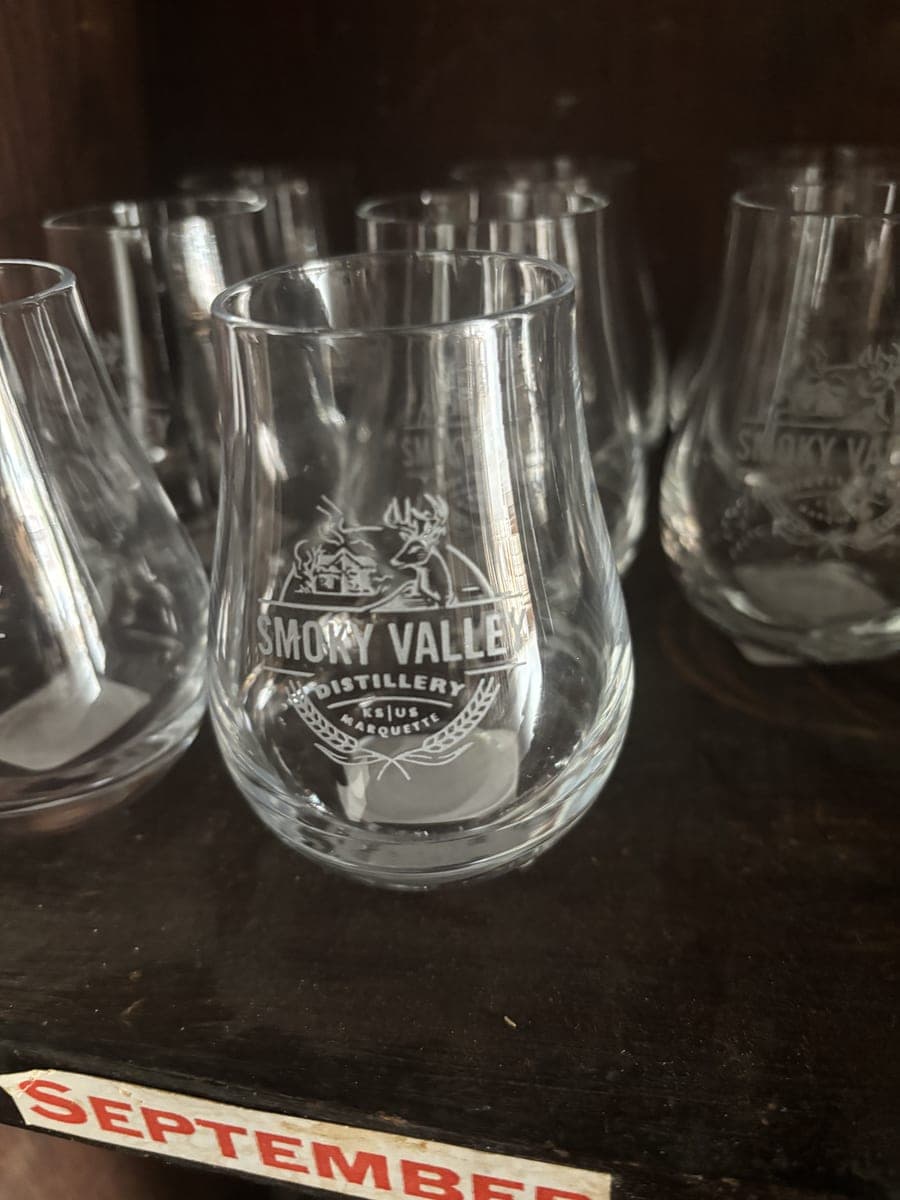
Logo Tasting Glass
$16.95A tulip-shaped nosing glass etched with the Smoky Valley Distillery crest — shaped to concentrate aroma for tasting our bourbon and whiskey neat.
View in the shop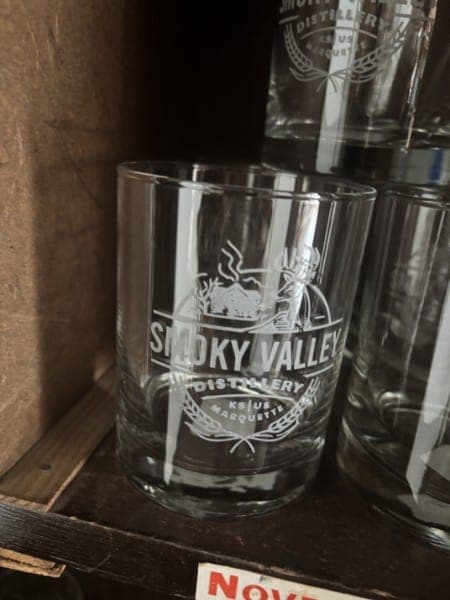
Old Fashioned Glass
$19.95A heavy-bottomed rocks glass etched with our crest — built for an Old Fashioned, a bourbon on the rocks, or a neat pour.
View in the shopThe tasting glass is the tulip shape described above, etched with our crest. The Old Fashioned glass is the heavy rocks glass. Both ship anywhere in the US or can be picked up free at the tasting room Thursday through Saturday. If you are buying for somebody else, our Kansas distillery gift ideas guide covers what can legally be shipped and what has to be handed over in person.
If you buy one, buy the nosing glass. It changes more about a neat pour than any other twenty dollars you can spend on whiskey, and you can drink an Old Fashioned out of a water tumbler in a pinch. Glasses are one line item on a longer list — the bottles, modifiers, and five tools that go with them are in our home bar essentials guide.
The Things People Overthink
Crystal versus glass. Lead-free crystal is thinner, clearer, and rings when you tap it. It is nicer to hold. It does not make whiskey taste better — shape does far more work than material. Soda-lime glass is more durable and less expensive and does the same job.
Leaded crystal is the one real caution, and it is about storage rather than drinking. A 1991 study in The Lancet measured lead migrating out of leaded crystal into alcohol held in it, with port climbing from 89 to 3,518 micrograms of lead per liter over four months. A glass you empty in an evening is a far smaller exposure than a decanter holding spirits for years — but there is no reason to keep whiskey in leaded crystal, which is one of several reasons decanters are a bad idea generally.
Stems. A stem keeps your hand off the bowl. That matters for white wine served cold. Whiskey is served at room temperature, so a stem is a preference, not a function. The Glencairn's stubby base is a compromise on purpose: enough to hold, short enough not to tip on a crowded bar.
Thin rims. A thin rim genuinely does feel better on your lip and delivers liquid more precisely. It is also the first thing to chip. This is a real trade-off between a nice glass and a glass that survives four years of use, and there is no wrong answer.
Wide-bottomed "whiskey tumblers" with heavy cut patterns. Beautiful. Excellent for an Old Fashioned. Do not try to nose anything out of them.
Ice Is Part of the Glassware Decision
The single biggest thing you can change about whiskey on the rocks costs nothing: use one large cube instead of several small ones.
This is geometry, not preference. The same volume of ice broken into small pieces has much more surface area in contact with the whiskey, so it melts much faster. Small cubes chill the drink quickly and then keep going, and you finish something noticeably weaker than what you poured. A two-inch cube or sphere chills nearly as fast and then holds. A two-dollar silicone mold solves this permanently, and it is the reason a rocks glass needs a wide mouth in the first place.
Crushed ice has its place — a julep, and a julep cup. It is not for a pour you plan to sit with.
How to Take Care of Them
Good glasses fail for boring reasons.
- Wash by hand, with a small amount of unscented dish soap. Rinse longer than you think you need to.
- Skip the dishwasher. Detergent leaves a film and rinse aid leaves a fragrance, and both of them arrive in your nose ahead of the whiskey. This is the most common reason a pour smells faintly of something that isn't whiskey.
- Air dry upright on a rack, not face-down on a towel. Face-down traps moisture and picks up the smell of the cloth.
- Store them upright and open, not inverted in a closed cabinet. An upside-down glass in a shut cupboard collects the shelf's odor and holds it in the bowl.
- Polish with a lint-free cloth if you care about how they look. Water spots are cosmetic; the towel you dry with is not.
If a glass ever smells off, a rinse with hot water and nothing else, then a full air dry, usually resets it.
Then Put Something in It
A glass is a delivery system, and the point is what you pour into it. If you want the method that goes with the nosing glass — pour size, how to nose without numbing yourself, when to add water — that is how to taste whiskey, step by step.
Our Rye Single Barrel Whiskey, named Best of Kansas at the 2025 Heartland Whiskey Competition, and the Kernza Whiskey made from a perennial grain only one other distillery in the world is working with are both worth the good glass. The rest of the whiskey lineup is on one page, and the bourbons are on another.
Come try both shapes side by side. A tasting and tour is $10 per person, runs 30 to 45 minutes, and is available Thursday through Saturday by appointment — and you can hold the glasses before you decide which one goes home with you.