
The Short Answer
Stand it upright, keep it out of the light, put it somewhere that stays a steady temperature, and make sure the closure is tight. That's the whole method for a sealed bottle.
For an open bottle there's one more variable: the air sitting on top of the whiskey. That's the thing that actually changes what's in the glass, and it's the thing you can do something about.
Everything below is why.
Whiskey Stops Aging the Day It's Bottled
This is the part that trips people up most, because wine trained everyone to think the opposite.
Federal regulation is unusually blunt about it. 27 CFR 5.1 defines age as "the length of time during which, after distillation and before bottling, the distilled spirits have been stored in oak barrels." After bottling, the clock stops. Glass is inert — there's no wood to pull tannin and vanillin out of, no charred layer filtering anything, no seasonal breathing in and out of the staves.
So a bottle you bought in 2020 and opened in 2026 is exactly the whiskey it was in 2020, assuming nothing went wrong. It didn't mellow on your shelf. Nothing in our small barrel aging process continues in your cabinet.
That reframes the whole job. You are not maturing anything. You are preventing losses.
Store It Upright — Always
Wine bottles lie down so the cork stays swollen and airtight. Whiskey bottles must not.
Wine is roughly 13% alcohol. Whiskey is 40 to 50%, and at that strength alcohol is an aggressive solvent. Held against natural cork for months, it softens and breaks down the cork structure. Two things follow: the seal gives out, and cork compounds leach into the spirit. A whiskey that has been lying on its side for a year can come back tasting flat and faintly of wet cardboard, and the fill level will have dropped.
Stand every bottle on its base, whether the closure is natural cork, a synthetic stopper, or a screw cap. If a bottle has been sealed for several years and you want to keep the cork supple, tip it just long enough to wet the underside — a few seconds, not overnight — and set it back upright.
Light Does More Damage Than People Expect
Barrel-derived color and flavor come largely from phenolic compounds, and phenolics are photosensitive. Ultraviolet and high-energy visible light break them apart, which is why a whiskey left in a sunny window loses color first and character second. That reaction doesn't run backwards. A faded bottle stays faded.
We see it on our own shelves. Anything that sits in the front windows of the COOP building gets rotated out, because over a Kansas summer the difference next to a cabinet-stored bottle is visible without any special lighting.
Practical version: a closed cabinet is ideal, a shelf across the room from a window is fine, and a bar cart in direct afternoon sun is the worst thing you can do to a bottle short of leaving it in a car. If a bottle came in a tube or box, that box is legitimately useful — keep the good stuff in it.
Temperature: Steady Matters More Than Cool
Aim for something like 59 to 70°F, but the number matters less than the stability.
Every temperature swing makes the liquid and the air above it expand and contract, and that pumps air past the closure in both directions. Over years, a bottle that cycles hard evaporates faster and oxidizes faster than one sitting at a boring, constant temperature. This is why two spots people love are both bad: the cabinet above the stove, and the garage. A Kansas garage swings from below freezing in January to well past 100°F in July, which is about the worst annual cycle you could design.
The top of the refrigerator is another one — warm air off the coils plus constant low-level vibration.
What About the Freezer?
An 80 or 90 proof spirit won't freeze in a home freezer, which the FDA recommends running at 0°F. So nothing breaks. But cold suppresses volatility, and volatility is how aroma reaches your nose. A frozen whiskey pours thick and smells like almost nothing.
That's exactly why the freezer works for vodka — a colder, more viscous pour is the intended effect, and our Premium Vodka is better for it. For whiskey, you're paying for aromatic compounds and then turning them off. Leave the bourbon on the shelf, and read how to taste whiskey for what temperature and glass shape are actually doing.
Once It's Open, Oxygen Starts Working
Here's the part a calendar can't answer.
The moment you break the seal, the whiskey shares the bottle with air, and oxidation slowly rearranges the aromatic compounds. Early on that can genuinely help — a tight, hot pour will often open up over the first few weeks. Past a certain point it goes the other way, and the whiskey loses top-end aroma and starts reading dull and slightly flat.
What controls the pace isn't how long the bottle has been open. It's the ratio of air to liquid:
| Fill level | Roughly how long before you'd notice |
|---|---|
| Full to about half | A year or more, very little change |
| Around one quarter | A few months before the aroma starts to soften |
| Last inch or two | Weeks to a couple of months — this is where bottles die |
The fix is simple and it works: when a bottle gets down to the bottom quarter, pour it into a clean smaller bottle. Less headspace, less oxygen, and the remainder holds for months instead of fading while you're saving it for an occasion. Plain screw-top glass bottles are all you need.
Two small habits help too. Cap the bottle between pours instead of leaving it open on the bar all evening. And check that the closure actually seats — a stopper that's been repeatedly jammed back in at an angle stops sealing long before it looks damaged.
Skip the Crystal Decanter
Decanters look the part and are a poor container for storage on two counts.
The serious one is lead. In a 1991 study published in The Lancet, Graziano and Blum measured lead migrating out of leaded crystal into the alcohol stored in it. Port that began at 89 micrograms of lead per liter climbed to 3,518 micrograms per liter after four months in a crystal decanter, and wines and spirits that had been stored in crystal long-term measured up to 21,530 micrograms per liter. Alcohol pulls lead out of the glass, and the longer it sits, the more it pulls. Modern lead-free crystal doesn't do this — but an inherited decanter with no markings is not something to guess about.
The mundane one applies to every decanter, leaded or not: a ground-glass stopper doesn't seal like a cork or a cap. Air moves, the level drops, and the whiskey oxidizes faster than it would have in the bottle it came in.
Use a decanter for a couple of hours of serving if you like the look of it. Store the whiskey in its own bottle, where the label also tells you what you're drinking.
Bottles You Intend to Keep
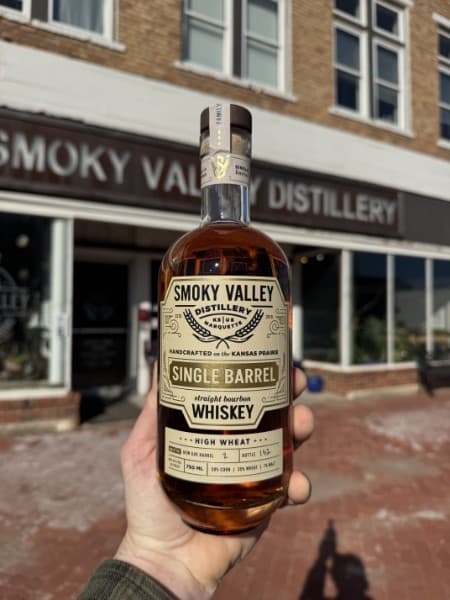
If you're holding a single barrel release — ours are bottled one barrel at a time, so a given High Wheat Single Barrel or Rye Single Barrel is genuinely not repeatable — a few extra habits are worth the effort.
- Original box or tube, which handles the light problem for free.
- Label turned away from any light source. Collectors care about label condition, and paper fades faster than the spirit does.
- Check fill levels once a year. A level that has crept down toward the shoulder means the closure is leaking, and that bottle should move to the front of the drinking queue rather than the back.
- Keep them somewhere with no temperature cycle. An interior closet beats a basement that swings with humidity or an attic that bakes.
Does Any of This Change by Category?
Bourbon and rye behave identically to any other whiskey — same rules, upright and dark. Whether a bottle is high corn or high rye changes what's in it, not how it keeps, which is a mash bill question rather than a storage one. The full lineup is on the bourbon and whiskey pages.
Naturally infused vodkas are the one place to be a little more careful. Our Wild Plum and Lingonberry take their color from actual fruit rather than added coloring, and fruit pigments are more light-sensitive than barrel color is. Those belong in a cabinet, not on a windowsill. Refrigerating them is fine and arguably better.
Proof plays no role in shelf stability at these strengths — anything at or above 80 proof is well past the point where spoilage is possible, which is a different question from what the number on the label actually means. That one is covered in what proof in whiskey is.
Taste the Difference Yourself
The clearest way to understand what bad storage costs you is to taste a well-kept pour beside one that's been sitting open and half-empty for two years. The second one isn't spoiled. It's just smaller.
A tasting and tour in Marquette is $10 per person, runs 30 to 45 minutes, and is available Thursday through Saturday by appointment. We pour from bottles that get opened and finished quickly, which is its own kind of storage advice. If you want to set your home shelf up properly, our bottles are stocked at retail locations across Kansas, and the etched tasting glasses we use in the room are available too.