
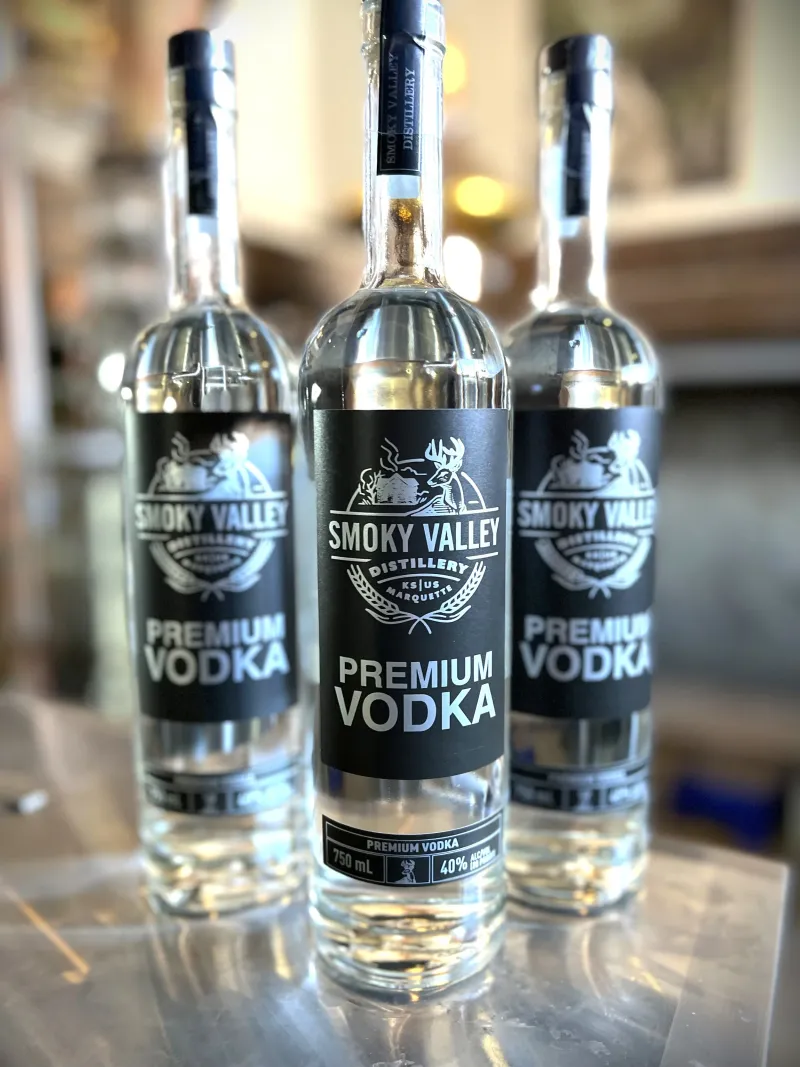
Vodka is the spirit people ask about least and store worst. It gets left open on a bar cart through a Kansas summer, or pushed to the back of a cabinet for four years between parties. Then somebody finds a half-empty bottle of flavored vodka from a wedding and wants to know whether it is still safe.
The short version is that it is almost certainly safe and quite possibly disappointing, and those are two different questions. Here is what actually happens inside the bottle.
The Short Answer
Unopened: effectively indefinite. Stored upright, out of direct light, at a reasonably steady temperature, a sealed bottle of vodka is the same spirit in twenty years that it was on the day we filled it.
Opened: safe indefinitely. Flavor fades slowly — very slowly for unflavored vodka, meaningfully faster for flavored.
The one real exception: flavored and infused vodka, where the added flavoring material is the fragile part. Four of our five vodkas are flavored, so this is the version of the question we actually get asked.
Why Vodka Does Not Spoil
Spoilage needs something alive. At 40% alcohol by volume — where every one of our vodkas is bottled — there is far too much ethanol and too little available water for bacteria, yeast, or mold to establish themselves. The alcohol is not a preservative added to the product; the alcohol is the product.
That is also why you will never see a date on the bottle. The mandatory label items for distilled spirits are listed in 27 CFR 5.63: brand name, class and type designation, alcohol content, net contents, the name and address of the bottler or distiller. There is no shelf-life or expiration date on that list, because there is no point at which a 40% ABV spirit becomes unsafe to drink. A separate regulation requires the Government Warning, and that is the only health language on the label.
So nothing on a vodka bottle is telling you to hurry. The clock that does exist is a flavor clock, and it runs at different speeds depending on what is in the bottle.
What a Sealed Bottle Does
Essentially nothing, which is the honest answer.
Glass is inert. Unlike whiskey, vodka was never picking up character from wood in the first place, so there is no process to continue or interrupt — if you want the long version, vodka vs. whiskey covers the two decisions that separate them. A sealed bottle has no meaningful air exchange, so oxidation is not happening at any rate you could measure.
The one thing that can go wrong with a sealed bottle is the seal itself. If a closure was never seated properly, or a bottle has spent years cycling between hot and cold, alcohol slowly evaporates out and the fill level drops. A level that has crept down below the shoulder tells you air has been moving in and out, and that bottle should be opened and enjoyed rather than saved further.
Store it standing up. The logic is the same as it is for whiskey — at 40% ABV, alcohol in prolonged contact with a natural cork degrades the cork and ruins the seal. Our how to store whiskey guide goes through the upright-and-dark reasoning in full, and all of it applies here.
What an Open Bottle Does
Once the seal is broken, the vodka shares the bottle with air, and oxidation starts rearranging whatever aromatic compounds are present.
Here is why vodka survives this better than almost anything else on your shelf: there is less to lose. A bourbon's value is largely in a crowd of barrel-derived aromatics — vanillin, oak lactones, caramelized wood sugars — and oxidation picks those apart one by one. A clean unflavored vodka was built to express grain, water, and texture rather than a bouquet. With less aromatic complexity exposed, there is less to degrade.
Practically, that means an open bottle of our Premium Vodka — 100% Kansas corn, proofed with sandstone-filtered Kiowa Aquifer water — kept capped between pours will taste close to unchanged for years, not months. The failure mode is not spoilage but evaporation: a bottle left open on the counter every weekend for a summer comes back slightly thin.
The same habits that protect a whiskey protect a vodka, and they are small:
- Cap it between pours. Not at the end of the night — between pours.
- Check that the closure actually seats. A stopper repeatedly jammed in at an angle stops sealing long before it looks damaged.
- Decant when it gets low. If a bottle is down to the last inch or two and you want to keep it, pour it into a clean smaller bottle. Less headspace means less air sitting on the spirit.
Flavored Vodka Is the Real Exception
This is the part worth reading twice, and it is the part we have the most direct experience with, because only one of our five vodkas is unflavored.
The alcohol content does not change — our flavored vodkas are all bottled at 40% ABV, the same as the Premium — so nothing in the bottle becomes unsafe. But flavored vodka contains something the unflavored version does not: natural flavoring material, added after the spirit is finished. That material is organic, delicate, and the first thing to go.
Two mechanisms do the damage.
Oxidation works on the flavor compounds themselves. The specific note you bought the bottle for — plum, lingonberry, dill, jalapeno — is carried by a relatively small set of volatile molecules, and oxygen degrades them faster than it degrades a neutral spirit's much simpler profile. An open bottle does not turn unpleasant. It turns vague.
Light works on color. Our Wild Plum and Lingonberry vodkas take their color from actual fruit rather than from added coloring, and fruit pigments are considerably more photosensitive than the barrel-derived color in a whiskey. A bottle on a windowsill will visibly pale over a Kansas summer, and the flavor fades alongside the color.
So the practical guidance diverges from the unflavored answer. Keep flavored vodka in a closed cabinet or the refrigerator, not on display. Treat an open bottle as having roughly a year of its best self rather than several, and finish the fruit-forward ones first. The Pickle Vodka and Smoked Jalapeno Vodka are a little more robust — savory and smoke notes hold up better than fruit — but neither is improving in there either.
One clarification, since the words get used loosely: all four of ours are flavored vodka in the federal sense, with flavoring added after distillation, and none crosses the sugar threshold that would make it a cordial or liqueur. If that distinction is new, flavored vodka vs. infused vodka sorts out which term is an actual label class and which is just a technique.
The Freezer Question
Vodka is the one spirit the freezer is genuinely for.
A 40% ABV spirit will not freeze solid in a home freezer. The FDA recommends keeping a freezer at 0°F, and published figures for when 80-proof vodka actually freezes sit well below that — the exact number varies with how you define the transition, but every version of it is colder than a household freezer reaches. Your bottle will get thick and syrupy rather than solid, and it will not burst.
What cold does is suppress volatility, which means fewer aromatics reaching your nose and a heavier, rounder texture on the palate. For whiskey that is a straight loss, which is why we tell people to leave the bourbon on the shelf. For a clean vodka served neat, in a martini, or in a shot, it is the intended effect — the whole point of the serve is texture and cold rather than bouquet.
Worth knowing: the freezer does not preserve anything. It changes how the vodka drinks tonight; it does not slow the clock on an open bottle in any way you would notice. Chilling a flavored vodka is a judgment call, since cold mutes exactly the fruit and pepper notes you bought it for. We generally pour those closer to refrigerator temperature than freezer temperature.
How to Tell If a Bottle Has Suffered
Vodka does not announce itself the way milk does. There is no sour smell and no visible spoilage, so the signals are subtler:
- A faint, papery nose where there used to be a clean grain character.
- A flavored vodka that has gone generic — you can tell it is flavored but not what with.
- Visible color loss in a naturally colored bottle like the Wild Plum or Lingonberry.
- A dropped fill level, which means the seal has been leaking and air has been cycling through for a while.
None of those make a bottle dangerous. They mean you are drinking a diminished version of it, and the right response is to put it in a mixed drink where it has company rather than pour it neat.
Where "Goes Bad" Is a Real Risk
Two adjacent things genuinely do spoil, and they get confused with vodka because they live next to it.
Cream liqueurs contain dairy. They have a real shelf life, they usually carry a date, and once opened they belong in the refrigerator and should be used within the window the producer states. Nothing in this article applies to them.
Batched cocktails are the other one. The moment you mix vodka with citrus juice, dairy, egg, or fresh produce, you have made a perishable food with a short life, and the alcohol is now too dilute to protect it. Fresh juice in particular starts losing quality within hours. If you are batching ahead for a crowd, batch the shelf-stable components and add the fresh ones at service — the same principle our guide to batch cocktails for a crowd works through for bourbon.
The Short Version
Vodka does not go bad. An unopened bottle is effectively immortal; an open bottle is safe for as long as you own it. Unflavored vodka holds its character for years with nothing more than a seated cap and a dark cabinet. Flavored vodka is the one that rewards attention, because the flavoring material and the fruit color are the fragile parts — keep those out of the light and drink them while they are still telling you what they are.
All five of our vodkas are distilled from 100% Kansas corn at our place in Marquette and bottled at 40% ABV. The full lineup is on the vodka page, and if you would rather taste them side by side than read about them, a tasting and tour is $10 per person, runs 30 to 45 minutes, and is available Thursday through Saturday by appointment. We open and finish bottles quickly in the tasting room, which is its own kind of storage advice.