
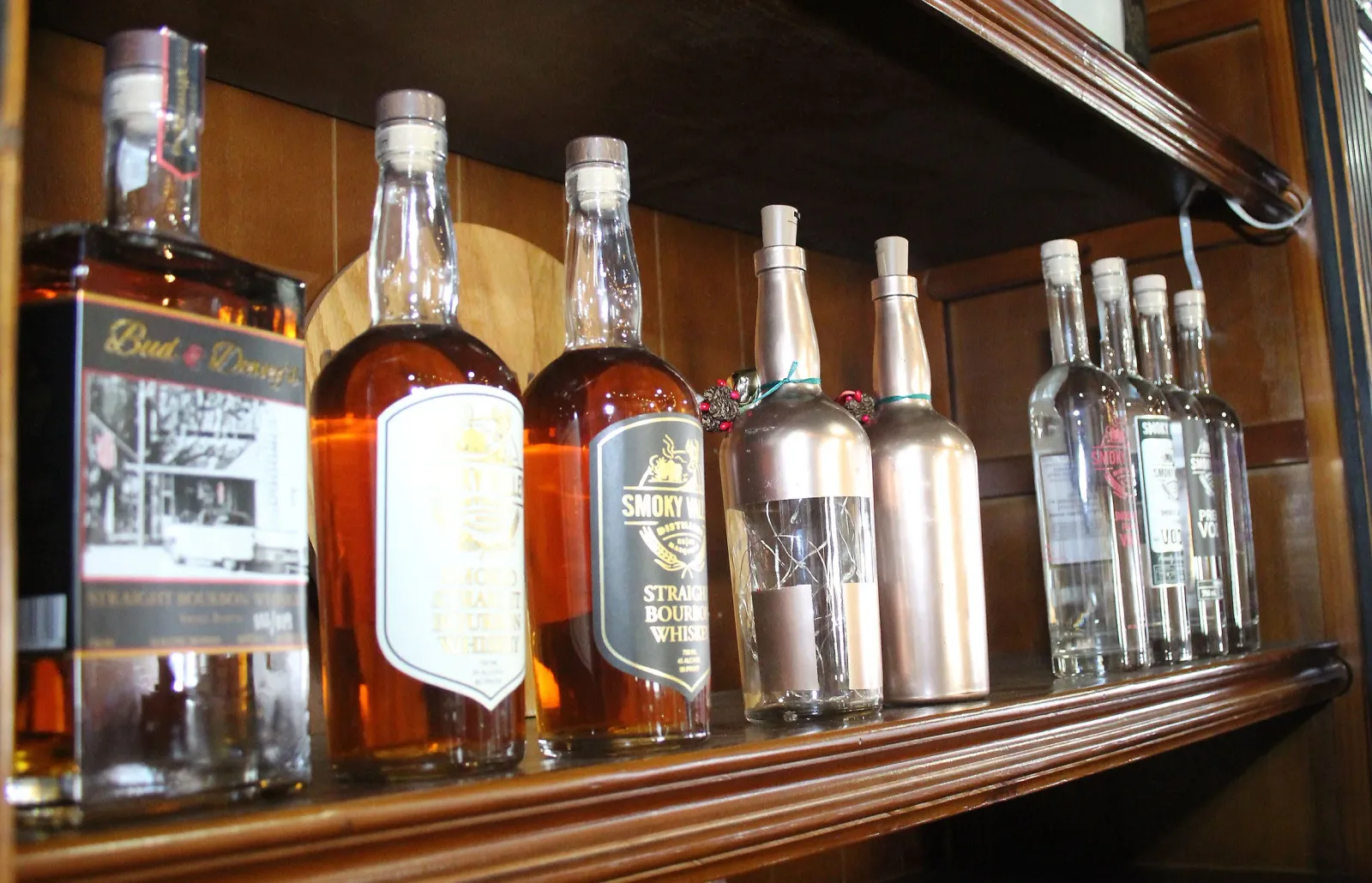
Same Grain, Same Water, Two Completely Different Spirits
Most articles on this subject start with the finished bottles — one clear, one amber — and work backward. We are going to start where we actually start, which is a load of Kansas corn arriving at the building.
Our Premium Vodka is 100% corn. Our Straight Bourbon is majority corn. Both are mashed with the same sandstone-filtered water from the Kiowa Aquifer, in the same mash tun, in the same small building in Marquette, Kansas. For the first several days of their lives they are close to indistinguishable.
Then two decisions get made, and those two decisions are the entire difference between vodka and whiskey.
| Vodka | Whiskey | |
|---|---|---|
| Base material | Any grain, potato, or grape — ours is 100% corn | Grain only; bourbon must be at least 51% corn |
| Distillation proof | 190 proof (95% ABV) or higher | Bourbon: 160 proof (80% ABV) maximum |
| Aging | None | Required — new charred oak for bourbon |
| Color | Clear | Amber, entirely from the barrel |
| Our bottling proof | 80 proof (40% ABV) | 90 proof (45% ABV) |
| Where flavor comes from | The grain, faintly, plus any infusion | Grain, fermentation, and the barrel |
Where the Two Are Genuinely Identical
Milling, mashing, and fermentation are the same job in both cases. You grind the grain, cook it with hot water so the starches convert into fermentable sugars, pitch yeast, and wait while the yeast turns those sugars into alcohol. At the end you have a low-alcohol liquid that is going to become either spirit depending on what happens next.
Everything about this stage matters to both products. Grain quality carries through. Water carries through. Fermentation temperature and time create flavor compounds that survive into the bottle. We wrote the two processes up separately in how vodka is made and how bourbon is made, and if you read them side by side, the first half of each is nearly the same article.
The First Split: How High You Distill
This is the decision most people have never heard of, and it matters more than aging does.
Distillation concentrates alcohol, but it also sorts flavor. Alcohol and water are not the only things in the wash — there are hundreds of congeners, the heavier aromatic compounds that carry grain, fruit, spice, and funk. The higher you push the proof, the more of those you leave behind.
Vodka is distilled past its own flavor, on purpose
Federal rules define vodka as neutral spirits distilled at or above 95% alcohol by volume — 190 proof. At that concentration almost nothing survives except ethanol and water. That is not a shortcut; it is the definition of the category. The standards for both spirits are published in the TTB's distilled spirits product categories.
The craft in vodka is in what survives that stripping, and in the water you proof it back down with. Corn leaves a soft sweetness and a creamy weight that wheat and potato do not, which is why we use it and why our Premium Vodka reads as gently sweet rather than sharp. We put that choice side by side with the other traditional base in corn vodka vs. potato vodka.
Whiskey is distilled to keep its flavor
Bourbon may not come off the still above 160 proof, and it must enter the barrel at no more than 125 proof. Those ceilings exist specifically to protect the congeners. Whiskey is defined by the very compounds vodka is defined by removing.
This is why the "whiskey is just aged vodka" idea does not hold up. Put vodka in a barrel and you get oak-flavored vodka, because everything that would have become whiskey was distilled away long before the barrel entered the picture.
The Second Split: Oak, or No Oak
Vodka goes from still to filtration to proofing to bottle. Whiskey goes into wood and waits.
The barrel is not a container — it is an ingredient. Charred new oak gives up vanillin, caramelized wood sugars, and tannin, and the spirit moves into and back out of the wood as temperature swings across the seasons. Kansas is well suited to this: hot summers and cold winters push the liquid deeper into the staves and draw it back out again.
We age in small barrels, which increases the wood-to-spirit contact area and speeds that exchange up considerably — the reasoning is laid out in the art of small barrel aging. Our Straight Bourbon spends two to four years in oak. The vodka bottled the same week spent zero days there.
What happens after the still
Vodka is not finished when it comes off the still. It still has to be filtered and then proofed down — cut with water from something near 95% ABV to the 40% ABV in the bottle. That means more than half of what is in a bottle of vodka is water, which is why the water source is not a marketing detail for us. Our Kiowa Aquifer water is naturally mineral-balanced and needs very little treatment, and at that dilution ratio it is doing a large share of the work.
Whiskey gets proofed down too, but from a much lower starting point and after the barrel has already made most of the decisions.
Why Whiskey Costs More
This part is rarely explained, and it is not because whiskey is inherently more valuable.
Vodka can be distilled, filtered, proofed, bottled, and sold within a few weeks. Whiskey cannot. Our Straight Bourbon spends two to four years in a barrel before anyone can buy it, which means the grain, the labor, the barrel, and the warehouse space are all paid for years before a single bottle generates revenue. On top of that, some of the liquid evaporates through the wood every year — the angel's share — so you bottle less than you put in.
For a small distillery, that is the real difference between the two categories: vodka pays the bills while the whiskey sleeps. It is also why a craft distillery's vodka is often the first product it releases and its aged whiskey the last.
What This Means When You Actually Drink Them
Vodka is a base. Because it contributes so little of its own, it lets whatever you add be the flavor. That is a feature, not a shortcoming. It is also why the flavored expressions work as well as they do — our wild plum, smoked jalapeno, lingonberry, and dill pickle vodkas are built on a spirit clean enough to carry an infusion without arguing with it. Our vodka cocktails guide leans on exactly that.
Whiskey is the flavor. In an Old Fashioned or a Manhattan you are tasting the whiskey with some framing around it, not the other way around. Swap the whiskey and you have a different drink. Swap the vodka in a Moscow Mule and most people would not notice.
There is a serving-temperature difference too. Vodka is usually served cold, which suppresses aroma and emphasizes texture. Whiskey is usually served at or near room temperature, because chilling it would mute the barrel character you paid for.
The proof gap between the two is smaller than most people assume — 80 proof against our 90 — and pour sizes differ more than the spirits do. The NIAAA's definition of a standard drink puts 1.5 fl oz of 80-proof spirits at the same alcohol content as a 12 oz beer, which is a more useful yardstick than the category on the label.
So Which One Is "Better"?
Neither, and the question usually means "which do I like." Vodka rewards you for what you build around it. Whiskey rewards you for paying attention to it.
If you want to find out which camp you fall into, the fastest test is drinking them side by side from the same distillery — same water, same grain, same hands — so the only variables left are the two decisions described above. If you already know you are a whiskey person, bourbon vs. whiskey sorts out the categories inside that family, and our Kernza Whiskey is the most unusual thing we make.
Taste Both in One Sitting
We pour across the whole range in the tasting room in Marquette — five vodkas, two whiskeys, and five bourbons. A tasting and tour runs $10 per person and takes about 30 to 45 minutes, Thursday through Saturday by appointment, and you can see the production floor where both spirits are made before you taste them.
If you would rather run the comparison at home, our bottles are stocked at retail locations across Kansas.