
A Mash Bill Is Just the Grain Recipe
Every whiskey starts as a pile of grain. The mash bill is the recipe for that pile — which grains, and how much of each, usually written as percentages by weight before anything is cooked, fermented, or distilled.
That's the whole definition. The reason it gets talked about so much is that this one decision does more work than almost any other. It sets the flavor range the whiskey can occupy, and under federal law it also decides what the whiskey is allowed to be called.
You'll see the term on our bourbon and whiskey pages constantly, so it's worth laying out properly: what each grain contributes, how the percentages are regulated, and — the part that usually gets skipped — what a mash bill genuinely cannot tell you about what's in the glass.
The Four Grains and What Each One Does
Nearly all American whiskey is built from four grains. Each one is doing a specific job.
Corn — sweetness and body
Corn is the sweetest of the four and the backbone of bourbon. It gives you caramel, vanilla, and a round, full mouthfeel. Corn on its own tends toward simple, though, which is why almost nobody distills a whiskey from corn alone and then ages it seriously.
Rye — spice and structure
Rye is the assertive one. Black pepper, cinnamon, dried herbs, and a dry finish that snaps shut instead of trailing off sweet. A little rye in a bourbon mash bill adds definition. A lot of it takes over — our Rye Single Barrel Whiskey runs 82% rye, and it's the boldest thing we make.
Rye is also a difficult grain to work with. It's sticky when cooked and it foams hard during fermentation, which is part of why rye-heavy whiskeys tend to come from people who chose to make them rather than from people optimizing for yield.
Wheat — softness
Wheat does the opposite of rye. It's gentle and bready, mildly sweet, and it mostly steps back and lets the corn and the barrel come through. That's the entire idea behind a wheated bourbon like our best-selling Bud & Dewey's, where wheat takes the seat rye normally occupies.
Malted barley — the engine
Malted barley is almost always the smallest number in the mash bill, often around 5%, and it's rarely there for flavor. Malting — germinating the grain and then drying it — activates enzymes that convert starch into fermentable sugar. Without that conversion, the yeast has nothing to eat. Barley malt is the most efficient source of those enzymes, so it earns its slot on chemistry rather than taste.
Other grains are perfectly legal and do get used. Ours includes one you won't find almost anywhere else: Kernza, a perennial grain developed by The Land Institute in Salina, 25 miles from our door.
The 51% Rule: How Mash Bills Define Categories
Here's where the grain recipe stops being a stylistic choice and becomes a legal one. The federal standards of identity for whisky, at 27 CFR 5.143, assign category names based almost entirely on the mash bill:
| Category | Mash bill requirement |
|---|---|
| Bourbon whiskey | At least 51% corn |
| Rye whiskey | At least 51% rye |
| Wheat whiskey | At least 51% wheat |
| Malt whiskey | At least 51% malted barley |
| Rye malt whiskey | At least 51% malted rye |
| Corn whiskey | At least 80% corn |
The same regulation adds the production limits that travel with those names: distillation at 160 proof or less, and entry into charred new oak barrels at 125 proof or less — see what proof in whiskey means for how those two caps and the 80 proof bottling floor fit together. Corn whiskey is the outlier — it doesn't require new charred oak at all, and needs no barrel time unless an age claim appears on the label. Not every category is defined by grain, either; light, blended, and spirit whiskey and the newer American single malt are covered in our guide to the types of American whiskey.
Two details people routinely get wrong:
"Straight" is about time, not grain. A straight bourbon is a bourbon that has spent at least two years in charred new oak, with no coloring, flavoring, or blending materials added. The mash bill requirement doesn't change at all. Our Straight Bourbon is a bourbon that also cleared the aging bar.
Bourbon carries a stricter additive rule than the categories beside it. In that same table, a non-straight rye or wheat whiskey may legally contain harmless coloring, flavoring, and blending materials. Bourbon may not — straight or otherwise. It's the one exception carved out in that column.
How to Read the Percentages
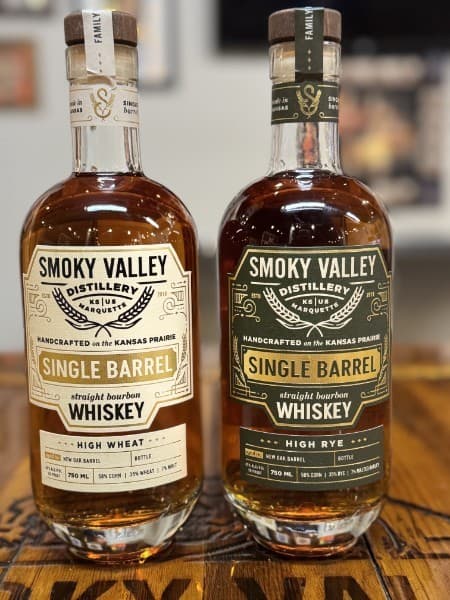
A published mash bill like 58% corn, 37% wheat, 5% malt — that's our High Wheat Single Barrel Bourbon — is measured by weight of grain going into the mash. It isn't a measure of what ends up in the bottle, and the numbers don't scale linearly into flavor. Rye in particular punches well above its percentage; moving a bourbon from 8% rye to 20% rye changes it far more than that twelve-point gap suggests.
Two more things worth knowing before you start comparing bottles:
Nobody is required to tell you. The standards of identity set minimums for using a category name. They don't require the actual percentages on the label. When a distillery publishes a full breakdown, it's choosing to.
"High rye" and "wheated" aren't legal terms. They're useful shorthand with no federal definition behind them, so what counts as high rye at one distillery may be unremarkable at another. Read them as a direction, not a specification.
Our Mash Bills, and What They Change
The clearest way to understand mash bills is to hold everything else still and change only the grain. That's more or less what our single barrel program does — same water from the Kiowa Aquifer, same Kansas-grown grain, same ten-gallon barrels, same warehouse.
- High Wheat Single Barrel Bourbon — 58% corn, 37% wheat, 5% malt. Toasted grain, honey, butterscotch. Soft the whole way through.
- High Rye Single Barrel Bourbon — the same idea with rye in wheat's place. Spice-forward, layered, and noticeably drier on the close.
- Rye Single Barrel Whiskey — 82% rye, 12% corn, 6% malted barley. Well past the 51% line, which is why it stopped being a bourbon. Named Best of Kansas at the 2025 Heartland Whiskey Competition.
- Straight Bourbon — corn-forward with rye for spice and malted barley for depth. The reference point for everything else on the shelf.
- Bud & Dewey's — wheat in the secondary slot instead of rye. Sweet cereal and vanilla, and our best seller by a wide margin.
- Kernza Whiskey — corn, malted barley, and Kernza. It lands between bourbon sweetness and rye spice, with a nutty, herbal character neither of those grains produces on its own.
If you want the grain difference explained rather than listed, bourbon vs. rye takes the two mash bills apart side by side, and how bourbon is made follows one from the grain bill through to the bottle.
What a Mash Bill Doesn't Tell You
This is the part that gets lost once people start trading grain percentages like baseball statistics.
The mash bill sets a range. Everything after it decides where in that range the whiskey actually lands — yeast strain, fermentation length and temperature, where the distiller makes the cuts between heads, hearts, and tails, barrel size, char level, warehouse position, and time. Hand an identical mash bill to two distilleries and you'll get two whiskeys nobody would confuse.
Barrel size matters more than most people expect. We age in ten-gallon barrels instead of the industry-standard fifty-three, which means far more wood contact per gallon and a faster, different maturation curve. That's covered in small barrel aging, and on our whiskey it's a bigger lever than a few points of rye either way.
Then there's barrel-to-barrel variation inside one mash bill and one production run, which is the entire premise of a single barrel release. Same recipe, same day, different barrels, genuinely different whiskeys.
So: use the mash bill to predict a direction. Sweet or spicy, soft or dry, round or sharp. Don't use it to predict the whiskey.
The Fastest Way to Learn This
Taste two whiskeys that differ by one grain. That's the shortcut, and it's the reason we pour our lineup in the order we do.
Our High Wheat and High Rye single barrels are the clearest pair we have: same distillery, same water, same barrel program, one variable moved. Once you've had those back to back, "wheated" and "high rye" stop being label vocabulary and start being things you can pick out blind.
A tasting and tour in Marquette is $10 per person, runs about 30 to 45 minutes, and is available Thursday through Saturday by appointment — we walk through the mash bill of each spirit with the production floor right behind you. If you'd rather set the comparison up at home, our bottles are stocked at retail locations across Kansas, and how to taste whiskey covers the method for getting something useful out of a side-by-side pour.