
Ask someone to name the types of American whiskey and you'll usually hear bourbon and rye, and maybe Tennessee. The official list is longer and more specific than that, and it's written down in federal regulation rather than tradition.
We make whiskey that lands in several of those categories, and one bottle that doesn't fit any of the named ones. So here's the whole map: what makes a spirit whiskey at all, the types defined by grain, the types defined by blending, and the words that sit on top of a type without being one.
The Rule Every Whiskey Starts From
The federal standards of identity for whiskey live at 27 CFR 5.143. The regulation spells it "whisky" throughout, which is a quirk of the text, not a separate product; we explain the spelling split in whiskey vs. whisky.
Before any type applies, a spirit has to clear the base definition. American whiskey is:
- Distilled from a fermented mash of grain, any grain
- Distilled at less than 190 proof (95% ABV)
- Stored in oak (corn whiskey is the one exception)
- Bottled at no less than 80 proof (40% ABV)
The 190 proof ceiling is what separates whiskey from vodka. Distill a grain mash above it and you have neutral spirits; stay below it and some of the grain's character survives into the glass. We cover that line in more detail in vodka vs. whiskey.
A spirit that clears this bar and nothing more is simply "whiskey." Everything below is a narrower name a distiller earns by meeting more rules.
The Five Grain Types: Bourbon, Rye, Wheat, Malt, and Rye Malt
Five types are named after the grain that makes up at least half the recipe. All five share the same production rules: distilled at 160 proof or less, and stored in charred new oak barrels entered at 125 proof or less.
| Type | Mash requirement | Notable extra rule |
|---|---|---|
| Bourbon whiskey | At least 51% corn | Must be made in the US; no added coloring or flavoring |
| Rye whiskey | At least 51% rye | None |
| Wheat whiskey | At least 51% wheat | None |
| Malt whiskey | At least 51% malted barley | None |
| Rye malt whiskey | At least 51% malted rye | None |
The grain decides more than the name. Corn brings sweetness and body, rye brings pepper and a dry finish, and wheat brings a soft, bready sweetness. What a mash bill is walks through each grain's job and why the percentages matter.
Bourbon is stricter than its neighbors in two ways. First, the word may not be used on whiskey "not distilled and aged in the United States," which is the only geography in any of these five definitions; does bourbon have to be made in Kentucky covers why that rule names the country and not a state. Second, the regulation allows harmless coloring, flavoring, and blending materials in a non-straight rye, wheat, or malt whiskey, with one written exception: bourbon.
The 51% threshold also means the secondary grain can be surprisingly large without changing the type. Our High Wheat Single Barrel Bourbon is 37% wheat. It's still bourbon, because the corn is at 58%. A wheat whiskey would need wheat at 51% or more. The same arithmetic is what separates bourbon from rye, covered in bourbon vs. rye.
Corn Whiskey: The One That Skips the Charred Barrel
Corn whiskey asks for more corn than bourbon does, at least 80%, and then relaxes almost everything else. It is distilled at 160 proof or less like the grain types, but it is not required to touch a barrel at all unless the label makes an age claim. If it is stored, it goes into used or uncharred new oak at 125 proof or less.
That barrel rule is the whole difference. Charred new oak is where bourbon gets most of its color, vanilla, and caramel. Take the char away and a very corn-heavy spirit stays pale and grain-forward. That's why a high-corn mash can end up as two very different whiskeys depending on what it goes into.
American Single Malt: The Newest Type
For most of the regulation's history, the only malted barley category was malt whiskey: 51% malted barley, charred new oak. In December 2024, the Alcohol and Tobacco Tax and Trade Bureau finalized a separate American single malt standard, effective January 19, 2025. To use the name, a whiskey must be:
- Mashed, distilled, and aged in the United States
- Distilled entirely at one US distillery
- Made from a mash of 100% malted barley
- Distilled at 160 proof or less
- Stored in oak barrels of no more than 700 liters, which may be used, uncharred new, or charred new
- Bottled at no less than 80 proof, with disclosed caramel coloring as the only permitted addition
The barrel flexibility is the point. Because used barrels are allowed, an American single malt can pick up character from casks that previously held other spirits or wine. Malt whiskey, held to charred new oak, doesn't have that option.
"Straight" and "Bottled in Bond" Are Not Types
These two words show up constantly and get mistaken for categories. The regulation calls straight "a further designation of a type," and it is optional.
Straight means the whiskey has spent at least two years in the barrel with no added coloring, flavoring, or blending materials. It doesn't change the grain recipe. A straight bourbon is a bourbon that also met the time requirement. Under 27 CFR 5.74, any whiskey aged less than four years must carry an age statement, so a young straight whiskey tells you its age on the bottle.
Bottled in bond is stricter still. 27 CFR 5.88 requires one distiller at one distillery in one distilling season, at least four years in wood, and bottling at exactly 100 proof. It can be applied to bourbon, rye, or other spirits; it's a quality and provenance guarantee, not a style. Our guide to how to read a whiskey label covers both designations alongside the terms that carry no legal meaning at all, and what bottled in bond means takes the bonded rules condition by condition.
Light, Blended, and Spirit Whiskey: Where Neutral Spirits Come In
The remaining categories are defined less by grain than by how much high-proof spirit is in the bottle.
Light whiskey is distilled at more than 160 proof, above the grain types' ceiling but still under whiskey's 190 limit, and stored in used or uncharred new oak. Higher distillation strips out more grain character, so light whiskey is exactly what the name suggests.
Blended whiskey must contain at least 20% straight whiskey, measured on a proof-gallon basis, which counts alcohol rather than liquid volume. Up to 80% may be neutral spirits. When a blend names a type, the bar goes up: a blended bourbon whiskey must be at least 51% straight bourbon.
Spirit whiskey sits at the far end. It needs only 5% whiskey or straight whiskey, with the straight portion under 20%, and up to 95% neutral spirits.
Tennessee Whiskey Is a State Definition
Tennessee whiskey is a well-known American style that is not a federal type. The word "Tennessee" doesn't appear anywhere in 27 CFR 5.143. The definition comes from state law, Tennessee Code 57-2-106, which requires Tennessee whiskey to be:
- Manufactured in Tennessee
- Made from a grain mixture of at least 51% corn
- Distilled to no more than 160 proof
- Filtered through maple charcoal before aging
- Aged in new, charred oak barrels in Tennessee
- Entered into the barrel at no more than 125 proof, and bottled at no less than 80 proof
Read against the bourbon rules, the grain, proof, and barrel requirements line up almost exactly. What Tennessee adds is the charcoal filtering step and a requirement that the whole process happen inside the state. The statute also carves out a narrow exception to the charcoal step, limited to a distillery in a county that approved manufacturing by referendum in 1979 and that was licensed in 2000. For the full comparison — how the charcoal step works, and why a trade treaty calls Tennessee whiskey straight bourbon anyway — see bourbon vs. Tennessee whiskey.
Where Our Own Shelf Lands
Our shelf touches several of these categories, and one bottle sits outside all of the named ones. Every one of these is distilled here in Marquette.
- Straight Bourbon: straight bourbon whiskey. Corn-forward with rye and malted barley, aged two to four years.
- Bud & Dewey's: a wheated straight bourbon. Wheat replaces rye as the secondary grain, but corn still leads, so it's bourbon rather than wheat whiskey. What wheated bourbon is explains the difference in the glass.
- High Wheat Single Barrel Bourbon and High Rye Single Barrel Bourbon: two bourbons that push the secondary grain in opposite directions without crossing 51%.
- Rye Single Barrel Whiskey: rye whiskey. At 82% rye, 12% corn, and 6% malted barley, it's well past the rye line. Named Best of Kansas at the 2025 Heartland Whiskey Competition.
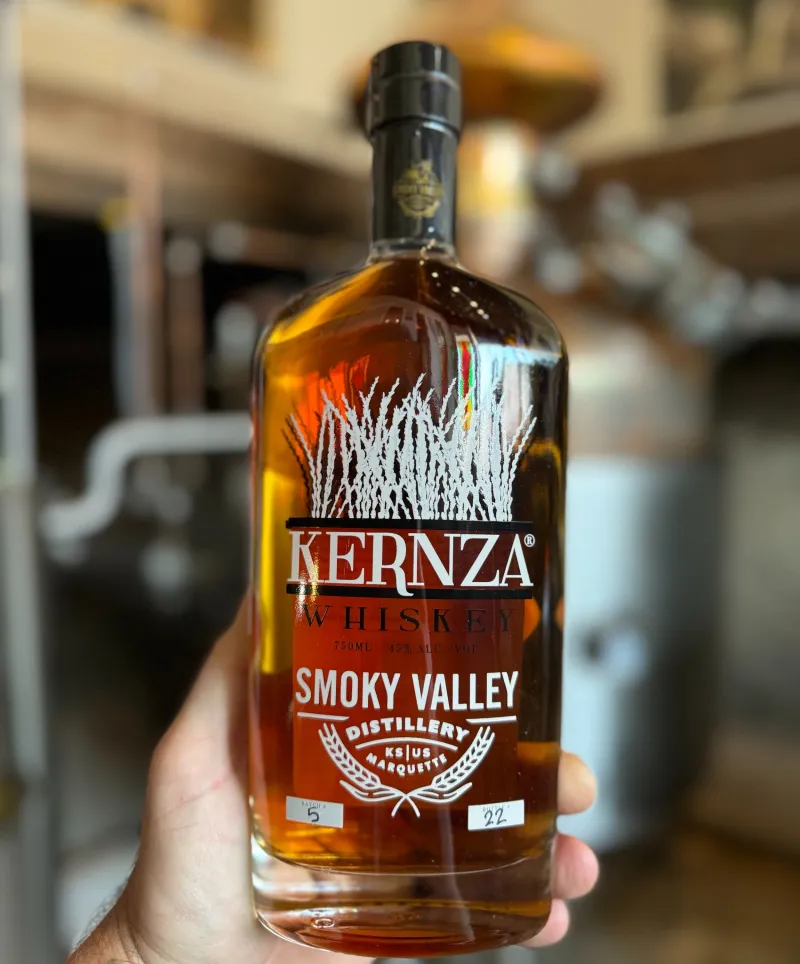
- Kernza Whiskey: corn, malted barley, and Kernza, a perennial grain developed by The Land Institute in Salina. The regulation has no named type built around Kernza, which is part of what makes it unusual. We're one of only two distilleries in the world using it. What Kernza is tells the grain's story.
The Short Version
American whiskey is any grain spirit distilled under 190 proof, stored in oak, and bottled at 80 proof or more. From there, the type depends on the grain (bourbon, rye, wheat, malt, rye malt, and corn), on single-distillery malted barley (American single malt), or on how much neutral spirit is blended in (light, blended, and spirit whiskey). Straight and bottled in bond are promises stacked on top of a type. Tennessee whiskey is defined by Tennessee.
The fastest way to understand the categories is to taste them side by side. Our whiskey and bourbon lineups put straight bourbon, wheated bourbon, rye, and Kernza on one counter. A tasting and tour is $10 per person, runs 30 to 45 minutes, and is available Thursday through Saturday by appointment.