
The question usually arrives as "Is Jack Daniel's a bourbon?" and the honest answer takes longer than people expect. The liquid meets the federal bourbon recipe. A trade treaty says it is bourbon. The company that makes it says it isn't. All three of those are true at once.
Bourbon and Tennessee whiskey are the two American whiskeys most often confused for each other, because on paper they nearly are each other. The difference comes down to one production step, one state line, and one word a handful of distilleries have decided not to print. Here's what each law requires, what the extra step does, and how to tell them apart in the glass.
Start With What They Share
Bourbon is defined by federal law. The standards of identity at 27 CFR 5.143 require a fermented mash of at least 51% corn, distillation at 160 proof or less, storage in charred new oak barrels entered at 125 proof or less, bottling at 80 proof or more, and production in the United States. No coloring, flavoring, or blending materials may be added. Two years in that barrel makes it straight.
Tennessee whiskey is defined by state law. Tennessee Code 57-2-106 says a spirit may be labeled Tennessee whiskey only if it is:
- Manufactured in Tennessee
- Made of a grain mixture that is at least 51% corn
- Distilled to no more than 160 proof
- Aged in new, charred oak barrels in Tennessee
- Filtered through maple charcoal prior to aging
- Placed in the barrel at no more than 125 proof
- Bottled at not less than 80 proof
Read the two lists against each other and four of the seven Tennessee requirements repeat the bourbon standard outright; a fifth, new charred oak, repeats it with a state line attached. What Tennessee added is the charcoal step and a requirement that both distillation and aging happen inside the state.
| Bourbon | Tennessee whiskey | |
|---|---|---|
| Defined by | Federal law (27 CFR 5.143) | Tennessee state law (Tenn. Code 57-2-106) |
| Where it can be made | Anywhere in the United States | Tennessee only — distilled and aged there |
| Minimum corn | 51% | 51% |
| Maximum distillation proof | 160 | 160 |
| Barrel | Charred new oak, entered at 125 proof or less | New charred oak, entered at 125 proof or less |
| Minimum bottling proof | 80 | 80 |
| Charcoal filtering before aging | Permitted, not required | Required (maple charcoal), one statutory exemption |
| Added coloring or flavoring | Prohibited | State law is silent; federal labeling rules still apply |
The word "Tennessee" appears nowhere in the federal regulation. Our guide to the types of American whiskey lays out every category that regulation does create, and Tennessee whiskey is not one of them. It's a state definition stacked on top of a federal one.
The Lincoln County Process
The step that does the separating is charcoal filtering — what the industry calls the Lincoln County Process and what Jack Daniel's calls charcoal mellowing.
New-make whiskey comes off the still clear and, by most accounts, a little rough. Before it goes into the barrel, Tennessee distillers pass it through sugar maple charcoal. Jack Daniel's own account is that the founder "mellowed his whiskey drop by drop through 10 feet of charcoal made from hard sugar maple," and that the step made the whiskey roughly twice as expensive and three times as long to make. The charcoal is produced on site by burning stacks of maple, then ground and packed into vats; the spirit trickles through over several days. George Dickel chills its whisky before it meets the charcoal, on the theory that a cold spirit gives up more of what the charcoal is there to catch.
What the charcoal catches is the point. Activated charcoal adsorbs — it grabs certain molecules onto its surface as liquid passes through. Producers say the maple charcoal pulls out some of the heavier, oilier congeners that make young whiskey taste harsh, and leaves a lighter, softer spirit for the barrel to work on. Tennessee whiskey is famously smooth partly for that reason.
Note what the process does not do: it doesn't add anything. That matters, because the bourbon standard bans additives, and a subtraction isn't one. A bourbon distiller could charcoal-filter new-make tomorrow and still call the result bourbon. Most don't, because the charcoal also takes some of the grain character that turns into flavor after a few years in oak.
The name is a small piece of historical trivia. Lynchburg, where Jack Daniel's operates, was in Lincoln County when the practice took root. Moore County was carved out of Lincoln, Bedford, Franklin, and Coffee counties in 1871, and Lynchburg has been the Moore County seat ever since. The statute's one charcoal exemption — a narrow carve-out for a distillery in a county that approved manufacturing by referendum in 1979 and licensed it in 2000 — is generally understood to have been written for Benjamin Prichard's in Kelso, which sits in today's Lincoln County and does not use the process named after it.
Is Tennessee Whiskey Bourbon?
Here's where it gets genuinely interesting, because the answer depends on who you ask.
Ask the federal regulation and you get silence. The bourbon standard never mentions Tennessee, so there's no federal rule saying Tennessee whiskey is or isn't bourbon. What the standard does say is what bourbon requires, and a whiskey that clears all seven Tennessee criteria has cleared every one of those requirements too.
Ask the trade lawyers and you get a definition. The United States-Mexico-Canada Agreement, in Article 3.C.2 of its alcohol annex, requires Canada and Mexico to recognize "Bourbon Whiskey and Tennessee Whiskey, which is a straight Bourbon Whiskey authorized to be produced only in the State of Tennessee, as distinctive products of the United States." That language carried over from NAFTA. In the eyes of the treaty, Tennessee whiskey is a subset of straight bourbon, defined by geography.
Ask the producers and you get a split. Jack Daniel's declines the word bourbon and points to the charcoal step as the reason. Uncle Nearest, a newer Tennessee distiller, takes the opposite position on its own site and states that Tennessee whiskey "is, by law, a type of straight bourbon whiskey." Both companies make Tennessee whiskey to the same statute. The disagreement is about branding, not compliance.
The cleanest way to hold all of that: Tennessee whiskey is bourbon that has met extra conditions and chosen a different name. It's the same relationship Kentucky bourbon has to bourbon generally — a state name that guarantees something about origin, layered on a federal recipe — except that Tennessee wrote a process requirement into its law and Kentucky didn't.
Why Tennessee Wrote It Down
For most of its history, "Tennessee whiskey" meant whatever the Tennessee distilleries said it meant. The trade agreements recognized the name, but no statute defined it.
That changed with House Bill 1084, passed by the Tennessee General Assembly and signed as Public Chapter 341 in May 2013, effective July 1 of that year. The law locked in the seven requirements above, including new charred oak and the charcoal step, and attached a penalty: a manufacturer that violates it faces license suspension or revocation for at least a year.
The practical effect was to make the name defensible. Before 2013, a producer could in principle skip the charcoal or use a second-hand barrel and still print Tennessee whiskey on the label. After 2013, the words carry the same kind of guarantee that straight bourbon does.
What You Can Actually Taste
Set the law aside and pour the two next to each other, and the differences are real but narrower than the branding suggests.
The charcoal step tends to produce a lighter, rounder whiskey with less grain bite up front — Tennessee whiskeys often lean toward banana, vanilla, and soft caramel, with the sharper edges filed down. Bourbon that skipped the charcoal generally carries more of the mash bill into the glass: more rye pepper or wheat bread, more oak grip, a longer and rougher-edged finish. Neither is better. One had something taken out early; the other kept it and let the barrel deal with it.
Two things people assume are differences aren't:
- Sour mash is on the Jack Daniel's label and gets read as a Tennessee trait. It's a fermentation method — carrying spent mash from one batch into the next to control pH — and most bourbon is made the same way. It happens at the fermentation step, long before charcoal or barrel enter the picture.
- The barrel is identical by law. New charred oak, 125 proof entry, both sides. Most of what any American whiskey tastes like comes from that barrel, and what the charred layer does is the same chemistry in Lynchburg as it is in Marquette.
Our own bourbon takes the standard route. Off the copper pot still, proofed with sandstone-filtered water from the Kiowa Aquifer, and into a 10-gallon charred new oak barrel — no charcoal vat between the still and the wood. The small barrel puts far more oak surface against each gallon than the standard 53-gallon size, so where a Tennessee distiller smooths the spirit before aging, we let the barrel do the rounding during it. The one smoke in our lineup goes the other direction entirely: our Smoked Straight Bourbon is hand-smoked with hickory at bottling, after the barrel, which adds character rather than filtering it out.
Tasting Them Side by Side
The comparison is easy to run at home. Take a Tennessee whiskey and a bourbon at similar proof — our Straight Bourbon at 45% ABV against a 90-proof Tennessee bottle is a fair match; against an 80-proof one, expect the strength difference to show up as heat before the charcoal does. What proof means explains why that matters.
- Nose the Tennessee whiskey first. It's usually the softer of the two and gets flattened if the bourbon goes first.
- Look for grain, not barrel. Vanilla and caramel are in both. What separates them is how much pepper, bread, or raw-grain edge survived into the bourbon.
- Pay attention to texture. The charcoal step often reads as a lighter body and a cleaner entry more than as a different flavor.
- Compare the finish. Bourbon tends to hang on longer and drier; Tennessee whiskey tends to fade sweet and quick.
- Add a few drops of water to each and go back through. Water opens the bourbon more, because there's more in it to open.
Our full method for tasting whiskey goes step by step, and a proper nosing glass makes the texture difference much easier to catch:
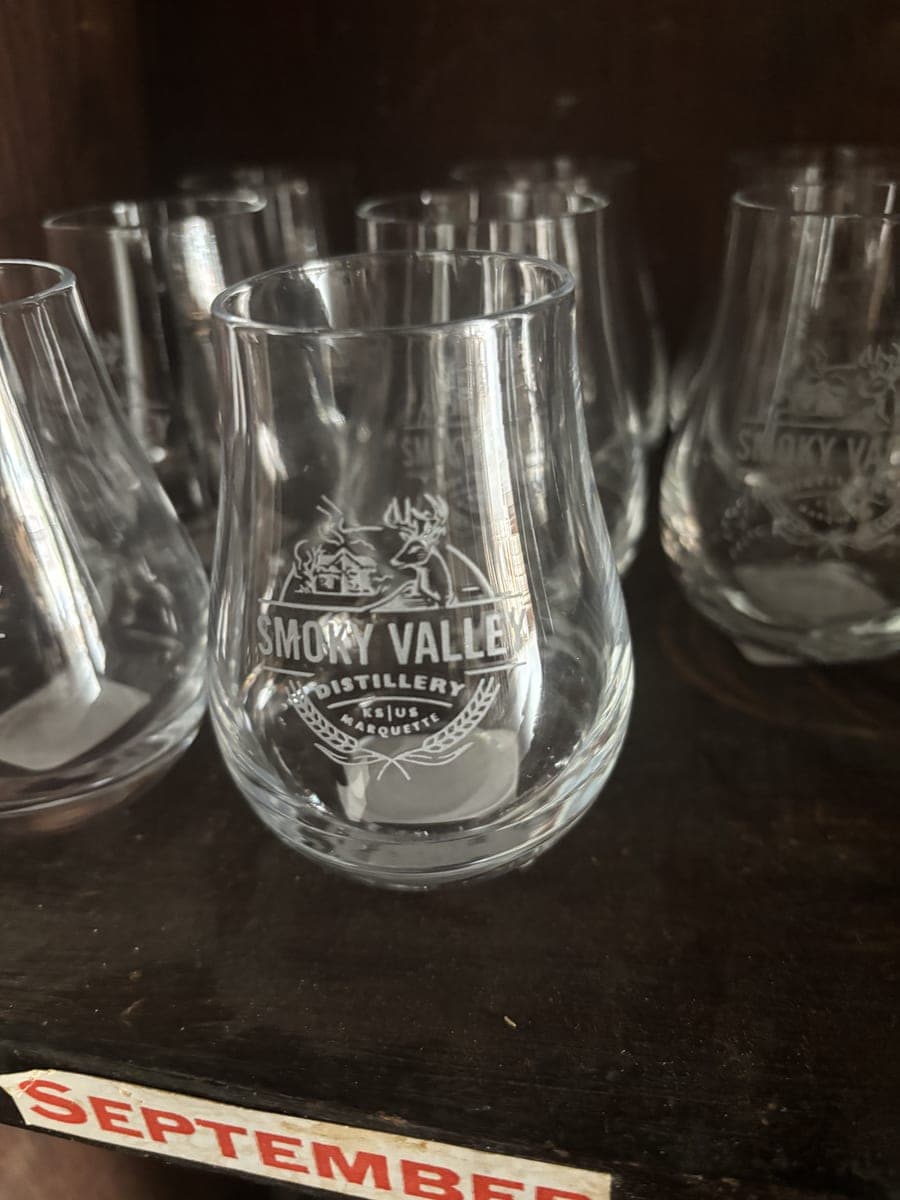
Logo Tasting Glass
$16.95A tulip-shaped nosing glass etched with the Smoky Valley Distillery crest — shaped to concentrate aroma for tasting our bourbon and whiskey neat.
View in the shop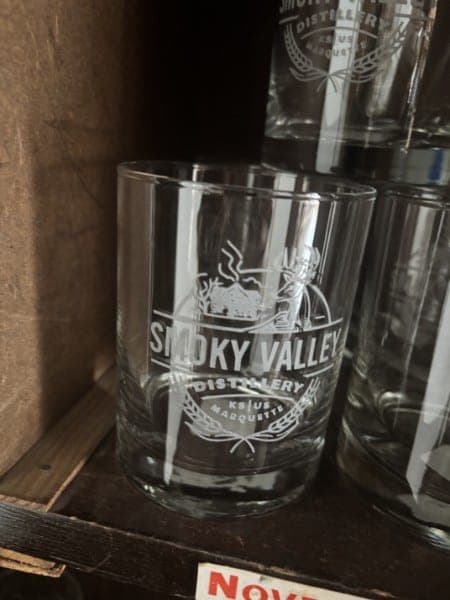
Old Fashioned Glass
$19.95A heavy-bottomed rocks glass etched with our crest — built for an Old Fashioned, a bourbon on the rocks, or a neat pour.
View in the shopWhich One Should You Buy?
Choose Tennessee whiskey if you want something soft and approachable, drink mostly with cola or ginger ale, or are pouring for people who find bourbon hot. The charcoal step was designed to produce exactly that whiskey.
Choose bourbon if you want the grain to show — the rye spice of a traditional mash bill or the honey of a wheated one — or if you drink it neat and like a finish that lasts. Bourbon also gives you far more range: every state, every mash bill, and the whole high rye vs. wheated spectrum, where Tennessee whiskey is a handful of producers working under one statute.
Buy one of each if you want to settle the "is it bourbon" question with your own palate. It's a better afternoon than reading the regulations.
If you're in central Kansas, the fastest way to taste the bourbon side of the comparison is a tasting and tour — $10 per person, 30 to 45 minutes, Thursday through Saturday by appointment. We pour the full bourbon lineup, and you can decide for yourself how much of the difference is the charcoal and how much is the state line. If you already know what you want, where to buy lists our Marquette tasting room and 16 retail partners across Kansas.