
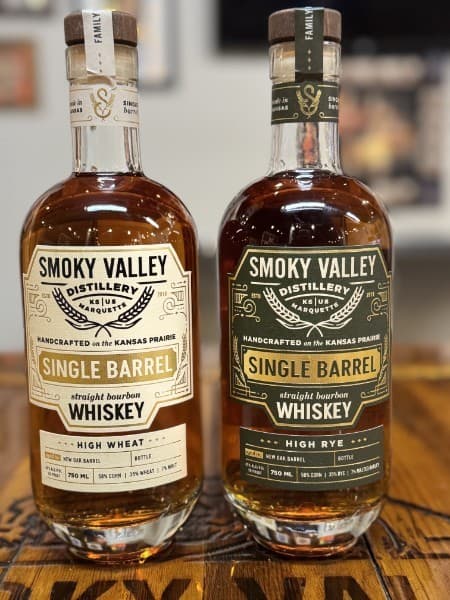
Two bottles sit on the counter in our tasting room, side by side. Both are bourbon. Both come from the same still, the same water, and the same size barrel. One tastes like black pepper and dry oak. The other tastes like honey on toast.
The only meaningful difference between them is which grain we put in after the corn.
That choice is what people mean when they say high rye or wheated, and it is the single most useful thing to understand about a bourbon shelf. Here's what each term actually covers, what federal law has to say about it (less than you'd think), what the research says you can genuinely detect, and how our own two single barrels compare when you taste them against each other.
Neither Term Is in the Regulation
Start with what is legally fixed. The federal standards of identity at 27 CFR 5.143 define bourbon as a whiskey made from a fermented mash of not less than 51% corn, distilled at 160 proof or less, and stored in charred new oak barrels entered at 125 proof or less. Add two years in that barrel with no coloring or flavoring and it may also be called straight.
That's the whole recipe requirement. The words "wheated" and "high rye" appear nowhere in the regulation. Neither is a protected term, neither has a threshold, and no agency checks them.
This puts them in the same bucket as "small batch" and "handcrafted" — descriptive shorthand the industry uses consistently but no one enforces. Our guide to how to read a whiskey label sorts the rest of the bottle into the same two piles: what federal law requires, and what is marketing.
The practical consequence: the only trustworthy number is a published mash bill. When a distillery tells you the percentages, you know what you're buying. When it only says "high rye," you know the direction and not the distance.
The 49% That's Left Over
Because corn has to be at least 51%, every bourbon recipe is a decision about what to do with the remaining space. In practice that space goes to a flavor grain plus a small amount of malted barley, which carries the enzymes that convert starch to fermentable sugar.
| Typical bourbon | High rye bourbon | Wheated bourbon | |
|---|---|---|---|
| Corn | 70–80% | 51–70% | 51–70% |
| Secondary grain | Rye, ~10–15% | Rye, ~18–35% | Wheat, ~12–37% |
| Malted barley | 5–10% | 5–10% | 5–10% |
| Direction in the glass | Balanced, corn-forward | Drier, spicier, peppery | Softer, sweeter, rounder |
Those ranges are industry convention, not law — see the section above. The one number on this page that comes off an actual label is ours: our High Wheat Single Barrel Bourbon is 58% corn, 37% wheat, 5% malt.
Note what that does and does not make it. At 37% wheat it is emphatically wheated, but corn still leads at 58%, so it is bourbon rather than wheat whiskey. Wheat whiskey is its own federal type and needs wheat at 51% or more. If the arithmetic behind those thresholds is new to you, what a mash bill is walks through each grain's job, and types of American whiskey lays out every category the 51% rule creates.
What Each Grain Does
Corn brings sweetness and body in both recipes. The secondary grain is where they separate.
Rye is the assertive one. It reads as black pepper, baking spice, dried herb, and a distinctly dry finish. It is why rye-forward bourbons feel sharper and why they hold their shape in a cocktail — the spice survives dilution, sugar, and vermouth. Push rye past 51% and you are no longer making bourbon at all; that's bourbon vs. rye.
Wheat is the quiet one. It contributes far less of its own aroma, which sounds like a weakness and isn't. With rye's pepper out of the way, what comes forward is corn sweetness and everything the barrel put in — vanilla, caramel, butterscotch, toasted grain. A wheated bourbon tastes more like its barrel than a high rye does, because there's less competing with it. What wheated bourbon is covers that category on its own terms.
Malted barley is in both, usually at 5 to 10%, and is doing a job rather than making a statement.
How Much of This Can You Actually Taste?
Honest answer: more than skeptics claim, less than marketing implies, and it depends heavily on how far apart the two recipes are.
The most useful study on this is Phetxumphou and colleagues, published in the Journal of the Institute of Brewing in 2020. The researchers took whiskeys distilled from controlled mash bills — two bourbons and two ryes — and aged them in new charred oak barrels from the same cooperage and the same stave lot, which removes the barrel as a variable. Trained panelists then ran a full descriptive analysis alongside GC-MS and LC-MS chemical profiling.
Two findings matter here:
- Samples differed significantly in 18 of 35 sensory attributes by mash bill and by aging time. Attributes like vanilla and apple tracked with longer aging and higher corn content; vegetal and hay-like attributes tracked with shorter aging. So grain effects are real and measurable, not folklore.
- The whiskeys with more extreme recipe differences were easier to discriminate. Two samples roughly 20 percentage points apart in their corn-to-rye ratio gave panelists real trouble.
That second point is the practical one. Comparing two commercial bourbons that sit a few points apart on the secondary grain is a hard test, and a lot of blind-tasting disappointment comes from exactly that setup. Put a genuinely high rye next to a genuinely wheated bourbon and the gap is obvious.
It is also worth knowing how much of any bourbon's flavor is the wood rather than the grain. Charring an oak barrel breaks it down in well-documented ways: lignin degrades into vanillin and related phenols, hemicellulose into furfural and its caramel-and-toasted-almond relatives, and the oak contributes lactones that read as coconut and sweet wood. That's a large share of what you taste in any bourbon. The mash bill decides what that barrel character gets layered onto — pepper, or honey.
We use 10-gallon barrels rather than the standard 53-gallon, which puts far more wood surface against each gallon of spirit. In our whiskey, the barrel speaks loudly. The grain decides what it's arguing with.
Our Two Single Barrels, Head to Head
This is the comparison we actually run in the tasting room, and it is a clean one because both bottles are single barrel releases from the same house.
High Rye Single Barrel Bourbon — 35% ABV. Rye spice, caramel, and toasted oak on the nose, with black pepper and dried fruit behind it. Bold rye up front on the palate, sweet caramel and vanilla underneath, oak tannin and baking spice holding the frame. The finish is warm and peppery. Where our Straight Bourbon uses rye as a supporting grain, this one puts it in a starring role.
High Wheat Single Barrel Bourbon — 45% ABV, 58% corn, 37% wheat, 5% malt. Toasted grain and warm honey on the nose with a hint of vanilla caramel. Soft and round on the palate: honey butterscotch, toasted wheat, gentle sweetness. The finish is clean and mellow rather than sharp.
One caution when you compare them: these two bottles differ in proof as well as grain. The High Rye is 35% ABV and the High Wheat is 45%. Strength changes how hot a pour reads and how quickly aroma comes off the glass, which is a separate variable from the mash bill — what proof means covers why. For a grain-only comparison, our wheated Bud & Dewey's sits at the same 45% as the High Wheat and makes a fairer partner against a higher-proof rye-forward pour.
And because both single barrels are single barrels, the specific barrel matters too. We taste and select each one individually instead of blending hundreds together for consistency, which is the whole point — and the tradeoff. Single barrel vs. small batch explains what each approach buys you.
Tasting Them Side by Side
The comparison only works if you set it up properly. Two glasses, two pours of about half an ounce each, at room temperature, no ice yet.
- Nose the wheated one first. It is quieter; leading with the high rye will flatten it.
- Look for the secondary grain, not the barrel. Vanilla and caramel are in both. What separates them is pepper and dry spice on one side, honey and bread on the other.
- Sip small and go back and forth twice. The contrast sharpens on the second pass, when you know what you're comparing.
- Add a few drops of water to each. Water opens aroma in both, and it usually opens the high rye more.
- Note the finish length. Rye tends to linger dry and peppery; wheat fades sweet and short.
Our full method for tasting whiskey goes deeper on each step. A nosing glass makes a real difference here, because the whole exercise depends on aroma:
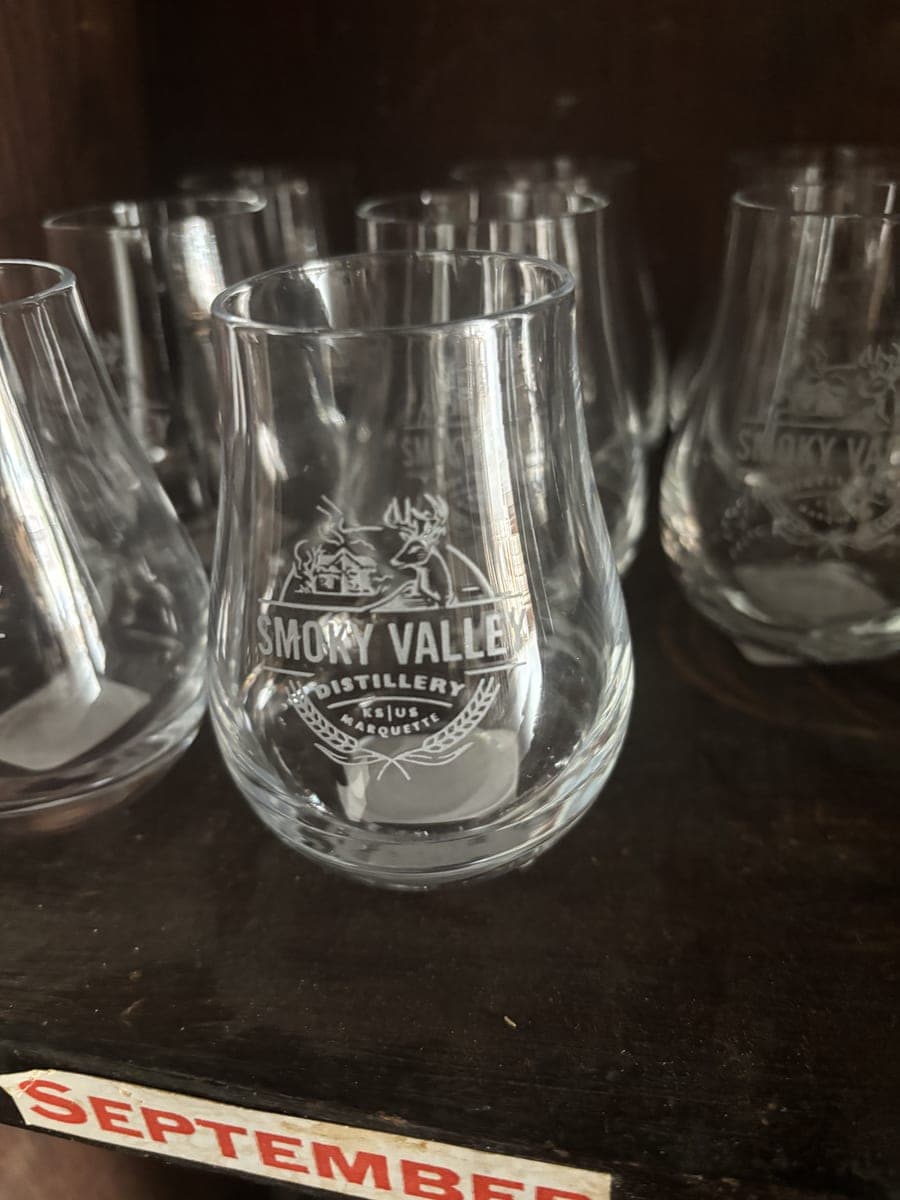
Logo Tasting Glass
$16.95A tulip-shaped nosing glass etched with the Smoky Valley Distillery crest — shaped to concentrate aroma for tasting our bourbon and whiskey neat.
View in the shop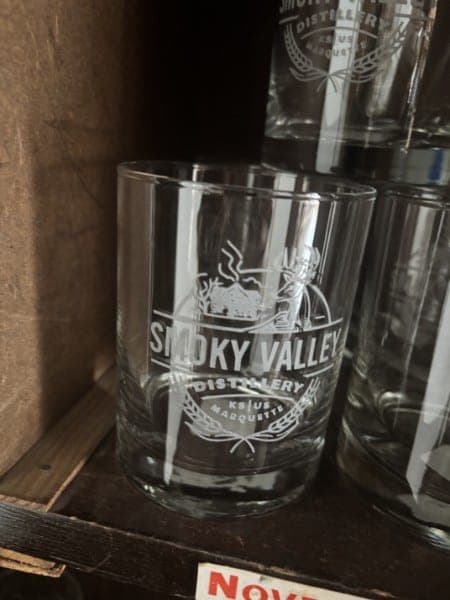
Old Fashioned Glass
$19.95A heavy-bottomed rocks glass etched with our crest — built for an Old Fashioned, a bourbon on the rocks, or a neat pour.
View in the shopWhich One Should You Buy?
Neither is better. They're answers to different questions.
Choose high rye if you drink Manhattans, want a bourbon that holds its own in a cocktail, like a dry finish, or find sweeter bourbons cloying. Rye spice pushes against sweet vermouth rather than adding to it, which is why our High Rye is the bottle we reach for when a Manhattan is the goal.
Choose wheated if you drink bourbon neat, are new to whiskey, or are buying for someone whose taste you don't know. The softer profile is the safer gift. It's also why Bud & Dewey's is our best seller. For an Old Fashioned, pull the sugar back or use honey syrup — the wheat is already doing some of that work.
Buy both if you want to actually learn your own palate. That's the version of this we recommend, and it's why the side-by-side is part of every tour.
The fastest way to settle it is to taste them in the same sitting. A tasting and tour is $10 per person, runs 30 to 45 minutes, and is available Thursday through Saturday by appointment — we'll pour the full bourbon lineup and you can decide where your palate lands. If you already know which one you want, where to buy lists our Marquette tasting room and 16 retail partners across Kansas.