
Two Labels That Sound Official — Only One Is Literal
Walk down a bourbon aisle and you'll see "single barrel" and "small batch" printed on bottles with equal confidence. They look like a matched pair of quality tiers. They aren't.
One of those terms is completely literal. The other is a marketing description with no fixed meaning at all. Knowing which is which changes how you read a bourbon label — and what you should expect when you actually pour it.
Single barrel means exactly what it says: the whiskey in that bottle came from one barrel, bottled on its own, never mixed with anything else.
Small batch means the distiller combined several barrels before bottling. How many? That's entirely up to them.
What "Single Barrel" Actually Means
A single barrel release is the least-processed way a distillery can bring whiskey to market. A barrel is chosen, dumped, filtered, brought to bottling proof, and put in glass. Nothing from any other barrel goes in.
That has a consequence most people don't think about until they've bought two bottles of the same single barrel product: the expression is finite. A barrel yields what it yields, and because we age in smaller barrels rather than the industry-standard 53-gallon size, our single barrel runs are genuinely short. When those bottles are gone, that whiskey no longer exists. The next barrel we select carries the same name and the same mash bill, but it is not the same whiskey.
This is why single barrel bottles often carry a barrel number or a hand-written bottle count. It isn't decoration. It's telling you which specific barrel you're drinking.
What "Small Batch" Means — And Why Nobody Regulates It
Here's the part that surprises people: there is no federal standard for "small batch."
The rules that govern bourbon are genuinely strict. As laid out in 27 CFR 5.143 and summarized in the TTB's distilled spirits product categories, bourbon must be made in the United States from a mash bill of at least 51% corn, distilled to no more than 160 proof, entered into new charred oak barrels at no more than 125 proof, and bottled at no less than 80 proof. No coloring, no flavoring, no shortcuts. We cover all six requirements in detail in our guide to bourbon vs. whiskey.
What that body of regulation never does is define "small batch." Or "single barrel," for that matter. Neither term appears among the defined categories. They are descriptive language, and the meaning is set by whoever prints the label.
So What Does It Tell You?
In practice, small batch signals intent rather than quantity. A distiller pulling barrels for a small batch release is chasing a target flavor — a consistent house profile that tastes the same this year as it did last year. Blending is the tool that gets them there. One barrel came out oakier than expected, another lighter; combined, they average toward the intended character.
At a large operation, "small batch" might mean two hundred barrels. At a distillery our size, it would mean a very different number. Same two words, wildly different scale. That's not deception — it's just an undefined term doing undefined work.
Why One Barrel Tastes Different From the Next
If the mash bill, the yeast, the distillation cuts, and the fill date are all identical, why doesn't every barrel come out the same?
Two reasons: the wood, and where the barrel sat.
Every barrel is a different tree. Oak staves vary in grain density and in how much wood sugar they hold. Char depth varies slightly from barrel to barrel. That variation gets transferred straight into the whiskey over years of contact.
Storage conditions matter enormously. Aging isn't passive storage — it's driven by temperature. As the warehouse warms, the spirit expands into the wood and pulls out vanillin, caramelized sugars, and tannin. As it cools, it retreats. Barrels that sit warmer, or that catch a wider daily swing, work the wood harder and age faster than barrels a few feet away.
Here in central Kansas, that's not a subtle effect. Our summers run hot and our winters run genuinely cold, and the swing between them does real work on a barrel. It's one of the reasons Kansas whiskey has its own character — the climate is part of the recipe. You can read more about the full process in how bourbon is made.
The Same Mash Bill, Two Different Whiskeys
Put two barrels from the same production run side by side and you'll often find one leaning sweeter and rounder while the other pushes oak and spice. Neither is flawed. They're just two honest outcomes of the same starting point.
A small batch release smooths that difference out. A single barrel release hands it to you undiluted. That's the whole trade.
Our Single Barrel Releases
We bottle three single barrel spirits, and each one shows the concept from a different angle.
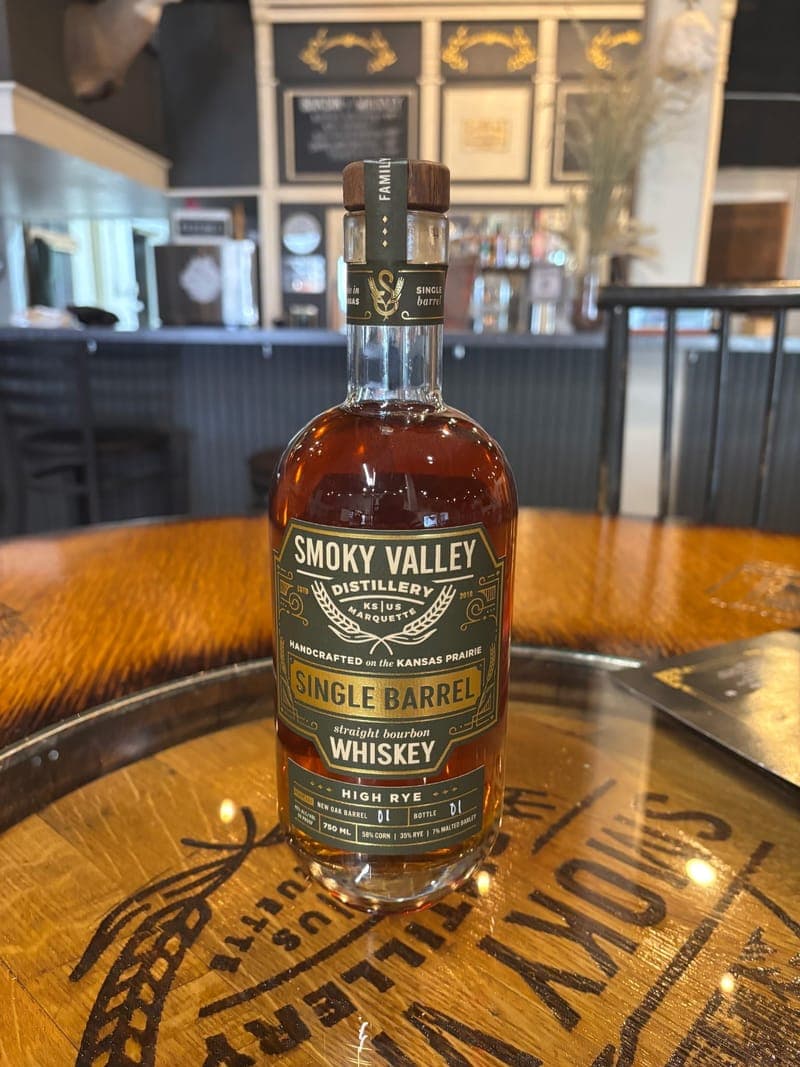
High Rye Single Barrel Bourbon
Our High Rye Single Barrel Bourbon leans hard into rye's contribution. Rye spice and black pepper on the nose, caramel and vanilla underneath, and oak tannins holding the finish together. Because rye is the loudest grain in the bill, barrel-to-barrel variation is especially easy to pick out here — one barrel's pepper is another's dried fruit.
High Wheat Single Barrel Bourbon
The High Wheat Single Barrel Bourbon runs the opposite direction: 58% corn, 37% wheat, 5% malt, bottled at 45% ABV. Wheat is a softer grain than rye, so the profile turns toward toasted grain, honey, and butterscotch, with a round mouthfeel and a clean fade. If you want to understand what the wheat is doing, our post on wheated bourbon breaks down the mash bill difference.
Rye Single Barrel Whiskey
Our Rye Single Barrel Whiskey isn't a bourbon — at 82% rye, 12% corn, and 6% malted barley, it's well past the corn threshold bourbon requires. It's bold and spice-driven, with butterscotch and a subtle coffee note running underneath, bottled at 45% ABV.
It was named Best of Kansas at the 2025 Heartland Whiskey Competition, presented by Kansas Corn. That award went to a single barrel — which is a good illustration of the format's appeal and its limitation at the same time. A specific barrel earned it.
How to Taste a Single Barrel
Single barrel whiskey rewards attention, and it's worth pouring deliberately.
Start with about an ounce in a glass that narrows at the top — a Glencairn if you have one, a small wine glass if you don't. The taper concentrates aroma where you can reach it.
Nose it first with your mouth slightly open, which keeps the alcohol from overwhelming everything else. Take a small sip and let it coat your tongue before swallowing. The first sip mostly calibrates your palate; the second is the one that actually tells you something.
Then try a few drops of water. On a 90-proof single barrel this can open up aromas that were sitting underneath the alcohol. Add it a drop at a time — you can always add more, and you can't take it back.
If you're comparing across barrels or bottles, keep pours modest and keep track. For reference on what constitutes a standard serving, the NIAAA's standard drink guidance puts a serving of 80-proof spirits at 1.5 ounces.
Which Should You Buy?
If you've found a bourbon you love and you want that same experience every time, small batch is built for you. Consistency is the entire point of blending.
If you'd rather taste something that exists in a couple hundred bottles and then never again, single barrel is the more interesting purchase. You're getting one barrel's specific personality, including the parts a blender would have averaged away.
Our honest suggestion: taste them next to each other before deciding. Compare a single barrel against Bud & Dewey's, our wheated best seller, and the difference in approach becomes obvious in about thirty seconds. Both are good whiskey. They're built to do different jobs.
Single barrels also make excellent cocktails when the barrel has character to spare — a high rye single barrel in an Old Fashioned or a Manhattan brings spice that a softer bourbon can't.
Come Taste the Difference
The fastest way to understand any of this is to have the barrels in front of you. Our tasting room in Marquette is open Thursday through Saturday, and a guided tasting runs $10 per person — we'll pour our single barrels alongside the rest of the bourbon lineup so you can find the difference yourself.
Bring a friend who insists they can't tell bourbons apart. They'll change their mind.