
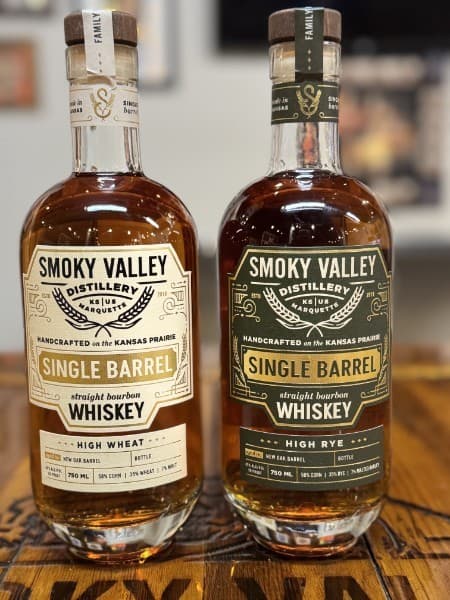
Somebody at the counter holds up a photo of a bottle they are thinking about buying and asks which one is better: the cask strength or the barrel proof. It is a fair question, asked the way the shelf presents it — two different phrases, two different prices, surely two different things.
They are the same thing. Not approximately, not in practice — the same, in the same sentence of the same federal regulation. And while everyone is busy comparing those two phrases, there is a third one that does mean something different, and almost nobody asks about it.
The Short Answer
Under US law, barrel proof and cask strength are one restricted statement with two spellings. The rule is 27 CFR 5.87, and its first paragraph reads:
The term "barrel proof" or "cask strength" may be used to refer to distilled spirits stored in wood barrels only when the bottling proof is not more than two degrees lower than the proof of the spirits when the spirits are dumped from the barrels.
One sentence, both phrases, one condition. Neither term implies a different method, a different strength, or a different standard of care.
What they tell you is simple: no water was added after the barrel was emptied. The whiskey went from wood to glass at whatever strength the wood left it.
The reason you see one word on a Scotch and the other on a bourbon is dialect, not law. Cask is the British and Scottish word for the vessel; barrel is the American one. A Speyside distillery writes cask strength because that is what the thing in its warehouse is called. We would write barrel proof for the same reason.
What the Two-Degree Window Actually Buys You
The rule is not "identical to the barrel." It is "not more than two degrees lower," and that gap is worth understanding because it is the difference between a legal term and a marketing one.
Two degrees of proof is one percentage point of alcohol by volume. On top of that, § 5.65(c) allows a labeling tolerance of plus or minus 0.3 percentage points between the stated strength and the actual strength — the same tolerance that applies to every bottle on every shelf, which we go through in how to read a whiskey label.
Stack those and the honest read on a barrel proof label is this: the liquid is within about one and a third percentage points of what was in the barrel, on the low side only. Nobody is adding alcohol. The number cannot drift upward.
That is a tight window, and it is why the phrase is worth something. Compare it to small batch or reserve, which have no definition at all and no agency checking them. Barrel proof is in the opposite pile — a phrase most people assume is marketing copy, which is in fact a statement TTB will hold a bottler to.
The Term That Really Is Different
Here is the one that gets skipped. Paragraph (b) of the same section covers a separate family of phrases:
The term "original proof," "original barrel proof," "original cask strength," or "entry proof" may be used only if the distilled spirits were stored in wooden barrels and the proof of the spirits entered into the barrel and the proof of the bottled spirits are the same.
Read those two paragraphs next to each other and the structure comes clear. Barrel proof looks at the whiskey coming out. Original barrel proof looks at the whiskey going in. They measure opposite ends of the aging process, and adding the word original does not intensify the first claim — it replaces it with a different one.
It is also a much harder claim to earn. A barrel that spent years breathing has almost certainly moved off its entry number in one direction or the other, so matching entry proof at bottling usually means the bottler proofed the whiskey back down to where it started. Which, note, is the opposite of what a reader reaching for original barrel proof probably thinks they are buying.
| Phrase | Regulation | What it compares | What it tells you |
|---|---|---|---|
| Barrel proof, cask strength | § 5.87(a) | Bottle vs. the dump | No water added after the barrel, within two degrees |
| Original proof, original barrel proof, original cask strength, entry proof | § 5.87(b) | Bottle vs. the fill | Bottling proof equals barrel entry proof |
Two phrases that differ by one adjective, pointing at two different events, years apart.
Why the Number Moves From Barrel to Barrel
A barrel proof release cannot have a fixed proof the way a 90-proof bourbon does, because the strength inside a barrel is not stable. Oak is porous. Both water and ethanol work their way out through the staves over years, and which one leaves faster depends on the air outside the wood — the mechanism we cover in what the angel's share is.
In dry air, water leaves faster than alcohol and the proof in the barrel climbs. In cool, damp air, alcohol keeps going while water loss slows, and the strength falls.
That gives barrel proof an arithmetic you can check yourself. Under 27 CFR 5.143, bourbon, rye, wheat, and malt whiskey must enter the barrel at 125 proof or less. So any barrel proof bourbon on a shelf above 125 proof did not get there by filling hot — it is not legally allowed to. It gained that strength in a warehouse, out of the wood, over years of dry Kentucky or Kansas summers.
At the other end, the same regulation sets the floor: anything sold as whisky must be bottled at not less than 80 proof. A barrel that drifted below that is not a barrel proof release, it is a problem.
Barrel size changes how fast all of this happens. Our barrels hold ten gallons rather than the industry-standard fifty-three, which means proportionally more wood surface per gallon of spirit and a faster exchange in both directions — the whole subject of small barrel aging, and part of why a two-year whiskey here drinks like a four-and-a-half-year whiskey somewhere else.
Barrel Proof Is Not Single Barrel
Two phrases with the word barrel in them, describing completely different decisions:
- Barrel proof is about strength. No water after the dump.
- Single barrel is about sourcing. Every bottle in the release came out of one barrel instead of a blend.
A whiskey can be one, the other, both, or neither. A good number of famous barrel proof bourbons are batches of dozens of barrels dumped together — which is exactly why they carry batch codes, since each batch lands on its own number. And a single barrel bottling is frequently proofed down to a tidy 90 or 100 before it goes in the bottle. Ours are: the High Wheat Single Barrel and the Rye Single Barrel are both single barrel and both proofed down.
Which of those words a producer has to earn, and which one anybody can print, is the whole argument in single barrel vs. small batch bourbon.
Cask, Barrel, and the Two Rulebooks
The dialect split has a legal wrinkle behind it that is worth a minute, because it runs the same direction as the rest of the US-versus-Scotland comparison in bourbon vs. Scotch.
The Scotch Whisky Regulations 2009 are detailed about a great many things. Regulation 3 defines the categories and sets the 40% ABV minimum; regulation 12 governs maturation, age, and distillation statements. Cask strength is not among them — the phrase has no provision of its own anywhere in those regulations. In its home country, it is ordinary trade language.
In the United States it is a restricted statement with a number attached. And because part 5 binds importers as well as distillers — the labeling requirement applies to anyone who sells, ships, or removes spirits from customs custody — a Scotch bottled for the American market is held to the same two-degree window on its US label as a bourbon from Kansas.
So the regulation that polices the phrase cask strength most tightly is not British. It is ours.
How to Drink One
A barrel proof pour is not a stunt, but it does ask for a different approach than a 90-proof whiskey, and the reason is physical rather than macho.
A 2017 molecular-simulation study in Scientific Reports, Dilution of whisky – the molecular perspective, modeled where guaiacol — one of the compounds responsible for smoky, woody aroma — actually sits in a water-ethanol mixture. It was found mostly at the liquid-air interface in mixtures up to about 45% ethanol by volume, and was increasingly pulled down into the bulk of the liquid at 59% and above. Most barrel proof whiskey lives in that upper band. Which means the aroma is not missing from a strong pour; it is sitting lower in the glass, under an ethanol burn that is also numbing the palate you were going to use on it.
Hence the method: taste it neat first, then add water, then taste it again. The second pour tells you what the first one was hiding.
How much water is simple arithmetic. For a 1.5 oz pour of a 124-proof whiskey:
| To land near | Add | In practical terms |
|---|---|---|
| 100 proof (50% ABV) | 0.36 oz | About two teaspoons |
| 90 proof (45% ABV) | 0.57 oz | A shade over half an ounce |
| 80 proof (40% ABV) | 0.83 oz | About five teaspoons |
Add it a few drops at a time rather than all at once — you cannot take it back out, and the interesting point is usually somewhere before the number you were aiming at. The full flight method, including pour order and what to write down, is in how to taste whiskey.
Keep an eye on the pour size too. The NIAAA counts 0.6 fl oz of pure alcohol as one standard drink, so 1.5 oz at 62% ABV is about one and a half standard drinks in a glass that looks identical to a single. The glass itself matters more here than anywhere else, because a tulip-shaped nosing glass collects what a tumbler lets off the top:
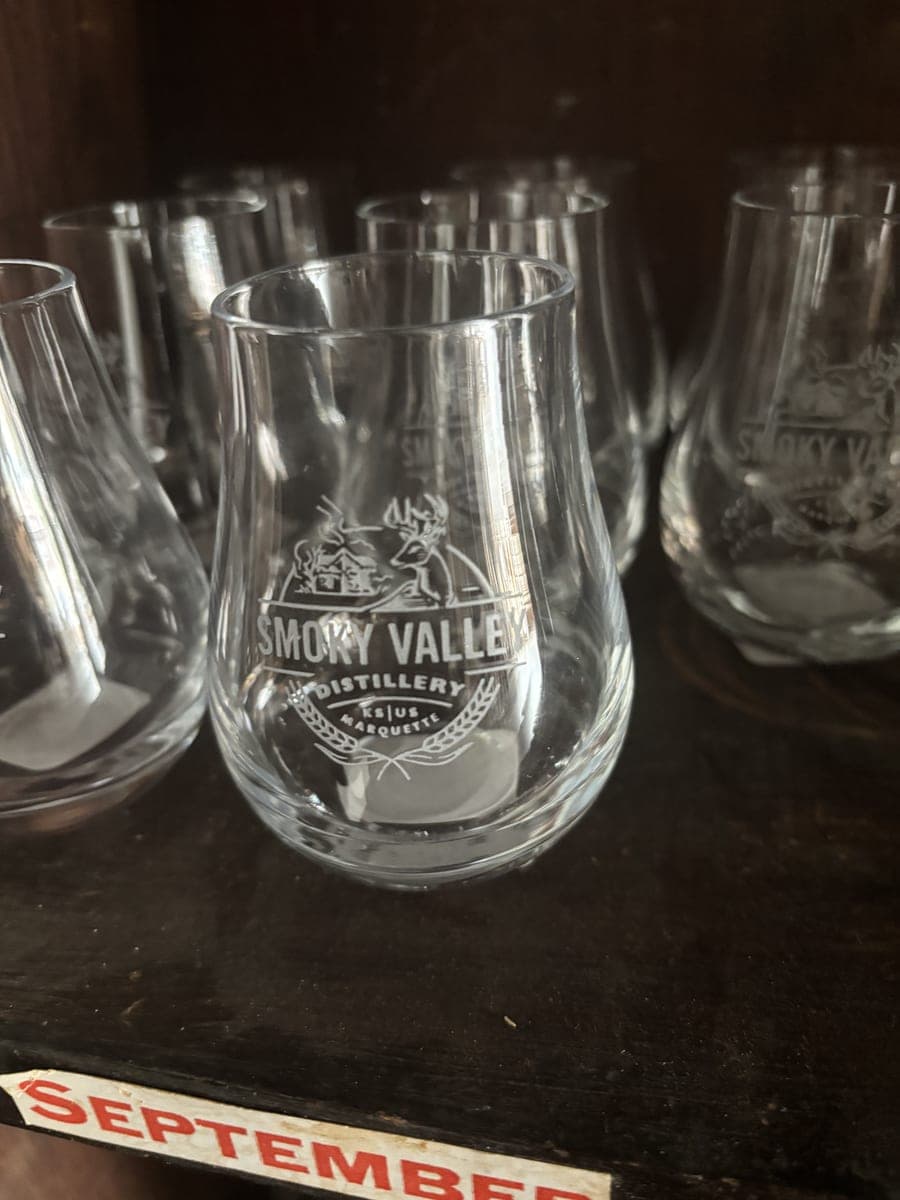
Logo Tasting Glass
$16.95A tulip-shaped nosing glass etched with the Smoky Valley Distillery crest — shaped to concentrate aroma for tasting our bourbon and whiskey neat.
View in the shop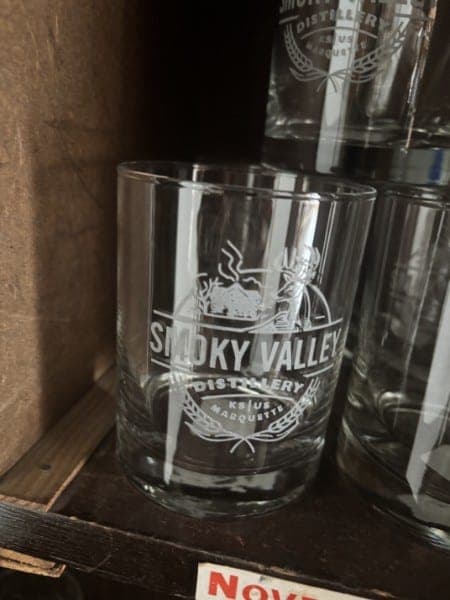
Old Fashioned Glass
$19.95A heavy-bottomed rocks glass etched with our crest — built for an Old Fashioned, a bourbon on the rocks, or a neat pour.
View in the shopMore on which shape does what, and why, is in the whiskey glassware guide.
Why Nothing on Our Shelf Says Barrel Proof
Everything we bottle is proofed down, and we would rather explain that than dress it up.
Our whiskey comes off a 250-gallon copper pot still in the old COOP building and goes into 10-gallon charred new oak. Cutting it to bottling strength is done with the same sandstone-filtered water from the Kiowa Aquifer that we mash with — the water is a Marquette ingredient, not a diluent of convenience, and our process walks the whole sequence. The Straight Bourbon, Smoked Straight Bourbon, Bud & Dewey's, and Kernza Whiskey all land at 45% ABV, 90 proof, on purpose.
There is a practical side to that at our scale. A ten-gallon barrel does not hold many bottles, and every barrel comes out of the rickhouse on its own number — which is precisely what makes a barrel proof program a per-barrel exercise rather than a product line. A distillery choosing a proof and hitting it batch after batch is making a different promise than one bottling whatever each barrel happened to land on, and both are honest.
What we publish instead are the four things that tell you what is actually in the bottle: the mash bill, the proof, the barrel, and the time. If you want to know where a particular barrel of ours is sitting right now, ask on a tour. That is a conversation with the person who filled it.
The Ten-Second Label Check
- See barrel proof or cask strength? Same claim. No water after the dump, within two degrees.
- See the word original in front of either? Different claim entirely — that one is about entry proof, not the dump.
- Over 125 proof on a bourbon? The warehouse put it there. Dry air, years of it.
- No proof number on the front at all? Then it is not a barrel proof bottling, whatever else the label says, because the number is the whole point and it changes every time.
- Also says single barrel? That is a separate fact about sourcing. Neither word implies the other.
Nothing on that list requires trusting anybody. All five are checkable against the bottle in your hand, which is the useful thing about the terms federal law actually defines.
Taste the Difference Proof Makes
The fastest way to understand what strength does to a whiskey is to taste the same spirit at two of them, side by side, and notice how much of the difference is aroma rather than heat.
A tasting and tour in Marquette runs $10 per person, takes 30 to 45 minutes, and is available Thursday through Saturday by appointment at 105 N. Washington. We pour the whiskey and bourbon lineups in a deliberate order, in front of the still they came off, and we will tell you exactly what each one was proofed to and why. If you would rather set the comparison up at home, our bottles are stocked at retail locations across Kansas.