
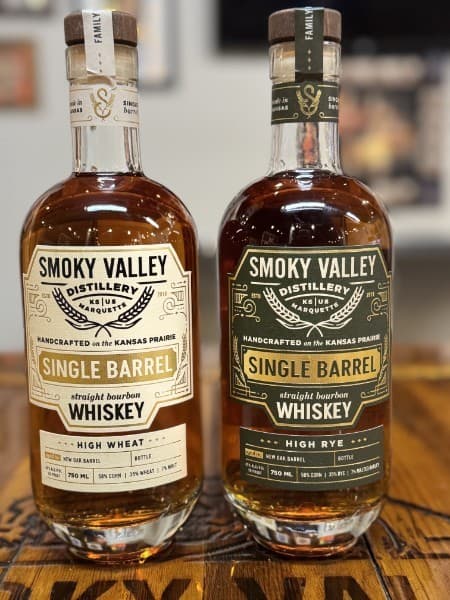
Two Kinds of Words on Every Bottle
Pick up any bottle of American whiskey and you're looking at two categories of text that appear identical and are not remotely the same.
Some of it is there because the federal government requires it, in an exact form, verified before the bottle could legally be sold. The rest is there because somebody in marketing liked how it sounded.
The trick to buying whiskey well is telling those two apart on sight. It takes about five seconds once you know where to look, and it will save you from a lot of expensive bottles that say very little.
What Federal Law Actually Requires
Distilled spirits labeling in the United States runs on 27 CFR Part 5, administered by the Alcohol and Tobacco Tax and Trade Bureau. The mandatory items live in § 5.63:
| What's required | Where it must appear | Regulation |
|---|---|---|
| Brand name | Same field of vision as the other two | § 5.64 |
| Class and type designation | Same field of vision | subpart I |
| Alcohol content | Same field of vision | § 5.65 |
| Name and address of the bottler or distiller | Anywhere on the container | § 5.66 |
| Net contents | Anywhere on the container | § 5.70 |
| Age statement, when required | Anywhere on the container | § 5.74 |
Plus conditional disclosures — added coloring, wood treatment, the state of distillation for certain American whiskeys, sulfites above 10 parts per million — and the Government Warning, which comes from a different rulebook entirely.
"Same field of vision" is the phrase doing the quiet work there. It means you cannot read the brand name without also being able to read what the product is and how strong it is, without turning the bottle. That's deliberate.
1. The Class and Type Designation Is the Whole Ballgame
If you read only one thing on a label, read this one.
The class and type designation is the plain category name: bourbon whiskey, rye whiskey, straight bourbon whiskey, blended whiskey. It isn't decorative. Each of those names is defined in 27 CFR 5.143 with hard numbers attached — grain percentages, distillation proof ceilings, barrel entry proof, what kind of barrel, and whether anything may be added.
Bourbon whiskey requires a mash of not less than 51% corn, distillation at 160 proof or less, and entry into charred new oak barrels at 125 proof or less. A distiller who misses any of those cannot print the word. Our guide to what a mash bill is walks through how those grain percentages shape what you taste.
So when a bottle's biggest, prettiest word is something like Reserve or Small Batch and you have to hunt around the label for the actual category, that's information. The category is the part somebody checked.
2. "Straight" Is a Claim, Not an Adjective
Straight looks like filler and isn't. Under § 5.143, straight whiskey must be:
- distilled at 160 proof or less
- stored in charred new oak barrels at 125 proof or less
- aged a minimum of two years
- made without harmless coloring, flavoring, or blending materials
That last line is the one people miss. Non-straight whiskeys in some categories may legally contain small amounts of added coloring and flavoring. Straight whiskey may not. When our Straight Bourbon says straight, it's a statement about what is not in the bottle as much as what is.
Bottled in bond is the other genuinely strict one. 27 CFR 5.88 requires the spirit to come from one distiller, at one plant, in one distilling season, aged at least four years in wood, reduced with nothing but pure water, and bottled at exactly 50% alcohol by volume — 100 proof. Domestic bottles must also print the distillery name and plant number. It's the closest thing American whiskey has to a guarantee of origin, and we take all six conditions apart in what bottled in bond means.
3. Alcohol Content, and the Fraction Nobody Mentions
§ 5.65 fixes the format: Alcohol __ percent by volume, __ percent alcohol by volume, or Alcohol by volume __ percent. Abbreviations are permitted, which is why almost every bottle reads 45% alc/vol or something close to it. Proof may also appear, but only in the same field of vision as the ABV — proof by itself isn't sufficient.
Here's the part that surprises people. Section 5.65(c) allows a tolerance of plus or minus 0.3 percentage points between the labeled strength and the actual strength. A bottle marked 45% may legitimately test anywhere from 44.7% to 45.3%. That's ordinary production variance, not a defect, and it's why chasing small proof differences between bottlings of the same whiskey is mostly chasing noise. We unpack the number itself in what proof in whiskey means.
4. Age Statements: Mandatory Under Four Years, Optional Above
This one runs backwards from how most people read it.
Under § 5.74, every domestic or foreign whiskey aged less than four years must carry an age statement. Once a whiskey passes four years the statement becomes optional. And when whiskeys of different ages are combined, the stated age must be the age of the youngest whiskey in the bottle — never the average, never the oldest.
Two consequences worth keeping:
- A young whiskey has to tell you it's young. An older one doesn't have to tell you anything.
- No age statement on an established brand usually means four years or more, not "unknown."
Our Straight Bourbon is aged two to four years in oak, which puts it in exactly the range where an age statement isn't optional — and we'd print it either way. Age is also the reason a bottle stops changing the moment it's filled, which we cover in how to store whiskey.
5. "Distilled By" vs. "Bottled By" — Who Actually Made It
The most revealing line on an American whiskey label is the name-and-address statement, and the verb in front of it is what matters.
§ 5.66(b) governs which phrase may be used:
- Distilled by — this company ran the still. It appears with the distiller's own name and address.
- Bottled by — this company filled the bottle. Nothing more is claimed.
- Produced by — a processing operation that changed the class or type of the product.
- Blended by, made by, prepared by, manufactured by — processing terms.
A bottle that says only bottled by was very likely not distilled by the brand on the front. That isn't automatically bad — plenty of good whiskey is sourced and finished thoughtfully — but it's a different thing from a distillery making its own spirit, and the label is obliged to let you tell.
Section 5.66(f) adds a second useful requirement: American whiskey labels must disclose the state of distillation, either inside the "distilled by" address, adjacent to the type ("Kentucky bourbon"), or as a standalone "Distilled in __" line.
Ours is a short answer. Everything we sell is distilled and bottled at our own plant in Marquette, so the name, the address, and the state of distillation come out as the same handful of words. What's in our bourbon lineup came off our still.
6. Net Contents, and the Sizes That Are Legal
Bottle sizes aren't a free choice either. § 5.203 sets the authorized standards of fill, and 750 mL — the size across our shelf — is one of twenty-five permitted metric sizes running from 50 mL up to 3.75 L. The 700 mL and 720 mL sizes common overseas are on that list too, which is why imports in those sizes turn up on American shelves.
If a spirit appears in an odd volume, it's either an authorized size you haven't met or it isn't a distilled spirit under Part 5.
The Government Warning
This one isn't Part 5 at all. It comes from 27 CFR 16.21, and the wording is fixed:
GOVERNMENT WARNING: (1) According to the Surgeon General, women should not drink alcoholic beverages during pregnancy because of the risk of birth defects. (2) Consumption of alcoholic beverages impairs your ability to drive a car or operate machinery, and may cause health problems.
Every bottle carries it, identically. It tells you nothing about the whiskey — but if it's missing, something is wrong with the bottle.
The Words That Mean Nothing
Now the other pile. None of the following has a federal definition, a minimum standard, or any agency checking it:
- small batch
- handcrafted, handmade, artisanal, craft
- reserve, select, private select, special reserve
- barrel select — as distinct from single barrel, which at least describes a real bottling method
- old, fine, premium
- "aged in oak barrels," with no number attached
Every one of those can be printed on any bottle by anyone. Some are entirely honest — we call Bud & Dewey's small batch because we make it in runs as small as 15 gallons in a 250-gallon pot still, and that's simply what happens here. But you have that from us, not from the label. Which terms get audited and which merely get asserted is the whole subject of single barrel vs. small batch bourbon.
One more that trips people up: whiskey and whisky on the front label mean nothing different. Federal law permits either spelling, which is why it changes from bottle to bottle.
You Can Look the Label Up
Most drinkers don't know this part: label approvals are public.
Before a bottle reaches the market, its label needs a Certificate of Label Approval from TTB. Those certificates — and the approved label images — are searchable by anyone through the Public COLA Registry, covering approvals from 1999 to the present, with no account required. If you want to see what a brand actually filed with the government, that's where it lives.
The Five-Second Check
In the store, in order:
- Find the class and type. Bourbon? Rye? Straight? That's the category the government verified.
- Read the verb. Distilled by or bottled by — who made it.
- Check for an age statement. Present means the distiller chose to tell you, or had to.
- Note the ABV, and don't agonize over three tenths of a point.
- Ignore the rest of the front. Reserve, handcrafted, and select are the distiller talking.
Four facts and one thing to skip.
Read Ours in Person
Every bottle on our shelf carries a Marquette, Kansas address, because there's only one place any of it was made. Our Rye Single Barrel Whiskey — Best of Kansas at the 2025 Heartland Whiskey Competition — runs an 82% rye mash bill, and the Kernza Whiskey is made with a perennial wheat grain only one other distillery in the world is working with. Both sit at 45% alc/vol in 750 mL, and both are on the whiskey page.
A tasting and tour is $10 per person, runs 30 to 45 minutes, and is available Thursday through Saturday by appointment. Bring the label questions — we'll hand you the bottle, walk the front and back of it with you, and then pour what's inside. If you'd rather start closer to home, our bottles are stocked at retail locations across Kansas.