
The Short Answer
Whiskey and whisky are the same word for the same thing. Neither is a misspelling.
Which one you see depends on where the bottle came from:
- Whiskey — Ireland and the United States
- Whisky — Scotland, Canada, and Japan
That's the whole rule, and it holds up most of the time. The interesting part is the fraction of the time it doesn't, which includes some of the most recognizable bourbon on the American shelf.
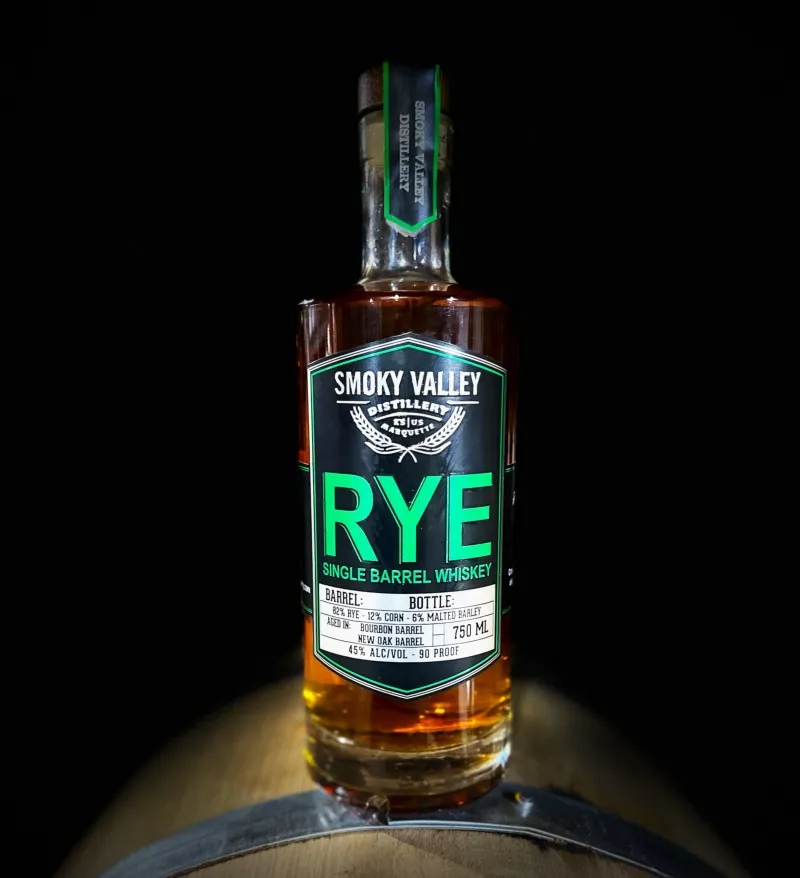
We spell it with the e. Our Rye Single Barrel Whiskey and our Kernza Whiskey both carry it, and so does every page on this site. Here's why — and why the other spelling isn't wrong either.
Where the Word Came From
Before it was whiskey, it was a full phrase in Gaelic.
Uisge beatha — in Irish, uisce beatha — means "water of life," assembled from the Old Irish words for water and for life. That phrase was itself a rendering of the Medieval Latin aqua vitae, a term that had been applied to distilled spirits since the 1300s. Distilling reached Ireland and Scotland with that Latin name attached, and the local languages put it into their own words.
English speakers then did what English speakers do to long foreign phrases: they wore it down. Uisge beatha became usquebaugh, usquebaugh became whiskie by about 1715, and whiskie settled into whisky.
Notice the shape of that history. The original English spelling had no e. The Online Etymology Dictionary dates the spelling split — Scotch whisky against Irish and American whiskey — to the nineteenth century, not to anything ancient. For the first hundred years the word was in English, everybody spelled it the same way.
Why the Split Happened
The extra letter arrived as a marketing decision.
Through most of the 1800s, Irish distillers held the premium end of the export market while column-still Scotch was moving in volume at lower prices. Dublin's distillers wanted daylight between their pot-still product and the blends coming out of Scotland, and adding an e to the word on the label was a cheap, permanent way to signal "not that."
The United States inherited the Irish spelling the same way it inherited a great deal else — through immigration. Irish and Scots-Irish distillers made up a large share of the people setting up stills in Pennsylvania, Maryland, and Kentucky, and the spelling they brought with them stuck.
Canada and Japan, meanwhile, both built their industries in the Scottish image, and both took the Scottish spelling along with the Scottish technique.
So the map isn't arbitrary. It's a record of who learned from whom.
What Each Country Actually Requires
Where the word appears in law, the local spelling is written into the statute:
| Country | Spelling | Where it's fixed |
|---|---|---|
| Scotland | whisky | The Scotch Whisky Regulations 2009 define and protect "Scotch Whisky" — distilled and matured in Scotland, at least three years in oak casks of 700 liters or less, bottled at 40% ABV minimum |
| Ireland | whiskey | "Irish Whiskey" is a protected geographical indication with a registered technical file; the Irish Whiskey Act 1980 set the three-year minimum |
| Canada | whisky | The federal Food and Drug Regulations, section B.02.020 govern "Canadian Whisky," with age claims tied to three years in small wood |
| United States | either | 27 CFR 5.143 — see below |
Japan is the outlier on this list. Its spelling is convention rather than statute, and until recently so was almost everything else — which is why the Japan Spirits and Liqueurs Makers Association had to write its own Standards for Labeling Japanese Whisky in February 2021, effective that April. Those are voluntary industry rules agreed among members, not law, adopted because consumers had no reliable way to tell Japanese-made whisky from imported spirit bottled in Japan.
The Part Almost Nobody Knows: US Law Says "Whisky"
Here's the wrinkle. American producers overwhelmingly print whiskey, but the federal government does not.
Open the standards of identity at 27 CFR 5.143. The section is titled "Whisky." No e. The definition reads: "'Whisky' or 'whiskey' is distilled spirits that is an alcoholic distillate from a fermented mash of any grain distilled at less than 95 percent alcohol by volume (190° proof) having the taste, aroma, and characteristics generally attributed to whisky, stored in oak barrels..."
And the labeling paragraph settles the question outright: "The word whisky may be spelled as either 'whisky' or 'whiskey.'"
That one sentence is why both spellings sit on American shelves without anyone hearing from the TTB. If you've read our pages on what proof means or what a mash bill is, you've already seen us switch to the no-e spelling mid-paragraph. That's us quoting the regulation as written — and now you know why it looks that way.
That same section is where every category on our shelf gets its name. Bourbon, rye, wheat, and malt whiskey are each defined there by grain recipe, which is a far more consequential distinction than a vowel.
The American Brands That Drop the E
Because the law permits it, several well-known American bottles use the Scottish spelling:
- Maker's Mark — Kentucky Straight Bourbon Whisky. The Samuels family chose the spelling as a nod to their Scottish-Irish ancestry, and the brand has kept it since the 1950s.
- George Dickel — Tennessee Whisky, spelled that way from the beginning as a claim of kinship with Scotch quality.
- Old Forester — Kentucky Straight Bourbon Whisky, from a brand that has been on the market continuously since 1870.
None of these are Scotch. None are made in a Scottish style. They're bourbon and Tennessee whiskey, made to American standards, wearing a spelling their founders liked. It's a useful reminder that the letters on the front of a bottle are branding, and the words that actually constrain the liquid — straight, bottled in bond, single barrel, the stated age — are the ones worth reading closely.
Whiskeys or Whiskies?
The plural follows the singular. That's the entire rule.
- whiskey → whiskeys
- whisky → whiskies
So: "we make two whiskeys and four bourbons," but "the back bar held a row of Japanese whiskies." When you're writing about the category in general and both kinds are in play, American style guides default to whiskeys, and there's no graceful way to cover both at once. Whiskys is the one form nobody uses.
Does the Spelling Tell You Anything Useful?
Almost nothing about the liquid, and quite a lot about the paperwork.
An e on the label doesn't indicate the grain, the still type, the age, the proof, or the quality. A pot-still Irish whiskey and a column-still American whiskey share a spelling and share very little else. A Scotch single malt and a Canadian blend share a spelling and sit further apart still.
What the spelling usually does tell you is which country's rulebook the bottle was made under — and that matters, because the rulebooks differ sharply on aging minimums, permitted additives, and what may be blended in. If you want to know what's in the bottle, read the category name and the age statement instead. Our guide to how to taste whiskey covers what to do once the pour is in the glass, and bourbon vs. whiskey sorts out the category names that genuinely change what you're drinking.
Why We Use the E
We're an American distillery in central Kansas, run by an American family, making spirits under American standards of identity. The e is the convention here, and we don't have a Scottish grandmother to argue otherwise.
There's a practical reason too. Our whiskeys are unusual enough already. The Kernza Whiskey is made with a perennial wheat grain that only one other distillery in the world is working with, and the Rye Single Barrel runs an 82% rye mash bill that took Best of Kansas at the 2025 Heartland Whiskey Competition. When the spirit inside is already the unfamiliar part, there's no reason to make the word on the label do extra work.
Both bottles sit at 45% alc/vol. Both are on the whiskey page, and both get poured in the tasting room.
Come Taste the Difference That Isn't a Spelling
If you want to understand what actually separates one whiskey from another, a vowel is the wrong place to look. Grain, still, barrel, and time are where it happens.
A tasting and tour in Marquette is $10 per person, runs 30 to 45 minutes, and is available Thursday through Saturday by appointment. We'll walk you past the still and pour the rye and the Kernza back to back, so you can taste an 82% rye mash bill against a perennial wheat one — a difference you can find in the glass, which is more than the e ever managed. Our bottles are also stocked at retail locations across Kansas.