
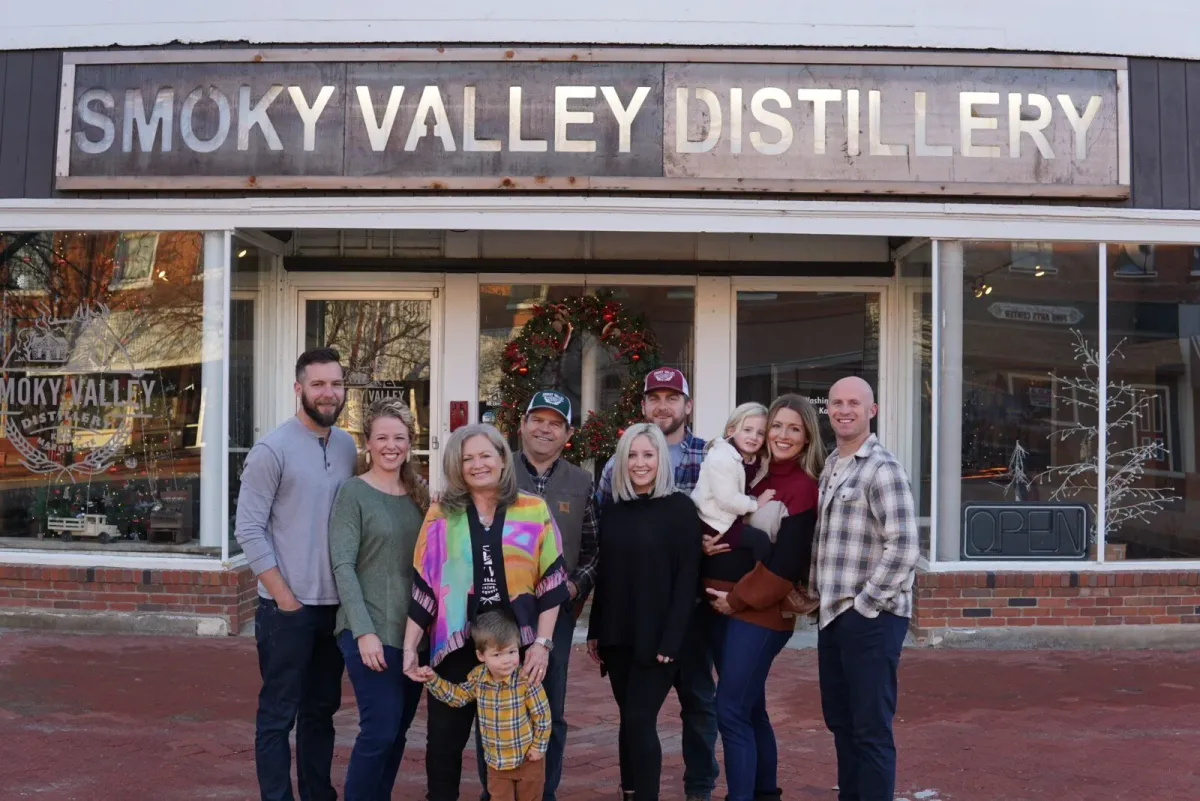
Most weeks somebody standing at our counter in Marquette asks a question that is not really about whiskey. Can I buy this on a Sunday? Can you mail one to my brother in St. Louis? Can my kid come on the tour? Is it legal to put this in the back seat?
Those are fair questions, and the honest answer to most of them is "it depends on where you are standing." Kansas regulates alcohol with a statewide ceiling and a local floor, and the result is a set of rules that changes shape across county lines and license types. Here is the practical version — the questions travelers actually ask us, with the statute behind each one so you can check our work.
Two notes before we start. We are distillers, not lawyers, and nothing below is legal advice. And every figure here comes from the Kansas statutes or the Division of Alcoholic Beverage Control's own published handbooks, which are linked throughout.
The Short Version
If you remember five things from this page, remember these.
- Spirits come from liquor stores and producers, not grocery stores. A Kansas grocery or convenience store can sell you beer up to 6% ABV and nothing stronger.
- Sunday depends on your city or county. A retail liquor store may be closed Sunday or open 9 a.m. to 8 p.m. A Kansas distillery may legally sell sealed bottles to go any day of the week.
- A tasting pour is half an ounce, by statutory definition.
- No Kansas distillery can ship you a bottle. The state's direct shipment law covers wine only.
- An opened bottle rides in the trunk. Sealed ones can ride anywhere.
Who Is Even Allowed to Sell You a Bottle
The first thing that surprises out-of-state visitors is how narrow the Kansas retail map is for spirits.
A retail liquor store is the general-purpose answer: packaged liquor, wine, and beer, to go. Our spirits sit on the shelves of 16 Kansas retailers under exactly that license.
A cereal malt beverage retailer is the license the grocery store and the gas station hold, and it is much narrower than people assume. The ABC handbook for CMB retailers is blunt about the ceiling: a CMB retailer may sell cereal malt beverage and, under K.S.A. 41-2702(a), beer containing not more than 6% alcohol by volume. Under K.S.A. 41-2704(g) it may not sell or allow possession of other alcoholic liquor on the premises at all, unless it also carries a drinking establishment, farm winery, or producer license. So no, there is no bourbon aisle at the supermarket here.
A producer — a microdistillery, a microbrewery, a farm winery — can sell what it makes, directly, to you. For us that authority is K.S.A. 41-354(a)(3): a microdistillery may sell its spirits in the original unopened container to consumers for consumption off the licensed premises. The same statute caps us at 50,000 gallons of spirits a year and limits the license to the single location it describes, which is why there is no second Smoky Valley storefront in Salina or Wichita. One building, one license.
If you are trying to work out which of the three you are standing in, distillery vs. brewery vs. winery lays out the federal and state paperwork behind each.
Hours, Sundays, and the Three Closed Holidays
Kansas publishes an actual chart for this — the Department of Revenue's hours and days of sale table — and the key sentence at the top of it is that these are maximum allowable hours. A city or county can impose stricter ones by ordinance or resolution, and some do.
Within that ceiling, the state sorts jurisdictions into two kinds. A basic sales jurisdiction has not expanded retail sales, or expanded and later restricted them. An expanded sales jurisdiction has authorized expanded sales, Sunday among them, and not pulled them back.
| Where you are buying | Monday–Saturday | Sunday |
|---|---|---|
| Retail liquor store, basic jurisdiction | 9 a.m. – 11 p.m. | No sales |
| Retail liquor store, expanded jurisdiction | 9 a.m. – 11 p.m. | 9 a.m. – 8 p.m. |
| Grocery or convenience store (CMB, off-premises) | 6 a.m. – midnight | No sales, or 9 a.m. – 8 p.m. in an expanded jurisdiction |
| Bar, restaurant, or club | 6 a.m. – 2 a.m. | 6 a.m. – 2 a.m. |
Retail liquor stores are closed by law on Easter, Thanksgiving, and Christmas Day. CMB off-premises sales are prohibited on Easter. And a local ordinance can pull a liquor store's closing time back as early as 8 p.m., so a 10:30 p.m. bottle run is a gamble in a town you do not know.
Producers run on a separate clock, and it is the most generous one in the book for bottles to go. Under K.S.A. 41-354(c), a microdistillery may make off-premises sales between 6 a.m. and midnight on any day — Sunday included, no local expansion vote required. That provision came in with the 2018 session, which also moved the start of service at licensed establishments to 6 a.m.
Which produces the odd situation that we are legally allowed to sell you a bottle on a Sunday morning when the liquor store in a basic jurisdiction down the road is not. We do not, as it happens: our doors are open Thursday 10–5, Friday 10–6, and Saturday 10–5, with other times by appointment. The statute is the ceiling. Our hours are the reality, and they are on the visit page along with the map.
Why the Pour Is Half an Ounce
The tasting room is the part of Kansas liquor law most visitors interact with without realizing it.
Two separate privileges are in play, and they are not the same privilege. Under K.S.A. 41-354(a)(4) a microdistillery may serve free samples of its own spirits on the licensed premises — provided the premises sits in a county where drinking establishments may sell liquor by the drink, and provided the samples are served only during the days and hours when clubs and drinking establishments may serve. Per the ABC's microdistillery handbook, those samples have to be withdrawn from inventory without charge. That condition is met here, which is why there is a tasting at the end of the tour.
Selling you a cocktail is a different thing entirely. K.S.A. 41-354 permits on-premises sales only where the licensee also holds a drinking establishment or class B club license on top of the microdistillery license, or a caterer's license for serving off premises. When one Kansas distillery has a full bar and the next one has a tasting counter, that stack of licenses is almost always the difference.
As for the size of the pour: Kansas defines it. Under K.S.A. 41-102(dd), a sample is not more than one-half ounce of distilled spirits, and a sample of a mixed drink is not more than one-half ounce of spirits. The handbook sets no cap on how many samples, but each one is that size.
That is less austere than it sounds once you do the arithmetic. Half an ounce of a 45% whiskey carries roughly the alcohol of four ounces of beer. A five-pour flight is somewhere near a pint of beer in total — the same alcohol, arriving in much smaller glasses, which is exactly the point when the goal is to taste rather than to drink. What proof means has the full conversion, and how to taste whiskey is what to do with half an ounce when you get it.
Wet, Dry, and the County Line
Kansas wrote prohibition into its own constitution decades before the nation tried it, and the architecture of that era is still load-bearing.
Article 15, Section 10 of the Kansas Constitution leaves regulation of intoxicating liquor to the Legislature and preserves local option: a city or county may stay dry, or put legal sales to its voters. The Kansas Legislative Research Department's liquor laws overview sets out the second layer, which catches more travelers than the first. Under the Club and Drinking Establishment Act, a county commission may submit one of three propositions to voters: prohibit the sale of individual drinks; permit drink sales only where an establishment takes 30% of gross receipts from food; or permit them with some share of receipts from food. The ABC Director has to respect whichever answer the county gave when issuing licenses there.
Practically, this is why a Kansas road trip can feel inconsistent. The restaurant in one county pours a cocktail with dinner; thirty miles on, the place with no kitchen cannot pour one at all; and Sunday retail hours vary town by town. If you are routing a trip around tasting rooms, the Kansas distillery guide and our central Kansas weekend itinerary are both built around calling ahead for exactly this reason.
Twenty-One, and Whether the Kids Can Come
Kansas is a 21 state with no wrinkle worth hunting for. K.S.A. 41-727 makes it unlawful for a person under 21 to possess, consume, obtain, purchase, or attempt to purchase alcoholic liquor or cereal malt beverage except as authorized by law. Penalties for 18-to-20-year-olds start at a class C misdemeanor with a $200 minimum fine and include a 30-day license suspension on a first conviction. The one notable exception is narrow: CMB furnished and supervised by a parent or legal guardian.
Whether a child may be present is a different question, and the state's answer is quieter than people expect. The ABC's licensee operations FAQ says no statute or regulation prohibits underage children from being on licensed premises while alcohol is served, and that local ordinances may say otherwise. So the answer at any particular door is a local one.
At ours: families are welcome on the tour. The still, the mash, the barrel room, and the 1919 COOP building are interesting at any age — the grain-to-glass walk in our process is the same walk regardless of who is standing in it — and the tasting at the end is for the adults in the group. Our own staffing sits under K.S.A. 41-354(f), which requires anyone manufacturing, selling, or serving to be at least 18, requires employees under 21 to be supervised by someone 21 or older, and requires anyone mixing or dispensing on the premises to be 21.
What You Will Actually Pay
One line item surprises people at the register. Retail sales of liquor and cereal malt beverage in Kansas carry an 8% liquor enforcement tax under K.S.A. 79-4101, and the ABC's microdistillery handbook confirms it applies to our sales to consumers.
It is not a surcharge invented by the seller and it is not the general sales tax rate. If you are comparing a shelf price in Kansas against one at home, that 8% is part of why the two do not line up.
Getting It Home: the Car, the Mail, and the State Line
In the car. K.S.A. 8-1599 makes it unlawful to transport alcohol in a vehicle on a highway or street unless one of a few conditions holds: the container is the original package with the seal unbroken and the closure in place; or it is in a locked rear trunk, a locked rear compartment, or a locked outside compartment occupants cannot reach while the vehicle is moving; or, in a vehicle with no trunk, it is behind the last upright seat or in an area not normally occupied by driver or passengers. There is a separate allowance for a passenger in a recreational vehicle or bus who has exclusive possession away from the driving compartment. A violation is a misdemeanor punishable by up to a $200 fine, up to six months, or both, and a second conviction generally brings a one-year license suspension.
Translation for a tasting room visitor: sealed bottles are fine anywhere in the car. Anything opened goes in the trunk. If you are staying over, Preston House is two blocks from our door and solves the question outright.
In the mail. There isn't a route. Kansas created a special order shipping license under K.S.A. 41-350 that lets a winery holding a federal basic wine manufacturing permit ship wine it produced directly to a consumer for personal or household use, with an adult signature required at delivery. The statute is written around wine, and no equivalent exists for distilled spirits. So when somebody asks us to mail a bottle of Bud & Dewey's to a cousin, the answer is genuinely no, not a policy. Distillery gift ideas is the workaround list we actually use, and our merchandise does ship, because glassware and caps are not spirits.
Across the state line. Plenty of our visitors drive in from Missouri, and the question comes up constantly. Missouri's quantity rule lives in RSMo 311.410, which addresses transporting intoxicating liquor in quantities exceeding five gallons into the state without the required fee or license. A few bottles for your own shelf is nowhere near that threshold; a trunk full of cases is a different conversation, and one to have with the Missouri Division of Alcohol and Tobacco Control rather than with us. The same goes in the other direction for Oklahoma, Nebraska, and Colorado, each of which writes its own rules.
The Question Behind the Questions
Almost everything on this page traces back to one structural fact: Kansas decided a long time ago that alcohol is a local decision wearing a state uniform. The ceiling is statewide. The floor is wherever you happen to be standing. That is why "it depends on your county" is the correct answer more often than it is a dodge, and why the single most useful thing a traveler can do is call the place before driving two hours to it.
For us the answer is simple enough to put in one paragraph, and it is the one we give over the phone most weeks.
Come See the Rules in Practice
We are a microdistillery at 105 N. Washington in Marquette, Kansas, open Thursday 10–5, Friday 10–6, and Saturday 10–5, with other times by appointment. A tasting and tour is $10 per person, runs 30 to 45 minutes, and ends with half-ounce pours across the lineup — five vodkas, five bourbons, and two whiskeys, all of it off one 250-gallon copper pot still. You can take sealed bottles with you; we cannot mail them; and we are glad to tell you which of the 16 Kansas retailers is closest to home.
Call (469) 496-1458 before you drive. If you are making a weekend of it, things to do in Marquette covers the rest of town and Preston House sleeps eleven two blocks away. Bring the legal questions. They are a better conversation standing next to the still.