
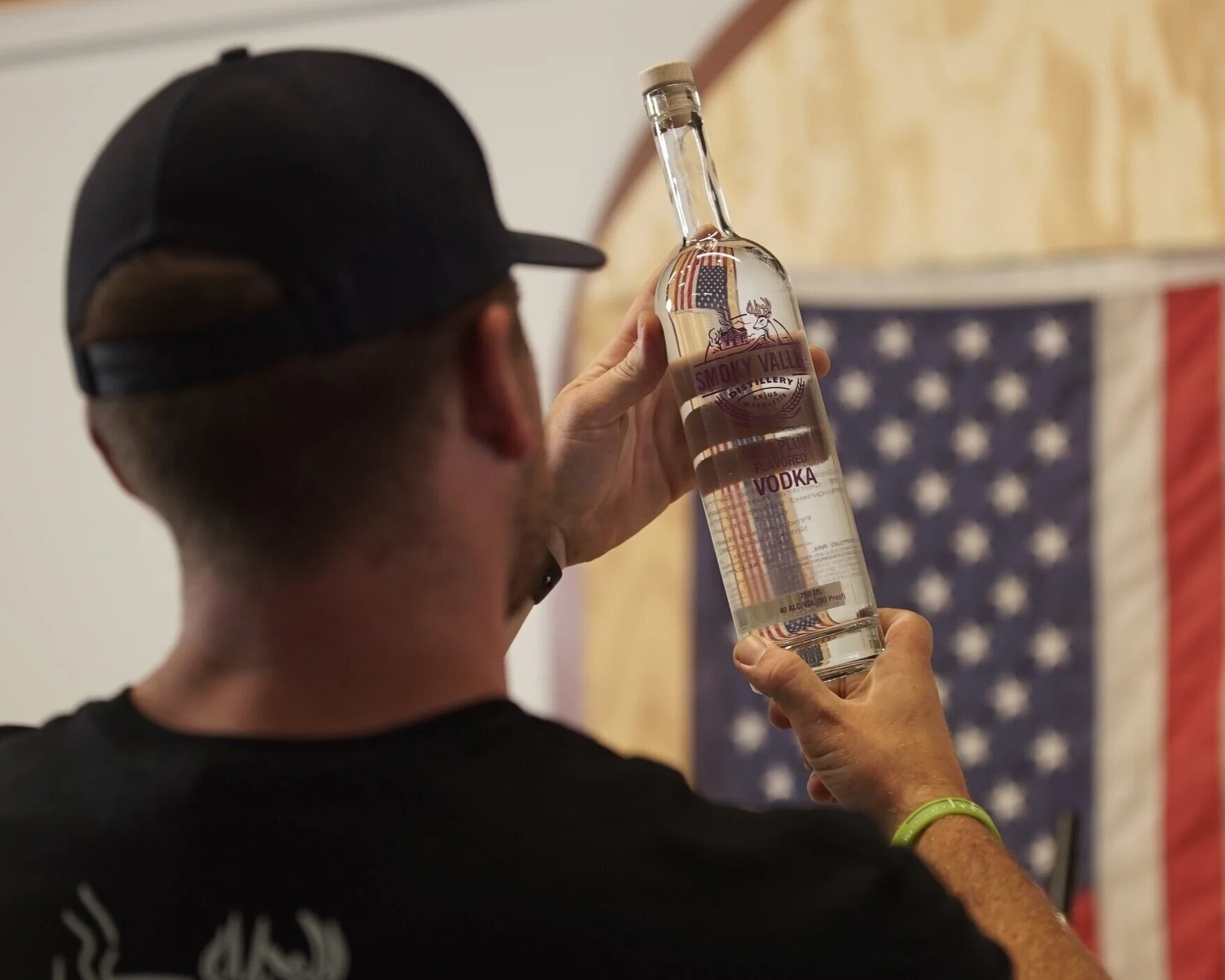
The question comes across the counter most weeks, usually in the first thirty seconds, usually from somebody who just drove in off K-4: so is this like a brewery?
It is a fair question, and the honest answer is that we have more in common with a brewery than most people assume and less in common than the word craft suggests. The distinction between a distillery, a brewery, and a winery comes down to one step in the process. Everything else — the strength of what ends up in the bottle, the federal permit framed on the wall, the tax, and what we are legally allowed to hand you — follows from that one step.
The One-Sentence Answer
All three ferment. Only a distillery separates what fermentation made.
- A brewery converts grain starch into sugar, ferments it, and packages the result.
- A winery ferments the sugar that is already sitting in fruit, and packages the result.
- A distillery ferments, and then runs the fermented liquid through a still to pull the alcohol back out of it.
That is the whole distinction. If you remember nothing else, remember that the still is the dividing line — and that the first half of what we do here would look awfully familiar to a brewer.
One Extra Step, and Everything Downstream
Walk the two processes side by side and they are the same article until the last chapter.
A brewer mills grain, cooks it with hot water so the starches convert to fermentable sugar, cools the liquid, pitches yeast, and waits. So do we. Our mash is Kansas grain and sandstone-filtered water from the Kiowa Aquifer, and up to the end of fermentation how bourbon is made describes a process a brewer would recognize on sight. A winemaker skips the conversion step entirely, because fruit arrives with its sugar already available — crush, ferment, done.
Then the brewer packages and the winemaker ages or bottles, and we go one more room over.
What comes out of our fermenters is a low-strength, cloudy, faintly beery liquid, and it is not the product. It is the raw material. Heating it in our 250-gallon copper pot still and taking off the fraction that boils first is what concentrates the alcohol and leaves most of the water and spent grain behind. Which fraction the distiller keeps is the decision that separates one spirit from another, and it is the subject of pot still vs. column still and, at the extremes, of vodka vs. whiskey — two products from nearly the same mash, separated almost entirely by how high they were distilled.
The law marks the same boundary from the other direction. Under 26 U.S.C. 5041, wine above 24% alcohol by volume stops being taxed as wine and gets taxed as distilled spirits. Fermentation on its own does not reliably reach anywhere near that, which is why the strong stuff needs a still and why the categories sort out as cleanly as they do.
Three Products, Three Rulebooks
Here is where the difference stops being academic. The federal government does not regulate "alcohol." It regulates three distinct industries under three separate bodies of rules, and a producer lives inside whichever one applies.
| Distillery | Brewery | Winery | |
|---|---|---|---|
| Federal operating regulations | 27 CFR part 19 — Distilled Spirits Plants | 27 CFR part 25 — Beer | 27 CFR part 24 — Wine |
| Labeling regulations | 27 CFR part 5 | 27 CFR part 7 | 27 CFR part 4 |
| Federal excise tax statute | 26 U.S.C. 5001 | 26 U.S.C. 5051 | 26 U.S.C. 5041 |
| Taxed per | Proof gallon | 31-gallon barrel | Wine gallon |
A distillery is not a brewery with extra equipment. In federal terms it is a distilled spirits plant — a qualified premises with its own permit, its own bonded storage rules, and its own recordkeeping, which is why the words on our labels are policed by a different part of the code than the words on a beer can. That labeling part is the one we write about most often: it is where how to read a whiskey label and what proof means come from.
A company can hold more than one of these qualifications. It just holds them separately, with separate paperwork for each.
The Tax Is the Part Nobody Sees
This is the single biggest practical difference between the three businesses, and almost no visitor knows it exists.
| Product | Statutory rate | Small-producer rate | Federal excise per container |
|---|---|---|---|
| Distilled spirits | $13.50 per proof gallon | $2.70 on the first 100,000 proof gallons | about 48¢ per 750 mL at 90 proof |
| Wine, 16% ABV or less | $1.07 per wine gallon | credit of $1.00/gal on the first 30,000 gallons | about 1.4¢ per 750 mL |
| Beer | $18 per barrel ($16 on a brewer's first 6 million) | $3.50 per barrel on the first 60,000, for brewers under 2 million | about 1.1¢ per 12 oz |
The per-container column is arithmetic, not a quoted figure: a US gallon is 3,785 mL, so a 750 mL bottle is 0.198 gallons, and at 90 proof that is 0.178 proof gallons — the unit the spirits tax is charged in. Multiply by $2.70 and you get 48 cents. At the full statutory rate the same bottle carries $2.41. A 31-gallon barrel works out to 11.3 cents a gallon at the small-brewer rate, and a 12 oz serving is 0.094 of a gallon.
Now the honest correction, because a forty-to-one headline would be misleading. Per serving, the gap collapses. The spirits rate is charged on alcohol content, and a 750 mL bottle holds about seventeen 1.5 oz pours, so those 48 cents spread out to under three cents a drink against roughly a penny for the beer. Two or three to one — real, and nothing like forty.
What the proof-gallon structure does mean is that a distillery's tax bill scales with strength, and that it comes due on a schedule that has nothing to do with how fast bottles leave the shelf. That is a working-capital problem a brewery does not have in the same shape, and it is one reason small distilleries are rarer on the ground than small breweries.
What Kansas Licenses, Side by Side
The federal government decides what you may make. The state decides what you may do with visitors — and in Kansas the three business types sit under three separate statutes with genuinely different terms.
| Microdistillery | Microbrewery | Farm winery | |
|---|---|---|---|
| Statute | K.S.A. 41-354 | K.S.A. 41-308b | K.S.A. 41-308a |
| Annual production cap | 50,000 gallons of spirits | 100 to 30,000 barrels of domestic beer | 100,000 gallons of wine |
| Free samples on the licensed premises | Yes | Yes | Yes |
| Sealed containers to go, for off-premises | Yes, 6 a.m. to midnight | Yes, 6 a.m. to midnight | Yes, 6 a.m. to midnight |
Two things in that table surprise people.
The first is that all three may hand you a free sample, which is the legal basis for every tasting room in the state, ours included. The second is what the table does not say: on the distillery side, pouring you a cocktail is a separate privilege from pouring you a sample. K.S.A. 41-354 allows on-premises sales only where the licensee also holds a club, drinking establishment, or caterer license, on top of the microdistillery license itself. When one Kansas distillery has a full bar and the one down the road does not, that is usually what you are looking at.
The farm winery statute carries one requirement the other two never have: a minimum share of Kansas-grown product, which stood at 30% and then 15% before that subsection expired at the start of 2023. We use Kansas grain because we want to, including Kernza perennial wheat from The Land Institute up the road in Salina, but no statute has ever required it of us.
One more state rule worth knowing before you plan a gift: Kansas allows direct shipment to consumers for wine only. We cannot mail you a bottle, which we go through in distillery gift ideas, and it is why where to buy matters as much as it does on this site.
What It Means When You Actually Visit One
Strip away the paperwork and the practical differences at the door come down to three things.
The pour size. A taproom sells you a pint because beer is 4 to 6% alcohol. We pour about half an ounce per spirit in a flight, because ours are 40 to 45%. That is not stinginess; it is the same amount of alcohol arriving in a smaller glass, and what proof means has the arithmetic.
The smell of the room. A brewery smells of hot wet grain. A winery at harvest smells of fruit must. A distillery smells of hot wet grain and of the sharp, clean note of ethanol coming off a still, and if you have never smelled the second one you will notice it the moment you walk into our COOP building.
The thing you are looking at. At a winery you are shown tanks and barrels. At a brewery, kettles and fermenters. At a distillery you are shown all of that plus the one machine the other two do not own, and most of a good distillery tour happens standing in front of it. Ours is laid out room by room in our process.
Where We Fit
We are a microdistillery in Marquette, Kansas — a family operation that opened in January 2020, with no other distillery within sixty miles in any direction. Our home is the 16,000-square-foot building erected in 1919 by Tom Collier for the Farmers Union COOP, the largest building in downtown Marquette.
Everything we sell comes off one 250-gallon copper pot still: five vodkas, five bourbons, and two whiskeys, including a Kernza whiskey made from a grain we are one of only two distilleries in the world to be using. The whiskey goes into 10-gallon charred new oak rather than the industry-standard 53-gallon barrel, which is the subject of small barrel aging. Our bourbon and whiskey collections show where each one landed, and the vodka shelf is where the flavored ones live.
What we are not is a brewery or a winery, and the difference is not a matter of scale or ambition. It is that one extra room.
Come Smell the Difference
The fastest way to understand any of this is to stand in it. A tasting and tour is $10 per person, runs 30 to 45 minutes, and is available Thursday through Saturday by appointment at 105 N. Washington in Marquette. We walk you from the grain to the still to the barrels in the order it actually happens, and you taste the lineup at the end.
If you are building a weekend around it, things to do in Marquette covers the rest of the town, and Preston House sleeps eleven two blocks away. Bring the brewery question. It is a better conversation standing next to the still than it is on a page.