

The still is the first thing people look for on a tour, and it is almost never what they pictured. Visitors who have watched a documentary about a big Kentucky house arrive expecting a column four stories tall, running day and night, with catwalks around it. What they find in the old COOP building is a 250-gallon copper pot — a vessel with a neck, not a tower — that gets filled, run, emptied, and cleaned, one batch at a time.
Both are stills. Both do the same physical job: separate alcohol from water using the fact that the two boil at different temperatures. They go about it so differently that the choice between them shapes nearly everything about what ends up in the bottle.
The Short Answer
A pot still is a batch still. You charge it, run it, and shut it down. Each run separates the alcohol from the wash one time, and a great deal of what came out of the grain rides along with it.
A column still is a continuous still. Wash goes in near the top and spirit comes out the other end without the machine ever stopping, and on the way through it is effectively distilled dozens of times over.
That is the whole difference in one line: a pot still separates once and carries the flavor with it; a column separates over and over and leaves the flavor behind.
How a Pot Still Works
Fermented wash — beer, essentially, somewhere around 8 to 10% alcohol — goes into the pot. Heat goes under it. Ethanol boils at 173°F and water at 212°F, so as the charge warms, the vapor coming off it is richer in alcohol than the liquid it left behind.
That vapor rises up the neck, bends through the arm at the top, and reaches a condenser, where it turns back into liquid and runs out as spirit. When the pot has given up what it has, the run is over. The distiller empties it, cleans it, and charges it again.
Three things follow from that design:
- One run is one enrichment step. Starting from an 8% wash, a single pass gets you to roughly 25 or 30 percent. A second pass on the collected low wines lands in the 60 to 75 percent range. If you want higher than that, you run it again.
- The flavor comes with it. Congeners — the esters, acids, and oils the yeast and grain produced during fermentation — have boiling points scattered on both sides of ethanol's. A single separation is a blunt instrument, so plenty of them come across. That is a defect if you are making vodka and the entire point if you are making whiskey.
- The cuts are a judgment call. Early vapor carries harsh volatile compounds (heads), the middle carries the good stuff (hearts), and the tail end turns heavy and oily (tails). Where the distiller moves the collection vessel is a decision made by nose and experience, run by run. Our guide to how bourbon is made walks through the full sequence that surrounds it.
Copper is not decoration, either. It reacts with sulfur compounds produced during fermentation and pulls them out of the vapor stream. A pot still has a lot of copper surface relative to the volume passing over it, which is one more reason the spirit it makes tastes the way it does.
How a Column Still Works
A column still replaces repetition with height.
The design most of the industry still uses was patented by Aeneas Coffey, an Irish excise officer turned distiller, who built on Robert Stein's earlier continuous still — Stein registered patent 5583 in December 1827, and Coffey's patent 5974 was applied for in 1830 and granted on 5 February 1831. Coffey's contribution was a second column, and the pair of them is why the thing works.
Inside each column is a stack of horizontal plates with perforations in them. Steam enters at the bottom of the first column — the analyzer — and rises. Hot wash is fed in at the top and flows down across the plates. Wherever rising steam meets descending liquid, alcohol is stripped out of the liquid and into the vapor. By the time the vapor reaches the top, the wash leaving the bottom is spent.
That vapor passes into the second column, the rectifier, and climbs through more plates. Each plate it passes is, in effect, another distillation: vapor condenses, re-boils, and the portion that moves up is a little richer in alcohol than the portion that falls back. Twenty or thirty plates is twenty or thirty separations in a single pass. The spirit drawn off near the top comes out around 96% alcohol — and it tastes like almost nothing, because everything with a different boiling point got left on a plate somewhere below.
And it never stops. Wash in one end, spirit out the other, for days or weeks at a stretch. That is the other half of the column's appeal: the labor per gallon is a fraction of what a batch still demands.
| Pot still | Column still | |
|---|---|---|
| Operation | Batch — fill, run, empty, clean | Continuous — runs for days without stopping |
| Shape | A vessel with a neck and an arm | A tall column packed with perforated plates |
| Separations per pass | One | One per plate, often 20 to 40 |
| Typical output strength | 60–75% ABV on a second run | Up to about 96% ABV in one pass |
| Effect on flavor | Carries congeners through | Strips them out plate by plate |
| Consistency | Varies run to run | Highly repeatable |
| Where the skill lives | In the cuts, made by hand | In the setup and the draw point |
| Typical products | Single malt Scotch, Irish pot still, cognac, craft whiskey | Vodka, gin base, grain whisky, most volume bourbon |
The Law Names the Proof, Not the Still
Here is the part almost nobody mentions, and it is the real reason the industry sorted itself the way it did.
American spirits regulation says remarkably little about equipment. What it does instead is set the proof — and the proof quietly picks the still for you.
Whiskey has a ceiling. The standards of identity at 27 CFR 5.143 require that bourbon, rye, wheat, malt, and the rest come off the still at 160 proof or less. A pot still lands under that number without trying. A column has to be deliberately restrained to stay beneath it, which is exactly what large Kentucky producers do: a tall beer column run at modest proof, followed by a second pot-shaped vessel called a doubler or a thumper. The ceiling exists to keep grain flavor in the spirit, and what proof in whiskey means covers the four separate points where that number gets set.
Vodka has a floor. Under 27 CFR 5.142, neutral spirits — the class vodka belongs to — must be distilled from any suitable material at or above 95% alcohol by volume, which is 190 proof. That is not a number a single pot run goes anywhere near. Reaching it means a column, a rectifying section, or putting the same spirit through the pot repeatedly until it gets there.
There is a physical wall just past that floor, which is worth knowing about. Ethanol and water form an azeotrope at about 95.6% ethanol by weight, at which point the vapor and the liquid have the same composition and distillation simply stops separating them. No still of any shape gets past it. The federal 190-proof floor for neutral spirits sits just underneath the hardest limit chemistry allows — whoever wrote it knew precisely where the wall was.
And one rulebook does name the equipment. Regulation 3 of the Scotch Whisky Regulations 2009 requires that Single Malt Scotch Whisky be distilled in pot stills at a single distillery. It is the rare case where a government legislated the machine rather than the result — and it is a large part of why malt Scotch tastes the way it does. We read the two rulebooks against each other in bourbon vs. Scotch.
The Third Answer: The Hybrid Still
Ask a craft distiller which kind of still they run and the honest answer is often both.
A hybrid still is a pot with a rectifying column mounted above it and a valve that decides whether the vapor goes through the plates or around them. Bypass the plates and it behaves like a plain pot still. Engage four or six of them and it climbs toward neutral. One vessel, two jobs — which matters enormously when you are buying your first still and a second one is not in the budget.
This is why pot versus column is less a fork in the road than a dial. The question a distillery actually answers every morning is how much rectification this particular spirit wants.
Which One Makes Better Spirit?
Neither, and the question is slightly wrong.
The column still has a reputation problem it did not earn. It gets described as the industrial option, the one that makes faceless spirit at scale. But the column is not a worse machine — it is a more precise one, and the only reason a clean, genuinely neutral vodka exists at all. Nobody gets to 190 proof on craftsmanship.
The pot still's advantage is not purity. It is the opposite: it is bad at removing things, and that failure is the whole product. Everything the grain and the yeast made has a chance of surviving the trip. The grain bill matters more as a result, and what a mash bill is explains why that recipe reads differently on a pot still than it does on a column.
So the real question is what you want in the glass. If the answer is taste the grain, use the pot. If the answer is taste nothing but what I add afterward, use the column.
What Comes Off Ours
Everything we make comes off a single 250-gallon copper pot still in the old COOP building on Washington Street. No column, no plates, no continuous run — a charge, a run, a set of cuts made by nose, and then the whole thing gets cleaned out for the next one.
That constraint shows up all over the lineup:
- The batches are small because the still is. Bud & Dewey's, our best-selling wheated bourbon, is made in runs as small as 15 gallons. There is no economic way to do that on a column.
- The grain survives. Our Straight Bourbon and the 82%-rye Rye Single Barrel Whiskey both lead with cereal character rather than with wood alone, and a pot still is why there is cereal character left to lead with.
- The barrels had to be small too. Pair a low-volume pot still with 10-gallon barrels and the oak moves faster to match — the reasoning behind that is in small-barrel aging.
The vodka side is the honest complication. Federal law puts neutral spirits at 190 proof minimum, and no single pot run reaches it, so any pot-still producer making vodka is getting there through repetition rather than through height. What we will not do is chase proof so hard that the corn disappears entirely, which is the tension described in how vodka is made — our Premium Vodka is 100% Kansas corn, and we would rather you could still tell.
Tasting the Still
You can taste the difference between the two machines without knowing anything about plates. Pour them side by side.
- Start with a neutral vodka, neat, at room temperature. Not ours, not anyone's in particular — just a widely available column-distilled bottle. Note how little there is to find. That absence is the column doing its job perfectly.
- Move to a pot-still whiskey. Our Straight Bourbon at 45% ABV is a fair comparison. The first thing you will notice is that there is something there — grain, bread, sweetness — before the oak even arrives.
- Go back to the vodka. It will read thinner than it did the first time. Your palate recalibrated.
- Add a drop of water to the whiskey and nose it again. More congeners means more to open up. The vodka does not change much, because there is little in it to change.
What you are tasting is not quality. It is how many times the spirit was separated on its way out of the still. A tulip-shaped nosing glass makes the contrast considerably easier to catch than a tumbler does:
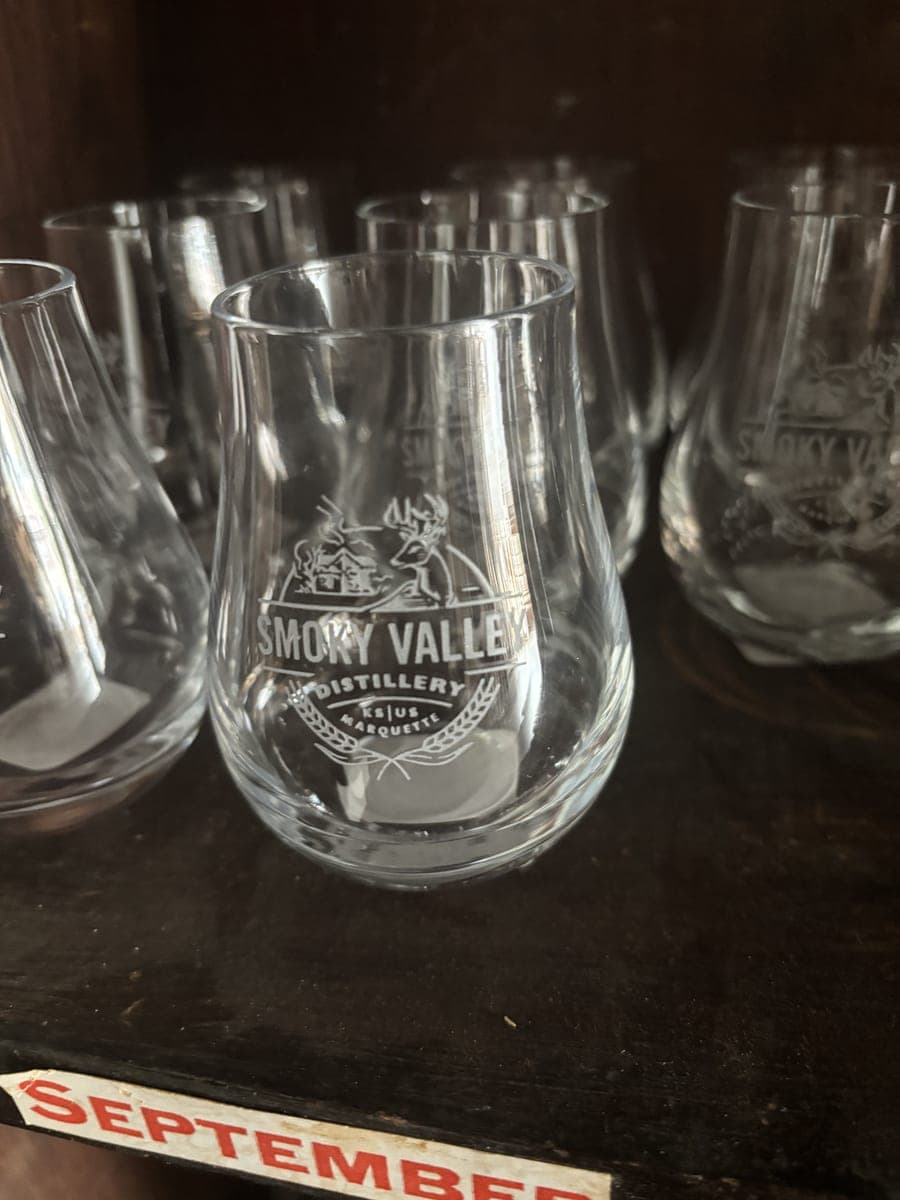
Logo Tasting Glass
$16.95A tulip-shaped nosing glass etched with the Smoky Valley Distillery crest — shaped to concentrate aroma for tasting our bourbon and whiskey neat.
View in the shop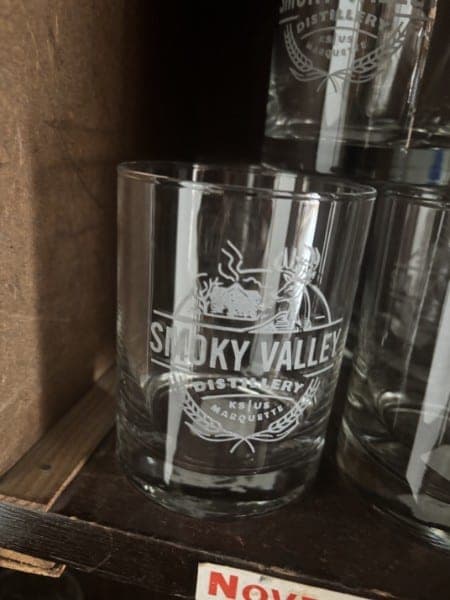
Old Fashioned Glass
$19.95A heavy-bottomed rocks glass etched with our crest — built for an Old Fashioned, a bourbon on the rocks, or a neat pour.
View in the shopThe full method, including the order we pour our own flight, is in how to taste whiskey. And if you want the category map that sits on top of all of this — bourbon, rye, corn, American single malt, and where each one comes from — start with types of American whiskey.
Better still, come see the pot. A tasting and tour runs $10 per person, takes 30 to 45 minutes, and happens Thursday through Saturday by appointment at 105 N. Washington in Marquette. You will get the rest of our process in person, and the full whiskey lineup in a glass, which is a better explanation than any page can manage.