
Five Drinks on This Site End With "a Cocktail Cherry"
The Manhattan, the Old Fashioned, the Whiskey Sour, the Perfect Manhattan, the Kansas Cherry Limeade — every one of them finishes with a cherry, and most recipes anywhere, ours included, just say "cherry" and move on.
That is a real gap, because the jar in the grocery aisle and the jar behind our bar are not two grades of the same food. They are two different products that happen to share a name, and one of them is the cheapest upgrade available to a home bartender. People tell us their Manhattans taste close but not quite right more often over the cherry than over the whiskey.
Here is what is in each jar, how each one got that way, and how to tell them apart in about ten seconds at the shelf.
The Word Used to Mean Exactly One Thing
In 1912, under the Food and Drugs Act of 1906, federal regulators issued Food Inspection Decision 141. It held that the name "maraschino cherries" belonged only to marasca cherries preserved in maraschino — maraschino being a liqueur distilled from the marasca, a small, sour variety of European wild cherry native to the mountains along the Dalmatian coast.
Anything else was an imitation and had to say so. Cherries of the pale Royal Anne type, artificially colored and flavored and packed in sweet syrup, could be sold as "Imitation Maraschino Cherries," or else labeled plainly as preserved cherries, artificially colored and flavored.
Then the American version took over the language. At a 1939 hearing on canned cherry standards, the evidence showed that "maraschino cherries" had simply come to mean, to ordinary shoppers, cherries dyed red and sweetened. In TC-194, dated March 15, 1940, the agency conceded the point.
The current policy, FDA Compliance Policy Guide 550.550, still carries that conclusion in its own words. "Maraschino Cherries" is the common or usual name of:
an article consisting of cherries which have been dyed red, impregnated with sugar and packed in a sugar sirup flavored with oil of bitter almonds or a similar flavor.
Read that again, because it is the whole argument. The federal definition of a maraschino cherry contains no cherry liqueur, no marasca, and an almond flavoring. The imitation won the name outright, and the original is the thing that now needs a qualifier.
How the Bright Red One Is Actually Made
The story you usually hear is that Prohibition killed the boozy version and the dyed one filled the gap. It is tidier than the truth, and the people who worked alongside the man responsible have been saying so for years.
The modern process came out of a land-grant food science department. Ernest H. Wiegand joined what is now Oregon State University in 1919, and cherry growers came to him with a practical problem: Oregon grew beautiful pale Royal Anne cherries — sold as Queen Annes too — and the fruit was delicate, spoiled fast, and turned to mush when preserved. Wiegand's answer was a brining method built around adding calcium salts to firm the fruit, and by Oregon State's own account that method is still the standard today. The building that houses the food science department there is named Wiegand Hall.
What the process does to a cherry is worth spelling out, because it explains everything about how the finished product tastes. Oregon State's extension bulletin Cherry Brining and Finishing lays out the sequence:
- The brine. Fruit goes into a sulfur dioxide solution with calcium added — the bulletin recommends 3,000 to 5,000 parts per million of calcium in fresh brine, depending on variety and maturity. The calcium firms the cell walls. The sulfur dioxide preserves the fruit and bleaches it pale.
- The wait. Brining runs four to six weeks before finishing begins.
- The leach. Before anything else happens, the cherries are rinsed in running water — the bulletin specifies 24 hours — to pull the sulfur dioxide back out.
- The rebuild. Sugar syrup goes in, in rising concentrations. Color goes back on. Flavor goes back in.
So the fruit arrives at the jar having had its color and most of its own flavor deliberately removed, and a different color and a different flavor deliberately installed. That is not an accusation; it is the design. A maraschino cherry is engineered to be firm, uniform, shelf-stable, and sweet, and it is extremely good at all four.
It is simply not fruit anymore. Which is fine on a sundae and wrong in a stirred whiskey drink.
Why some jars say "contains sulfites" and some do not
That leaching step is the reason. Under 21 CFR 101.100(a)(4), a sulfiting agent has to be declared on the label once it is present at 10 parts per million or more in the finished food. Processors who leach thoroughly land under that line; others do not. If you or a guest reacts to sulfites, that is the line on the back of the jar to read.
The Red Dye Question, Minus the Panic
This one is in the news, so here is the accurate version.
On January 15, 2025, the FDA revoked the authorization for FD&C Red No. 3 in food and ingested drugs. Food manufacturers have until January 15, 2027 to reformulate, which is under two months from the date on this article.
The reason matters as much as the ruling. The agency acted because of the Delaney Clause, a 1960 amendment that bars the FDA from authorizing a color additive found to cause cancer in humans or animals, full stop, with no room for a dose judgment. Two studies showed cancer in male laboratory rats. In the same announcement, the FDA stated that the way the dye causes cancer in male rats "does not occur in humans," that human exposure is typically far below those levels, and that "claims that the use of FD&C Red No. 3 in food and in ingested drugs puts people at risk are not supported by the available scientific information."
In other words, a legal trigger was pulled; a health alarm was not sounded. Plenty of red candy never used that particular dye in the first place — many jars have long used Red No. 40 — so the practical move is simply to read the ingredient list on the jar you already own.
We do not steer people away from the neon cherry on safety grounds. We steer people away from it in a Manhattan because it tastes like candy, which is a different complaint entirely.
Luxardo: the Other Thing Called Maraschino
Girolamo Luxardo founded the company in Zara in 1821, and the family still runs it. Their Original Maraschino Cherries are the bottle-shop benchmark, and they are made about as differently from the American product as you can get.
By Luxardo's own description, the jar is candied marasca cherries soaked in Luxardo marasca cherry syrup, roughly 50 percent fruit and 50 percent syrup, with no thickening agents and no preservatives of any kind. The dark red color is the fruit's own. The syrup is built from the same juice that goes into their Sangue Morlacco cherry liqueur, which is why the flavor reads as dense and faintly bitter, closer to a fig or a date than to a bright fresh cherry.
Two practical consequences. First, that syrup is an ingredient in its own right — a bar spoon of it in a whiskey drink works as a flavored sweetener, and it is the reason experienced bartenders guard the jar. Second, no preservatives means the open jar belongs in the refrigerator, not the cupboard.
Brandied Cherries, and Why "Cocktail Cherry" Means Nothing Legally
There is a third category, and it is the one most American bars actually pour: dark sweet cherries put up in a sugar syrup cut with brandy or bourbon.
Unlike "maraschino cherry," the phrase cocktail cherry carries no standard of identity and no federal definition. It is a shelf category. That cuts both ways — the excellent and the mediocre can both use the term, which leaves the ingredient list as the only thing that tells you which one you are holding.
The ones we stock are from Eli Mason in Nashville, Tennessee: a small-batch jar, 10 ounces, $19.95, and the same cherry we drop into a Manhattan built on our Rye Single Barrel Whiskey at the tasting room counter. A bourbon-syrup cherry suits our drinks slightly better than a straight marasca does, because the spirit note in the syrup is already speaking the same language as the whiskey.
Reading the Label in Ten Seconds
Ignore the front of the jar. Everything you need is in the ingredient list, and there are three tells:
- A dye name appears — Red No. 3, Red No. 40, or any "artificial color." That is the American maraschino, whatever the label art suggests.
- "Oil of bitter almonds," "natural and artificial flavor," or "artificially flavored" — the flavor was installed. Real cocktail cherries taste like the fruit and the syrup, so there is nothing to add.
- The list is short and starts with cherries — cherries, sugar or cane syrup, maybe brandy or bourbon, maybe lemon juice, and that is the end of it. That is the jar you want for a whiskey drink.
One more signal: price does not sort this cleanly, but use does. You put one or two cherries in a drink, so a jar that looks expensive on the shelf is cheap per cocktail, and it is the rare bar upgrade that costs less than a bottle of anything.
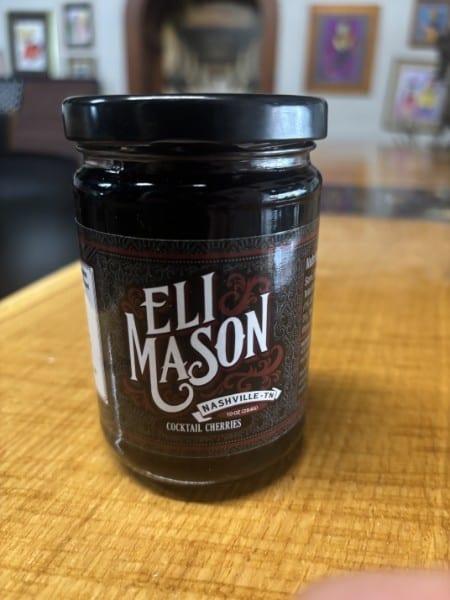
Eli Mason Cocktail Cherries
$19.95Small-batch cocktail cherries from Eli Mason — the finishing touch for a Manhattan, an Old Fashioned, or a pour of Bud & Dewey's on the rocks.
View in the shop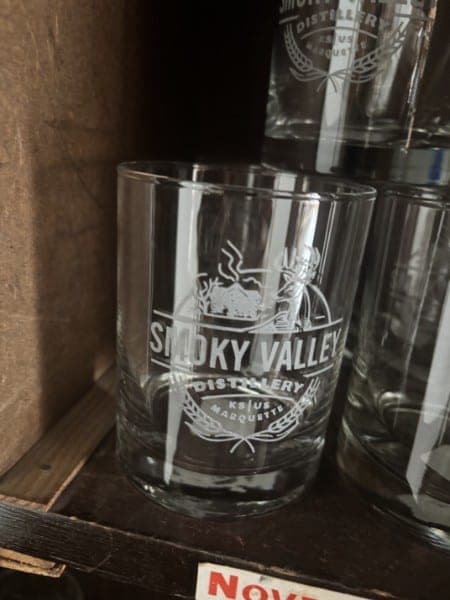
Old Fashioned Glass
$19.95A heavy-bottomed rocks glass etched with our crest — built for an Old Fashioned, a bourbon on the rocks, or a neat pour.
View in the shopWhich Cherry for Which Drink
- Manhattan and Perfect Manhattan — brandied or marasca, always. The drink is already sweet from the vermouth; what the cherry adds is depth, and something worth eating at the end.
- Old Fashioned — same answer. Our spec calls for a Luxardo cherry, and against sugar, bitters, and bourbon it is the one garnish that is also a flavor.
- Whiskey Sour — the classic flag is half an orange slice and a cherry pinned together across the rim. Use a dark one; it is eaten last and it is the final impression of the drink.
- Kansas Cherry Limeade — the exception, and a real one. Soda-fountain drinks are the tradition the American maraschino was invented for, and the bright red cherry belongs there, syrup and all.
- Sundaes, Shirley Temples, and anything a kid is drinking — the red jar, obviously. Nobody has ever wanted a bitter marasca on an ice cream sundae.
If you are stocking a bar rather than fixing one drink, our home bar essentials guide puts the cherry in context with the rest of the kit, and our bourbon cocktail recipes cover what to do with everything on the list.
What We Pour in Marquette
We keep real cherries behind the counter because the difference shows up immediately in a side-by-side, and a side-by-side is the easiest argument there is. If you are in central Kansas, we are open Thursday through Saturday in downtown Marquette and our tastings and tours run by appointment — a Manhattan built on our own rye is a reasonable way to find out whether the cherry really matters to you before you spend twenty dollars on a jar.
If you would rather not drive, the jars and the glassware ship from our online shop, and our bottles are stocked at retail locations across Kansas.
The Short Version
A maraschino cherry is a Royal Anne that was bleached in brine, firmed with calcium, re-dyed, and flavored with almond — a federal definition says so in those words. A cocktail cherry is whatever the maker says it is, and the good ones are fruit in syrup with nothing added to fake it.
Buy the dark jar for whiskey drinks, keep the red one for the soda fountain, read the ingredient list instead of the label art, and put whichever you open in the refrigerator.