
The Short Answer
Plain, unflavored vodka is gluten-free. That holds for vodka distilled from corn, potatoes, or grapes, and it also holds for vodka distilled from wheat, rye, or barley, the grains people usually worry about. Distillation leaves the gluten behind in the still.
Federal alcohol regulators have said so on paper since October 2020, and the Celiac Disease Foundation states plainly that "distilled liquors and hard ciders are also gluten-free." Where the answer changes is everything that happens after the still: flavorings, cross-contact, and whatever you pour the vodka into.
| What's in the glass | Gluten-free? | Why |
|---|---|---|
| Unflavored vodka from corn, potato, or grapes | Yes | No gluten in the base, none added |
| Unflavored vodka from wheat, rye, or barley | Yes | Distillation leaves protein in the still |
| Flavored vodka | Usually. Check the label | Flavor goes in after distillation |
| Cream liqueurs and canned cocktails | Check the label | Several ingredients added after the still; some cans are malt beverages |
| Bloody Mary, Moscow Mule, other mixed drinks | Depends on the mixer | The vodka is rarely the problem |
We make vodka from 100% Kansas corn, so the base-material half of this question never comes up for us. We also work with wheat, rye, and malted barley for our whiskeys, so the other half does.
Why Distillation Leaves Gluten Behind
Gluten is protein. FDA's gluten-free labeling rule, 21 CFR 101.91, defines it as the proteins that naturally occur in wheat, rye, or barley "and that may cause adverse health effects in persons with celiac disease."
Distillation is a separation by boiling point. The still heats a fermented wash, and alcohol and other light, volatile compounds turn to vapor, rise, and condense back into liquid on the other side. Anything that doesn't vaporize stays in the pot. Protein doesn't vaporize. Tricia Thompson, founder of Gluten Free Watchdog, puts it in one line: "Protein is not volatile and does not vaporize."
So when a run finishes, the grain solids and their proteins sit in the thick stillage left in the pot, and what came off the condenser is clear spirit. Vodka pushes that separation further than whiskey does. Federal law, 27 CFR 5.142, requires vodka to be distilled at or above 190 proof, or 95% alcohol, before it's cut with water for bottling. Whiskey has to come off the still at 160 proof or lower. The whole sequence, mash to bottle, is in how vodka is made.
The Alcohol and Tobacco Tax and Trade Bureau (TTB), which regulates alcohol labels, reached the same conclusion in Ruling 2020-2: "Distillation removes all protein (including gluten) if good manufacturing practices are followed." That last clause matters, and we'll come back to it.
What the Label Rules Say Now
For years the answer on paper didn't match the answer in the still. Under the earlier TTB Ruling 2014-2, the agency considered a gluten-free claim on any beverage "fermented or distilled from gluten-containing grains to be misleading." A wheat vodka could be gluten-free in fact and still not be allowed to say so.
Ruling 2020-2, issued October 13, 2020, replaced that policy. The points that matter for vodka:
- Spirits distilled from wheat, rye, or barley may be labeled gluten-free, as long as good manufacturing practices keep gluten-containing material out of the finished product.
- If anything goes in after distillation, the producer has to be ready to show three things: no protein in the distillate, no gluten in the added ingredients, and precautions against cross-contact.
- No numbers on the label. TTB treats a claim that states a specific gluten level, such as "contains x ppm," as misleading. The standard the ruling points to is FDA's: any unavoidable gluten must be "below 20 ppm," per 21 CFR 101.91(a)(3).
- The claim is voluntary. In TTB's words, the ruling "allows greater flexibility for industry members who wish to make voluntary 'gluten-free' claims." A vodka without those words on the label isn't telling you it contains gluten. Most bottles simply don't say either way.
One phrase to recognize: "processed to remove gluten" (or "treated" or "crafted"), paired with a statement that "the gluten content of this product cannot be verified, and this product may contain gluten." That's the wording TTB provides for fermented products made from gluten-containing grains, most often beer. It is a different claim from "gluten-free," and it shouldn't be read as one.
Where Gluten Can Get Back In
The distillation argument covers what comes off the still. It says nothing about what happens next. Three places deserve a look.
Flavorings. Every flavored vodka gets its flavor after distillation, which is why the Celiac Disease Foundation's guidance is to "always check ingredients for pre-made mixed drinks and flavored alcoholic beverages." Most flavorings contain no gluten at all. The point is that the still can't vouch for them. The producer has to. What "flavored" and "infused" each mean on that label, and which one is a regulated class, is in flavored vodka vs. infused vodka. Cream liqueurs and dessert-style bottles stack several ingredients on top of the spirit, so the same caution applies with more force.
Cross-contact. A distillery that also makes whiskey or beer handles gluten grains routinely, mashing and fermenting them, often on shared equipment. That's the situation TTB's good-manufacturing condition is written for. For whiskey drinkers, the Gluten Intolerance Group flags another route in: whiskey aged in a barrel that previously held beer.
The canned-cocktail cooler. Some ready-to-drink cocktails sold in grocery and convenience stores are built on a brewed malt base rather than distilled spirits, sometimes under a name that sounds like a vodka drink. According to the Celiac Disease Foundation, "malt-based beverages are not gluten-free." The fine print on the can tells you which kind you're holding.
Does the Base Grain Still Matter?
To TTB and the major celiac organizations, no. A properly distilled wheat vodka and a corn vodka are both gluten-free.
Some people with celiac disease prefer to skip spirits distilled from gluten grains anyway, and the advocacy groups leave room for that. The Gluten Intolerance Group's advice is that "the safe bet is looking for labeled or certified gluten-free spirits," and to err on the side of caution when a label is unclear. Vodka made from corn, potatoes, or grapes sidesteps the base-material question entirely. What corn and potato each do to the taste is covered in corn vodka vs. potato vodka.
An estimated 3 million people in the United States have celiac disease, according to the FDA. Nothing on this page replaces advice from a physician or dietitian who knows your case. A distillery can tell you how a spirit is made, not how your body will respond to it.
Mixed Drinks: Check the Mixer, Not Just the Vodka
In practice, the vodka is rarely what puts gluten in a cocktail. The other ingredients do.
- Bloody Mary. Our Bloody Mary recipe calls for a few dashes of Worcestershire sauce, which is vinegar-based. The Gluten Intolerance Group's rule on vinegar is short: "The only vinegar that needs to be avoided is malt vinegar." Malt vinegar isn't distilled, and malt comes from barley. If the Worcestershire or a bottled Bloody Mary mix lists malt vinegar, it isn't gluten-free. Neither is the small beer back some Midwest bars serve alongside, unless it's labeled gluten-free.
- Moscow Mule. A Moscow Mule is vodka, ginger beer, and lime, and most ginger beer is a nonalcoholic soft drink despite the name. Alcoholic ginger beers exist too. They're fermented products with their own ingredient lists, so check before you assume.
- Anything with beer, malt, or a premade mix. Same rule. Read each component on its own.
That goes for every recipe in our vodka cocktails collection too: the corn vodka base is gluten-free, and the mixers are yours to check.
Our Vodkas, Specifically
Every vodka we make starts from the same base: 100% corn grown in central Kansas, mashed with water from the Kiowa Aquifer and distilled in our copper pot still in Marquette.
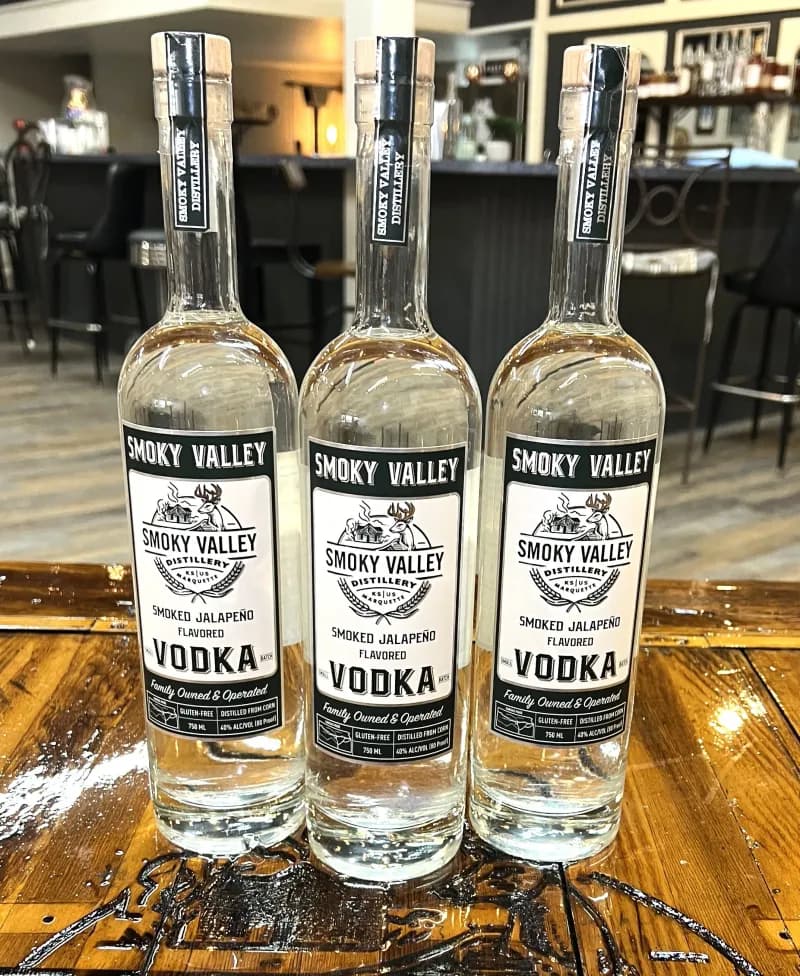
- Premium Vodka, Wild Plum, Smoked Jalapeno, and Pickle Vodka are listed as gluten-free.
- Lingonberry Vodka is built on the same corn base, but its product page doesn't carry the gluten-free designation. If you need a firm answer on that bottle, ask us rather than assume.
Our flavored vodkas get their plum, jalapeno, lingonberry, or dill by infusion after distillation, so they fall under the same "check the flavoring" rule as every flavored vodka on the shelf. And because we also work with wheat, rye, malted barley, and Kernza for our whiskeys, cross-contact is a fair question to put to us, the same as to any distillery that makes both. We're glad to answer it. Email Info@smokyvalleydistillery.com or ask at the tasting counter.
The 2020 rule shows up on our whiskey shelf, too. Our Straight Bourbon is distilled from corn, rye, and malted barley, and Bud & Dewey's from corn, wheat, and malted barley. Both carry a gluten-free designation, a claim TTB treated as misleading before October 2020. How the two categories split apart after the still is in vodka vs. whiskey.
Taste It for Yourself
A tasting and tour in Marquette is $10 per person, runs 30 to 45 minutes, and is available Thursday through Saturday by appointment. We'll pour the vodkas, walk you past the still, and answer questions about how each bottle is made. Our bottles are also stocked at retail locations across Kansas, and the full lineup is on the vodka page.