
It Is a Sour, Not a Dessert
Take the color away and look at what is in the glass: a spirit, a dry orange liqueur, fresh citrus, and a small measure of fruit juice. That is the architecture of a sidecar, a margarita, a kamikaze — spirit, sweet, sour. A Cosmopolitan is a sour that happens to be pink.
Almost every bad one is bad for the same reason, and it is not the recipe. It is the cranberry bottle. Reach for the wrong one and you have added sugar water to a drink that was already carrying a sweetener, and the result is the cloying pink thing that gave this cocktail its reputation. Reach for the right one and you get something dry, tart and bracing that tastes like a grown-up drink, because it is one.
So the cranberry aisle gets its own section below. Everything else here is straightforward.
The Spec
The International Bartenders Association lists the official build as 40 ml vodka citron, 15 ml Cointreau, 15 ml fresh lime juice and 30 ml cranberry juice, shaken with ice, strained into a large cocktail glass and garnished with a lemon twist.
Converted to the jigger on your counter that is about 1 1/3 oz, 1/2 oz, 1/2 oz and 1 oz. Our house build rounds the vodka up to a standard 1 1/2 oz pour and leaves the rest alone:
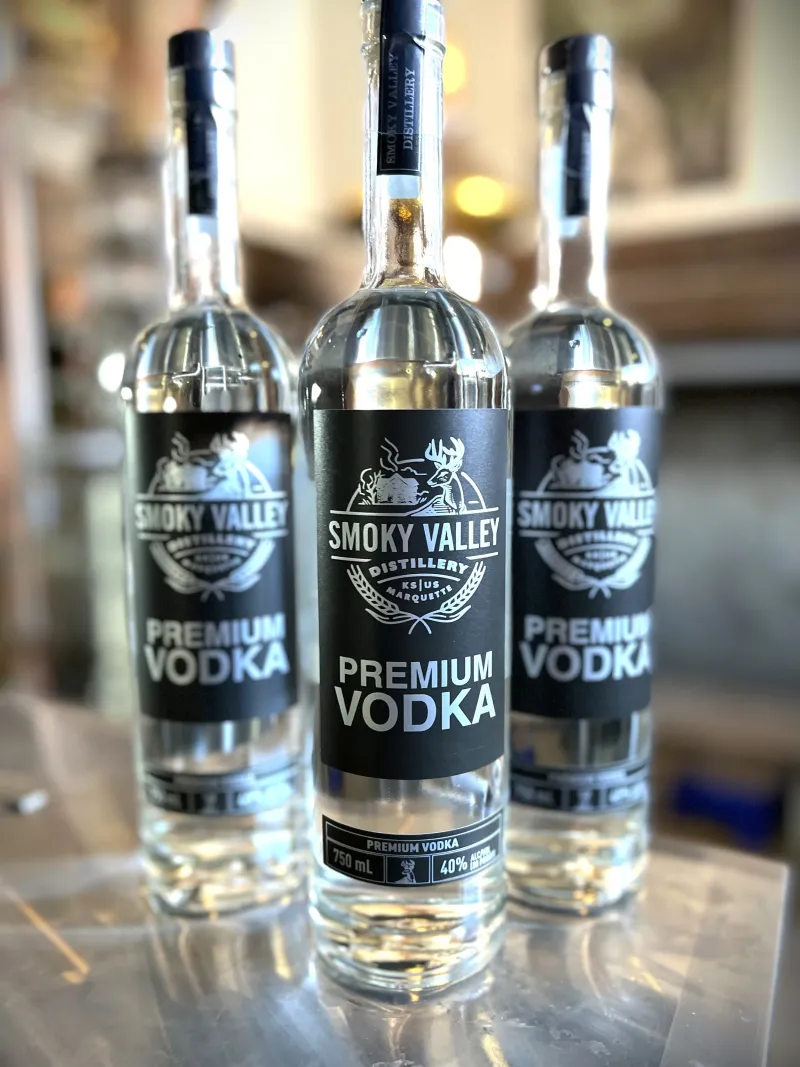
- 1 1/2 oz Premium Vodka
- 1/2 oz Cointreau or another dry triple sec
- 1/2 oz fresh lime juice
- 1 oz cranberry juice
- 1/4 oz simple syrup, conditional on which cranberry you bought
Two departures from the official spec, both deliberate.
No citron vodka. The IBA calls for lemon-flavored vodka, which is what Toby Cecchini reached for in 1988 because Absolut Citron had just launched and was the new thing behind every bar. We do not make a citrus vodka. Our Premium Vodka is 100% Kansas corn, and in a drink carrying half an ounce of fresh lime and half an ounce of orange liqueur, there is already more citrus in the glass than a flavored vodka would add. If you want the lemon note, add a lemon twist and let the oils do it.
The syrup is conditional, because the sweetness in this drink can arrive from two places and you only want it from one.
The Cranberry Aisle Is the Whole Problem
Two bottles sit next to each other on the shelf. One says cranberry juice. One says cranberry juice cocktail. They are not variations on a theme — they are different products, and the word doing the work is a federal labeling requirement rather than a marketing flourish.
Under 21 CFR 102.33(a), a beverage that contains less than 100 percent and more than 0 percent juice must, if its name uses the word "juice," include a qualifying term such as "beverage," "cocktail," or "drink." That is why the sweetened bottle is called cranberry juice cocktail. The word is there to tell you it is diluted.
How diluted? The USDA's commercial item description for cranberry juice products (A-A-20327A, June 2020) sets the styles: Style A is 27% cranberry juice by volume, Style B is 25%, Style C 22%, and Style D 20%. The same document permits sucrose, liquid sugar, invert sugar syrup or high-fructose corn syrup as sweeteners in juice drinks and juice cocktails, and allows Style D to carry added colors and flavors as well. Pure cranberry juice is its own listing — "pure cranberry juice (unsweetened)" — and runs 12.5 to 17.0 °Brix against the cocktail's 12.0 to 16.0.
Translated to the glass:
If you bought cranberry juice cocktail, roughly a quarter of that ounce is juice and most of the rest is water and sugar. Use it straight and skip the simple syrup entirely. The drink will still be a touch sweeter than the version below, and lighter in color, because you are pouring less cranberry than you think.
If you bought 100% unsweetened cranberry juice, you have something genuinely astringent — cranberries are sour enough that almost nobody drinks the juice neat, which is the entire reason the cocktail style exists. Use the 1/4 oz of simple syrup, taste, and add a little more only if the lime is winning. This is the version we make, and it is the one that tastes like the drink people describe when they say a good Cosmopolitan surprised them.
Either way, read the front of the bottle before you pour. It is the only ingredient in this recipe whose sugar content is not under your control.
Fresh Lime, and Why the Original Did Not Use It
Half an ounce of lime in a three-and-a-half-ounce drink is about an eighth of the glass. There is nowhere for bottled juice to hide, and bottled lime is cooked and preserved and tastes like it.
The historical joke is that the drink's ancestors ran on Rose's. The version that reached New York from San Francisco bars in the late 1980s was rail vodka, Rose's lime and Rose's grenadine, served up with a twist. Swapping that for fresh lime and Cointreau is most of what made the modern Cosmopolitan a real cocktail rather than a sweet novelty — and it is exactly the swap people undo when they reach for the squeeze bottle.
Shake it hard, 10 to 15 seconds. Citrus drinks get shaken rather than stirred because they need the aeration as much as the chill; the texture that separates a bar Cosmopolitan from a home one is mostly air. Then double strain, because a hard shake chips the ice and those chips melt in the glass while you drink. The difference between shaken and stirred, and which drinks want which, is laid out in our Manhattan versus Old Fashioned comparison.
The glass should be stemmed and chilled. We do not sell a coupe — the same problem comes up with our espresso martini, where the fix is the same: buy a cheap coupe, it beats an expensive rocks glass for anything served up.
Which Smoky Valley Bottle to Pour
| Bottle | ABV | In a Cosmopolitan |
|---|---|---|
| Premium Vodka | 40% | The house pick. Clean 100% corn, faintly sweet, no character of its own to fight the lime and cranberry. |
| Lingonberry Vodka | 40% | The variation worth making. Lingonberries are tart and cranberry-adjacent, so the bottle takes the vodka slot and half the cranberry's job — cut the juice to a splash, skip the syrup, and you get a drier, deeper-colored drink with no added sugar in it at all. |
| Wild Plum Vodka | 40% | Softer and jammier. The plum rounds the tartness off, which is the right call if you find the real thing too sharp and the wrong one if you ordered it because it was sharp. |
| Smoked Jalapeno Vodka | 40% | Makes a good drink and not a Cosmopolitan. Chile with lime and cranberry is closer to a spicy margarita; split it half and half with Premium if you want the heat behind the fruit rather than in front of it. |
| Pickle Vodka | 40% | No. Dill against cranberry is a fight nobody wins. It belongs in a Bloody Mary, where it is genuinely the best thing we make. |
The Lingonberry version is the one we would actually hand you at the counter. It is the same trick our easy vodka cocktails guide makes elsewhere — let a flavored vodka take a slot instead of stacking on top of one — and it turns a four-ingredient drink into a three-ingredient one without losing anything. The full lineup is on our vodka page, and what separates one base grain from another is in corn vodka versus potato vodka.
The Garnish Is Doing Real Work
Three garnishes are all correct, and they make three different drinks.
A lemon twist is the IBA's call, and it is the most restrained — oils over the surface, a clean citrus lift, nothing on the palate.
A lime wheel is the American bar standard and the most honest about what is in the glass.
A flamed orange twist is Dale DeGroff's contribution. He has been explicit that he did not invent the drink; what he added at the Rainbow Room was the orange peel, a move he borrowed from Pepe Ruiz's Flame of Love Martini. Hold a wide swath of orange peel skin-side down a few inches above the glass, warm it for a second with a lit match held between the peel and the surface, then squeeze — the oils ignite as they pass the flame and land on the drink faintly caramelized. Do it over the glass, with your hair and sleeves out of the way, and do not do it at all near a bottle you have just opened.
That one flourish is most of why the Cosmopolitan looked like a serious cocktail at a moment when it was being ordered by people who had never ordered a cocktail before.
Where It Came From
The honest answer is that four people have a claim and none of them is settled. Here is what is actually in print, and what is testimony.
In print: a drink called a Cosmopolitan appears in Pioneers of Mixing at Elite Bars: 1903-1933 built on gin, two dashes of Cointreau, lemon juice and raspberry syrup — the same shape as today's drink with different parts. An Ocean Spray label from 1968 promotes a "Harpoon" of two ounces of cranberry juice with one ounce of vodka or light rum. Neither is the modern Cosmopolitan; both show the idea was in the air for decades.
Testimony, and the parts most historians accept: Difford's Guide, drawing on Cheryl Charming's research, credits bartender Neal Murray with combining a Cape Codder and a Kamikaze at a steakhouse outside Minneapolis in 1975, and calls Cheryl Cook's claim well-supported: head bartender at The Strand on Washington Avenue in South Beach, she built hers on the newly launched Absolut Citron with triple sec, a dash of Rose's lime, and "just enough cranberry to make it oh so pretty in pink." The name, in that account, came from a 1989 Cosmopolitan magazine issue that featured the bar.
The version you are making is Toby Cecchini's. In 1988, at The Odeon in Manhattan, he was handed the San Francisco build — rail vodka, Rose's lime, Rose's grenadine — and rebuilt it with Absolut Citron, Cointreau, fresh lime juice and cranberry. Punch's oral history has him putting it plainly: what people think of as the Cosmopolitan is his drink. Dale DeGroff, in the same piece, says of himself, "I did not invent it."
Then Sex and the City arrived in 1998, the drink became a costume rather than a cocktail, and bartenders spent fifteen years rolling their eyes at it. That part is not history, it is fashion, and it has nothing to do with whether the thing in the glass is good.
How Strong Is It, Really
For a drink with a reputation for being frivolous, the arithmetic is reassuring.
1 1/2 oz of 80-proof vodka is 0.6 fl oz of pure alcohol. Half an ounce of Cointreau — 40% ABV, the same strength as the vodka, which surprises people who file triple sec under "mixer" — adds another 0.2. That is 0.8 fl oz in the glass, and the NIAAA counts 0.6 fl oz of pure alcohol as one standard drink.
So a Cosmopolitan is about one and a third standard drinks: lighter than our espresso martini and whiskey sour at one and a half, and well under our mint julep at nearly two. It is the gentlest shaken drink on this site, and it is the one with the loudest reputation for sneaking up on people — which probably says more about how fast a cold, tart, three-and-a-half-ounce drink disappears than about what is in it.
Troubleshooting
Too sweet. Cranberry juice cocktail plus the simple syrup. Pick one.
Harsh and sour, no fruit. 100% cranberry juice with no syrup at all. Add the quarter ounce.
Pale pink, tastes watery. Too much shaking over wet ice, or cranberry cocktail doing the work of juice. Fresh ice, fifteen seconds, stop.
Tastes like a Kamikaze. It nearly is one — add the cranberry back, or accept that you have made a perfectly good Kamikaze.
Dull after a few minutes. Normal. This drink is built cold and small on purpose; make two rounds of one rather than one round of two.
Cloudy with floating bits. Lime pulp. Double strain.
Take It Further
The cranberry-and-vodka family starts with the Cape Codder, one of the five builds in simple vodka cocktails, and our easy vodka cocktails guide covers the Lemon Drop and the two-ingredient Lingonberry Spritz that use the same logic as the variation above. For something with no classic behind it at all, the Teardrop and the Kansas Cherry Limeade are built on bottles only we make. Everything is on the recipes page.
Better still, taste the vodka before the lime and the cranberry get to it — a Cosmopolitan is a good drink and a poor way to learn what a vodka tastes like. We pour Thursday through Saturday in Marquette, Kansas; details are on our tastings and tours page, and our bottles are stocked at retail locations across Kansas.