
The Ice Is the Recipe
Most cocktails treat ice as a tool for getting cold. A julep treats it as an ingredient, and once you see that, every other instruction on this page stops sounding fussy.
Four things go in the cup: bourbon, sugar, mint, and crushed ice. Three of them you measure. The fourth is most of the drink's volume, and it keeps arriving — the ice melts into the bourbon the entire time you are holding it, so a julep you start is noticeably stronger than a julep you finish. That is not a flaw in the design. That is the design. A drink built to be nursed on a hot afternoon has to get gentler as the afternoon goes on.
Crushed ice rather than cubes is what makes the rate work, and the reason is surface area. Take a two-inch cube: it holds 8 cubic inches of ice and presents 24 square inches of surface to the bourbon. Crush that same cube into quarter-inch pieces and you have 512 of them, with a combined surface area of 192 square inches — eight times as much ice touching the whiskey, with no more ice in the cup. That is why a julep chills in twenty seconds, why the metal frosts, and why it keeps on diluting instead of sitting there like a rocks pour.
It also tells you what to do when you cannot get crushed ice. Put cubes in a clean kitchen towel and hit them with a rolling pin or the flat of a mallet. Uneven shards are fine — better than fine, because the small pieces chill fast while the larger ones hold the structure up. What does not work is cubes from the freezer tray, and what definitely does not work is the half-melted ones from the back of it.
The Spec, and the One We Are Settling
Two pages on this site have given a quick julep spec for years and they do not quite agree with each other. Our bourbon cocktail recipes roundup calls for 2 1/2 oz bourbon, 1/4 oz simple syrup or 1 teaspoon of sugar, and 8 to 10 mint leaves. Our simple bourbon cocktails page calls for 2 1/2 oz bourbon, 1 teaspoon of sugar or 1/2 oz of simple syrup, and 6 to 8 leaves. The bourbon matches. The sugar does not, and the gap is worth closing because it is a real doubling rather than a rounding difference.
Here is the arithmetic. USDA FoodData Central reference data puts a teaspoon of granulated sugar at 4.2 grams and a cup at 200 grams. Simple syrup made one-to-one is roughly half sugar by weight, and a quarter fluid ounce of it weighs a little over nine grams — call it four grams of sugar, which is a teaspoon. A half ounce is about twice that. So the first spec was internally consistent and the second one was offering you a choice between one teaspoon and two.
A quarter ounce of 1:1 syrup, or one level teaspoon of granulated sugar. That is the spec for the rest of this page, and it is deliberately on the dry side of what you will find elsewhere — because the ice is going to add four or five ounces of water before you are done, and sugar is the one element dilution does not soften.
Granulated sugar or syrup is a genuine choice rather than a shortcut either way. Sugar needs a teaspoon of water and a few seconds of stirring to dissolve, and it gives you something to press the mint against, which is the one small argument in its favor. Syrup mixes instantly and is the better call if you are making more than two.
Bruise the Mint, Do Not Muddle It
The single most common way to ruin a julep is to attack the mint.
Mint's aroma is not spread through the leaf. It sits in glandular hairs on the leaf surface — a peer-reviewed review of Mentha chemistry in Molecules notes that plant essential oils are "normally formed in special cells or groups of cells or in glandular hairs found on many leaves and stems" (Božović, Pirolli & Ragno, Molecules 2015, 20(5):8605–8633). Those hairs rupture under very little pressure. Pressing a leaf four or five times with the back of a spoon empties them.
Grinding the leaf open does something different. It breaks the interior of the leaf, which is where the chlorophyll and the vegetal, grassy, faintly bitter compounds live. That is the flavor people mean when they say a julep tasted like lawn clippings, and it is also why a badly made one has green flecks in it. A well-made julep has eight intact leaves sitting at the bottom of the cup looking barely touched.
Use spearmint if you have the choice. The mint sold as spearmint and the mint sold as peppermint are different plants with different signature compounds — spearmint's is carvone, peppermint's is menthol, and spearmint carries very little menthol. Peppermint is not wrong in a julep, but it is loud, and the cooling hit tends to arrive instead of the bourbon rather than alongside it. Published figures for how much of each compound a given plant carries vary enormously by variety and growing conditions, so this is a direction rather than a number: if the leaf tastes like chewing gum, use less of it.
Then there is the garnish, which is not a garnish. Slap the sprig once against your palm — hard enough to hear it, not hard enough to bruise the leaves — and plant it in the ice mound so it sits directly under your nose. Most of what you experience as the taste of a julep is actually arriving through your nose from a sprig you never put in your mouth.
The Cup, and Why It Has to Be Metal
Silver and pewter julep cups are not an affectation. They are the reason the drink works, and the physics is not subtle.
Thermal conductivity is the measure of how fast a material moves heat, in watts per meter-kelvin. Published values put silver at 428 and copper at 401. Tin — the main constituent of pewter — comes in at 68.2, and type 304 stainless steel at 14.4. Window glass is 0.96.
Copper moves heat roughly four hundred times faster than glass. That is the whole explanation for the frost: a metal cup pulls heat out of the room so quickly that water vapor condenses and freezes on the outside, and the frost then tells you the inside has reached the temperature you were stirring toward. A glass tumbler insulates. The drink inside still gets cold, but the cup gives you no reading, and your hand warms the contents through it.
Which is a problem for us, because we do not sell a julep cup. What we do sell is a copper mug, and copper is the second-best conductor on that list.
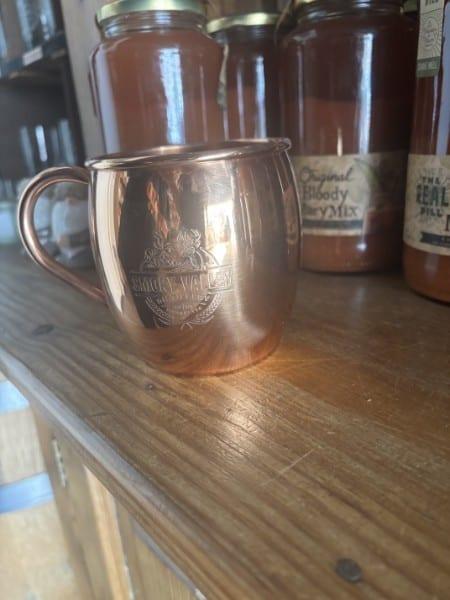
Copper Mule Mug
$19.95A classic copper mug engraved with the Smoky Valley crest — the traditional way to serve a Moscow or Smoky Mule ice-cold.
View in the shop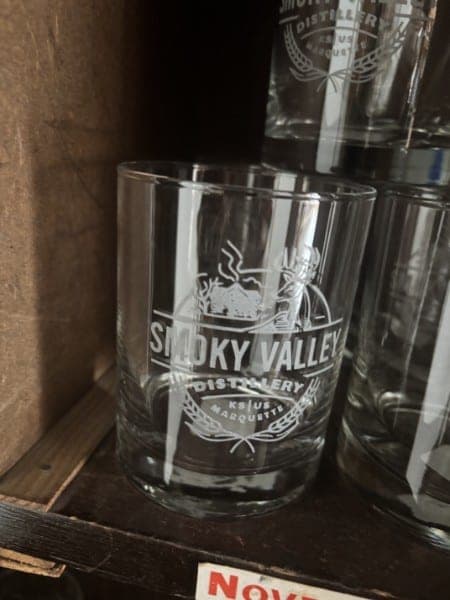
Old Fashioned Glass
$19.95A heavy-bottomed rocks glass etched with our crest — built for an Old Fashioned, a bourbon on the rocks, or a neat pour.
View in the shopThe copper mug is engraved for a Moscow Mule and that is what it was bought for, but physically it is the best julep vessel in our shop by a wide margin — and a julep is the one cold drink we make that contains no citrus at all, so the acid question that follows copper around other cocktails simply does not arise here. Pour a julep in it and it frosts like a silver cup, because 401 and 428 are the same number as far as your hand is concerned.
The etched Old Fashioned glass is the honest fallback. It will not frost and it will not read, so you stir for twenty seconds and trust it. The logo tasting glass is the wrong tool entirely — a one-and-a-half-ounce nosing glass cannot hold a julep, let alone the ice. More on which glass does what is in our whiskey glassware guide.
One last thing about metal: hold the cup by the base or the rim. Wrap your hand around a frosted copper mug and you will watch your own frost disappear, which is exactly as instructive as it is annoying.
Which Smoky Valley Bottle to Use
A julep asks something specific of a bourbon. It arrives already sweetened and already carrying a cooling herbal top note, and it is going to be watered down by a third before the sprig wilts. What survives that is backbone.
| Bottle | ABV | In a julep |
|---|---|---|
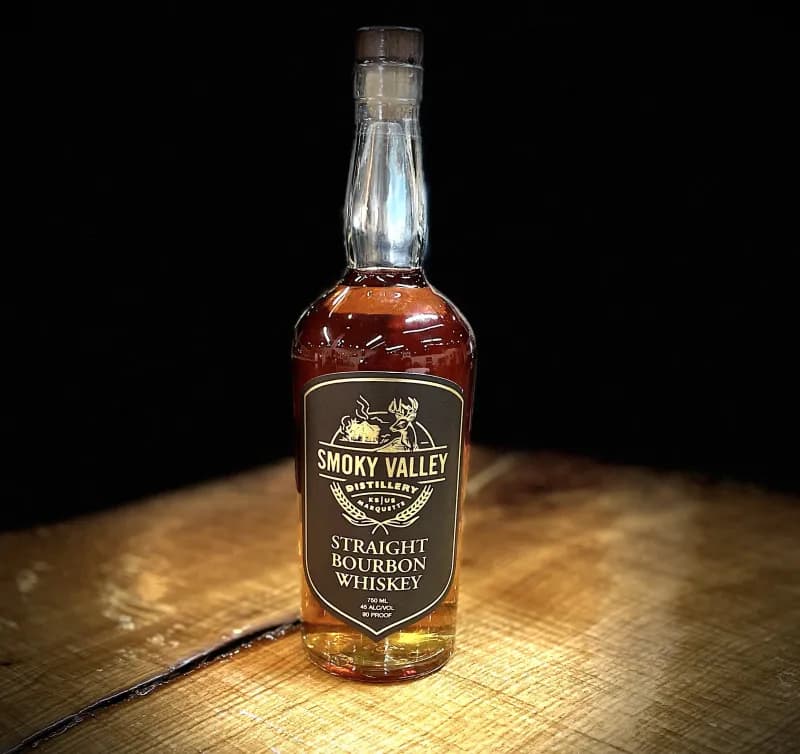
| Straight Bourbon | 45% | The house pick. Rye in the mash bill brings a dry, peppery edge that sits in the same register as mint and pushes back against the sugar instead of agreeing with it. |
| Rye Single Barrel Whiskey | 45% | Not a bourbon and not traditional, and the best julep we have made. An 82 percent rye mash bill against spearmint is the most interesting version of this drink on our shelf. |
| Smoked Straight Bourbon | 45% | Strange and good. Hand-smoked hickory under cold mint is a genuine surprise; cut the sugar back slightly, since smoke reads as sweetness here. |
| Bud & Dewey's | 45% | Makes a softer, rounder julep. Wheat instead of rye means vanilla and sweet cereal, which doubles up on the sugar — so drop to a scant teaspoon if you pour this one. |
| Kernza Whiskey | 45% | Its nutty, lightly honeyed character holds up better than expected under crushed ice, and it is the most unusual thing you can put in a julep cup. |
| High Wheat Single Barrel | 45% | Worth it if you have it open, though a single barrel's detail is the first thing heavy dilution takes away. |
| High Rye Single Barrel | 35% | Skip it here. At 70 proof it is a sipping bottle, and a julep's dilution flattens it. |
The wheated-versus-rye split behind that table is laid out in high rye versus wheated bourbon, and the proof arithmetic is in what proof means on a whiskey label. The full lineup sits on our bourbon page.
Juleps for a Crowd
You cannot batch a julep. The ice is the recipe, so a pitcher of pre-mixed juleps is either undiluted bourbon and sugar or a warm, watery mistake — and unlike most drinks, there is no version of it you can stir an hour ahead.
What you batch instead is the mint. Make a mint syrup: bring a cup of water and a cup of sugar to a simmer, kill the heat, drop in two generous handfuls of spearmint, cover it, and let it steep twenty minutes before straining the leaves out. It keeps a week in the refrigerator, and half an ounce of it replaces both the sugar and the muddling step. For a party this is the only way to make juleps at any speed, and it is what every bar serving them in volume does.
Then the math. Ten juleps is 25 oz of bourbon — a 750 mL bottle is 25.4 oz, so one bottle makes ten — plus 5 oz of mint syrup, a bunch of mint for the sprigs, and far more crushed ice than you have. Buy a bag. Our guide to batching bourbon cocktails for a crowd covers the general scaling rules, and a julep is the clearest exception to them on the site.
For anyone not drinking, mint syrup, soda water, and crushed ice in the same cup with the same sprig is a genuinely good drink and looks identical across a table.
Where the Word Comes From
"Julep" has nothing to do with mint, bourbon, or Kentucky. It traces back through Old French and Medieval Latin julapium to Arabic julāb, and before that to Persian golâb — gol, rose, plus āb, water. The word started life meaning rosewater, and it reached English as a term for a sweet liquid used to make medicine palatable.
That medicinal sense is how it arrived in America. Mint juleps were being prescribed for aching stomachs as early as 1784, and most historians place the drink's development in Virginia high society in the late 1700s or early 1800s, where it was drunk from silver goblets at breakfast. By 1816 silver julep cups were being handed out as prizes at Kentucky county fairs — which is to say the cup was a status object in Kentucky more than a century before the race it is now famous for.
Churchill Downs made the julep the Kentucky Derby's drink in 1938, and today close to 120,000 of them are sold there across the two days of the race. The drink is roughly a century and a half older than that association.
One Drink, and It Is Not a Light One
A julep tastes like a long, cold, mild thing. It is not.
Two and a half ounces of 90-proof bourbon is 1.125 fluid ounces of pure alcohol. The NIAAA counts 0.6 fluid ounces of pure alcohol as one standard drink, which makes a single julep just under two of them — a quarter more than our Whiskey Sour, which pours two ounces of the same strength. The sugar, the cold, and the mint all work to hide that, and the dilution arrives gradually enough that the first half of the drink is the strong half.
Worth knowing on a day when the plan is three of them in the sun.
Troubleshooting
It tastes grassy and bitter. The mint got ground instead of pressed. Eight leaves, four or five presses with the back of a spoon, and the leaves should still look like leaves.
The cup never frosted. Either it is glass, which will not, or the ice was cubes rather than crushed. Twenty seconds of stirring over cubes does not move enough heat.
It is too sweet. A half ounce of syrup instead of a quarter, which is the spec gap this page settles. Or a wheated bourbon at full sugar.
The last third is water. That is the drink working as designed, but you can slow it down by mounding fresh crushed ice on top halfway through rather than letting the level fall.
Gritty at the bottom. Granulated sugar that never dissolved. Add the teaspoon of water first and stir it out before anything else goes in, or switch to syrup.
Take It Further
The julep is one of two crushed-ice bourbon drinks worth knowing — the other is the smash, which adds lemon to the same build — and if you want the stirred, undiluted end of the spectrum instead, our Old Fashioned and Whiskey Sour are the two places to start. The winter counterpart to this drink, same bourbon logic in the opposite direction, is our hot toddy. All of it is on the recipes page, and three more easy builds are in bourbon cocktails.
If the smoked bottle intrigued you, what smoked bourbon actually is explains how it is made and smoked bourbon cocktails covers where else to put it.
Better still, taste the bourbon before it meets a pound of ice. We pour Thursday through Saturday in Marquette, Kansas — details on our tastings and tours page — and our bottles are stocked at retail locations across Kansas. If a julep station sounds like your kind of party, our private events room seats sixty.