
The Build, and Why It Is Mostly Water
A hot toddy is the only whiskey drink on this site where the whiskey is outnumbered three to one. Two ounces of bourbon, a tablespoon of honey, a half ounce of lemon juice, four ounces of hot water — seven ounces in the mug, and more than half of it is water.
That is not a compromise. It is the recipe. Two ounces of our 90-proof bourbon in a seven-ounce drink works out to roughly 13 percent alcohol by volume, which is table-wine strength served hot. Everything that makes a toddy worth making — the way honey and oak meet, the way steam carries lemon oil up to you before you taste anything — depends on that dilution. Build it stronger and you get a mug of warm whiskey, which is a different and considerably worse drink.
So the ratio is the recipe, and the technique comes down to two things: how hot the water is, and whether the honey actually dissolved.
Heat the Water, Do Not Boil It
Ethanol boils at about 173°F — the NIST Chemistry WebBook puts the normal boiling point at 351.5 K, averaged across 138 published measurements — and water boils at 212°F. Pour water straight off a rolling boil over two ounces of bourbon and you are holding a cup of liquid hotter than the point at which the most volatile and most interesting part of that bourbon wants to leave. You can smell it happening. That smell is the drink getting worse.
The second reason is simpler: you cannot drink it. A scald-risk model published in Burns in 2008 put the optimal drinking temperature for a hot beverage at about 136°F, balancing how satisfying the warmth feels against how badly it burns. Boiling water is 76 degrees past that.
The practical version: take the kettle off just before it boils, or let a boiled kettle stand a minute — call it 190°F. Four ounces of water at 190°F poured over three ounces of room-temperature bourbon, lemon, and honey averages out near 139°F before the mug takes its share, and the mug always takes a share. That is a drink you can start sipping almost immediately, which is the whole point on a night when the Kansas wind is doing what it does in January.
Preheating the mug is the step everyone skips and the one that matters most to the last two sips. Hot tap water, swirl, dump, build. A cold mug pulls 15 or 20 degrees out of a seven-ounce toddy in the time it takes to find the cloves.
Dissolve the Honey First
Honey is heavier than water and it does not want to go into a liquid that already has two ounces of alcohol in it. Add it last and you will stir, watch it streak, decide it is fine, and then find a sweet puddle waiting at the bottom of the mug.
Put the honey in the warm empty mug with about an ounce of the hot water and stir that on its own until it goes clear. Then add the bourbon, the lemon, and the rest of the water. It costs five seconds and it is the difference between a balanced drink and an under-sweetened one with dessert at the end.
If you make toddies more than once a winter, make honey syrup instead: two parts honey to one part warm water, stirred until combined, kept in a jar in the refrigerator. It pours like simple syrup and mixes instantly. Half an ounce of 2:1 honey syrup is about the same sweetness as a tablespoon of straight honey. We use the same trick in a wheated bourbon Old Fashioned, where honey syrup suits Bud & Dewey's better than sugar does.
Use a honey you would eat on toast. There are small apiaries selling at farmers markets within an hour of Marquette, and a dark wildflower or buckwheat honey brings molasses and a bitter edge that stands up to bourbon in a way a squeeze bottle of clover honey does not.
Fresh Lemon, and What the Cloves Are For
Half an ounce is one good squeeze from half a lemon. Use it fresh. In a drink this diluted there is nothing to hide behind, and bottled lemon juice tastes like the bottle.
The clove-studded lemon wheel is not decoration. It floats where the steam comes off, so for the first few minutes every sip arrives through a cloud of clove and lemon oil. Three or four cloves pushed into the peel of a wheel is plenty; a dozen turns the drink into a Christmas candle. The cinnamon stick is genuinely optional and does most of its work as a stirrer — whole cinnamon gives up very little in seven ounces of water in five minutes, whatever the photographs suggest.
What you should not do is drop the lemon wheel in early and crush it. The pith is bitter, and a toddy sits around long enough for that bitterness to find its way out.
Which Smoky Valley Bottle to Use
We make five bourbons and two other whiskeys, and they do not all behave the same way under four ounces of hot water. Dilution decides it: anything subtle disappears, and anything bottled at lower proof disappears first.
| Bottle | ABV | In a toddy |
|---|---|---|
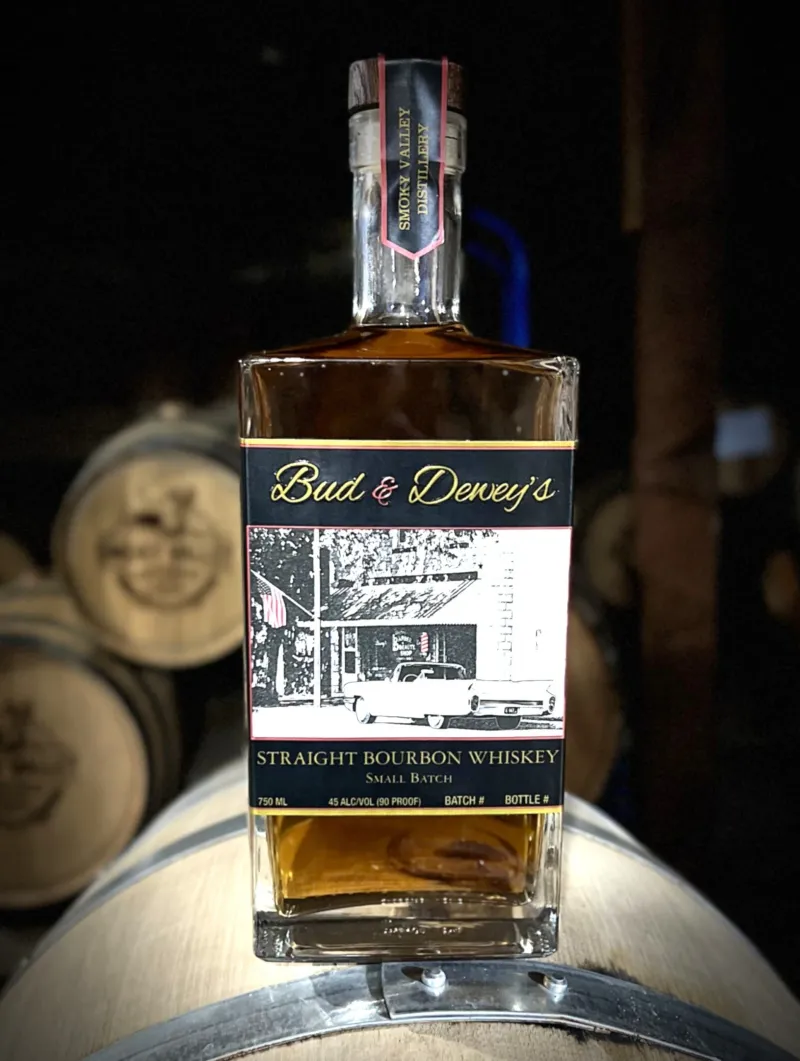
| Bud & Dewey's | 45% | The house pick. Wheat rather than rye as the secondary grain means vanilla custard and sweet cereal instead of pepper, and honey meets that head-on. |
| Smoked Straight Bourbon | 45% | The best twist on the drink we have found. Every bottle is hand-smoked with hickory in a culinary smoker, and hickory plus clove plus honey is a campfire in a mug. |
| Straight Bourbon | 45% | Rye in the mash bill makes a drier, spicier toddy. Pull the honey back to two teaspoons. |
| Rye Single Barrel Whiskey | 45% | For anyone who finds toddies cloying. An 82 percent rye mash bill brings black pepper and baking spice that argue with the honey instead of agreeing with it. |
| Kernza Whiskey | 45% | The sleeper. Its nutty, lightly honeyed character is already most of the way to this drink. |
| High Rye Single Barrel | 35% | Skip it here. At 70 proof it is a sipping bottle, and seven ounces of toddy flattens it to nothing. |
If you want the reasoning behind the wheated-versus-rye split, we laid it out in what wheated bourbon actually is, and the proof arithmetic is in what proof means on a whiskey label. The full lineup sits on our bourbon page.
The Mug, and Why Ours Is the Wrong One
A toddy needs a vessel that takes 190°F water without complaint: a heat-safe glass mug, a stoneware mug, or an Irish coffee glass with a handle.
We sell glassware, and we are going to tell you not to use it for this. Our etched Old Fashioned glass is a heavy, thick-walled rocks glass, and thick untempered glass handles sudden heat worst of all — and it has no handle, so even when it survives you cannot pick it up. The logo tasting glass is a nosing glass built for an ounce and a half at room temperature. The copper mule mug is the worst option in the shop for this one drink: copper is an excellent conductor, which is exactly why it is wonderful for an ice-cold Moscow Mule and unholdable with hot water in it.
Buy a plain glass mug for four dollars and save ours for everything else.
Four Variations Worth Making
- Cider toddy. Replace the water with hot apple cider and cut the honey in half. This is the best cold-weather use of Bud & Dewey's we know, and it is on the bottle's own serving list for a reason.
- Tea toddy. Build it on strong black tea instead of water. The tannin gives the drink grip, which suits the Rye Single Barrel. Use a plain English breakfast or Assam — a flavored tea fights the honey.
- Smoked toddy. Same build, Smoked Straight Bourbon in place of the wheated bourbon, and a wide lemon peel instead of the wheel. More ideas for that bottle are in our smoked bourbon cocktails.
- A pot for a crowd. Eight toddies is 16 oz bourbon, 8 oz honey syrup, 4 oz lemon juice, and 32 oz water held just under a simmer. Add the bourbon last, off the heat, and never let the pot boil. Our guide to batching bourbon cocktails for a crowd covers the scaling math in general.
For a version with no whiskey in it, honey, lemon, hot water, and the clove-studded wheel is a good drink on its own. Nobody at the table needs to know which mug is which.
Where the Word Comes From
"Toddy" has nothing to do with whiskey originally. The Online Etymology Dictionary traces it to the 1610s, from Hindi tari — the fermented sap of the palmyra palm, from tar, palm tree, and ultimately from Sanskrit tala. The Hindi r sits close enough to an English d to account for the spelling we ended up with.
The sense we use now — hot liquor, sugar, and spices in water — only turns up around 1761, by which point the word had traveled from a palm tree in South Asia to a mug in front of a fire. That is a better story than most cocktail origins, mostly because it is documented.
Does a Hot Toddy Help a Cold?
The honest answer: parts of it might, and the bourbon is not one of those parts.
Honey has real evidence behind it for coughs. A Cochrane review of six randomized trials covering 899 children aged 12 months to 18 years concluded that honey probably relieves cough symptoms more than no treatment, placebo, or diphenhydramine, while possibly making little or no difference compared with dextromethorphan. That same review is clear that honey should not be given to infants under 12 months because of the risk of infant botulism — which also means the non-alcoholic version above is not a drink for the very young.
Hot liquid and steam are comforting, and warmth does something for a sore throat even if it is temporary. The alcohol is not treating anything. A toddy is a good drink to have when you feel rough; it is not medicine, and if you are sick enough to be weighing options, talk to a clinician rather than a distillery.
Troubleshooting
It tastes watery. The water was not hot enough, or there was too much of it. Four ounces is the ceiling for two ounces of bourbon.
It is syrupy and the last sip is pure honey. The honey never dissolved. Dissolve it in an ounce of hot water in the empty mug before anything else goes in.
It smells like alcohol and tastes thin. The water was boiling. You drove the aromatics off the top.
It went cold halfway down. Cold mug. Preheat it.
It tastes harsh and bitter. Either you crushed the lemon wheel and got the pith, or a dozen cloves sat in it for ten minutes.
One Drink, Served Warm
Two ounces of 90-proof bourbon is about one and a half standard drinks, using the NIAAA measure of 1.5 fl oz of 80-proof spirits as one. The dilution and the warmth make a toddy feel gentler than a neat pour of the same bourbon, which is worth knowing before you go back to the kettle.
Take It Further
The toddy is one of three easy builds our wheated bourbon was made for — see 3 easy bourbon cocktails for a Whiskey Sour and a Bourbon & Ginger on the same bottle, or browse all our cocktail recipes.
Better still, taste the bourbon neat before you put it in hot water. We pour Thursday through Saturday in Marquette, Kansas — details on our tastings and tours page — and our bottles are stocked at retail locations across Kansas.