
A Negroni That Traded Gin for Bourbon
The easiest way to understand a Boulevardier is to start from the drink almost everybody already knows. A Negroni is gin, Campari, and sweet vermouth. Swap the gin for bourbon and you have a Boulevardier — same three roles, same bitter architecture, completely different drink.
That swap does more than you would expect from a one-ingredient change. Gin is clear, dry, and botanical; it stands beside Campari and lets the bitterness lead. Bourbon is sweet, round, and barrel-aged, and it arrives carrying vanilla, caramel, and oak. Put that under Campari and the bitterness stops being the headline. It becomes the frame around something warmer.
This is the one bourbon cocktail on our shelf that is genuinely bitter rather than sweet, and it is what we recommend at the counter to people who tell us they do not have a sweet tooth. It is also a cold-weather drink in a way the Negroni is not. Our Old Fashioned and Manhattan are the other two stirred, spirit-forward builds on this site, and the Boulevardier is the one that adds a third flavor axis to them.
The Spec We Pour, and the One from 1927
The Boulevardier first appeared in print in Barflies and Cocktails, the 1927 Paris cocktail book from Harry MacElhone of Harry's New York Bar. It is not in the main recipe list — it turns up near the back, inside Arthur Moss's essay "Cocktails About Town," credited to Erskine Gwynne, an American writer in Paris who founded a monthly magazine called Boulevardier (Imbibe, "History Lesson: The Boulevardier"). The drink is named after the magazine, not the other way around.
The 1927 spec is equal thirds: one part Campari, one part Italian vermouth, one part bourbon. Equal thirds is how most drinks of that era were written, and if you make it that way today it is a bitter, vermouth-heavy drink that tastes much more like a Negroni than like bourbon. It is worth building once, because it shows you exactly how much work the extra half ounce of whiskey does in the modern version.
Modern bars pour it bourbon-forward, and so do we:
| Version | Bourbon | Campari | Sweet vermouth | Reads as |
|---|---|---|---|---|
| 1927 original | 1 oz | 1 oz | 1 oz | A bitter aperitivo with whiskey in it |
| House spec | 1 1/2 oz | 1 oz | 1 oz | Balanced — bitterness and bourbon trading places |
| Bourbon-forward | 2 oz | 1 oz | 1 oz | A bourbon drink with a bitter edge |
Our bourbon cocktail recipes roundup has carried the 1 1/2 : 1 : 1 spec for years, with a note to bump the bourbon to 2 oz if it comes out too bitter for you. That advice stands, and this page is the long version of it. Unlike our mint julep, where two pages on this site disagreed about the sugar and we had to settle it, there is nothing to reconcile here — the half-ounce ladder above is a real preference range rather than an error.
Pick your rung by how much you like bitterness, not by how strong you want the drink. All three versions are strong.
What Campari Actually Is, and Why It Fights Back
Campari is a bitter Italian aperitivo, invented in 1860 by Gaspare Campari in Novara and still made to an undisclosed recipe. The bottle you buy in Kansas reads 24% alcohol by volume — 48 proof, about half the strength of our bourbon, which matters for the arithmetic at the end of this page. That figure is not universal: Campari is bottled at different strengths for different markets, and published figures span roughly 20.5 to 28.5 percent depending on the country, so a Boulevardier built in Europe is not quite the same drink as one built here.
Two practical things follow from what is in the bottle.
It is aggressively bitter, and bitterness does not dilute away politely. Sweetness softens as ice melts into a drink. Bitterness tends to hold its ground and then dominate the back half, which is the single best argument for a controlled stir and a glass that will not keep watering the drink down for twenty minutes.
It will bully a gentle whiskey. One ounce of Campari in a three-and-a-half-ounce drink is enough to erase a delicate bourbon completely. That is why proof matters here more than in most cocktails, and why the bottle table below gives a clear answer rather than a shrug.
One piece of trivia worth having, because guests do ask: the red used to come from carmine, a pigment made from cochineal insects. Campari Group discontinued carmine in 2006 in most markets, including the US, and moved to other coloring, though some bottles elsewhere still list E120. So the honest answer is that the US bottling has not used the insect dye for roughly two decades — and that sweet vermouth, being a wine product, carries its own fining question.
Speaking of which: sweet vermouth is aperitif wine, not a spirit. Most bottles sit at 16 to 18 percent alcohol, which means an open one is on a clock. Refrigerate it, use it inside a month, and do not pour a Boulevardier from a bottle that has been standing warm since summer — that one mistake ruins more of these than any technique error. The full explanation, including which bottles to buy, is in our guide to choosing and storing sweet vermouth.
Stir It. Do Not Shake It.
The rule is simple, and this drink is the clearest case for it: stir anything that is all alcohol, shake anything with citrus, juice, or egg. A Boulevardier is three spirits and nothing else, so it gets stirred.
Shaking would do two things wrong. It aerates, which leaves the drink cloudy and gives it a thin, frothy texture that fights the weight you want from bourbon and vermouth. And it chills much faster while adding more water, so you overshoot on dilution before the drink is properly cold. Stirring moves heat gently, keeps the liquid clear and viscous, and lets you stop where you want to. Our comparison of the Manhattan and the Old Fashioned works through the same technique question on two drinks that share this one's build.
Thirty seconds is the target, but the clock is a guide and your hand is the instrument. Stir until the outside of the mixing glass is genuinely unpleasant to keep holding. That is roughly the point at which the drink has reached temperature and taken on the ounce or so of water that turns three sharp ingredients into one.
No mixing glass is not a problem. Use a pint glass, or the larger half of a shaker tin, and a long spoon. What you need is enough room for the ice to travel.
Up, or Over One Big Rock
Both serves are correct, and they are different drinks.
Up, in a chilled coupe. No ice in the glass, so the drink stops diluting the moment you strain it. It stays exactly as you built it, warms gradually, and the bitterness holds the same proportion from the first sip to the last. This is the serve for drinking it in fifteen minutes, and the one we would pour you first.
Over one large cube, in a rocks glass. The drink keeps getting colder and softer the whole time it sits. Campari's bitterness recedes slightly as the water comes up, which is a genuine argument for this serve if you find the drink sharp. The key words are one and large. Four small cubes in a rocks glass will turn a Boulevardier into pink water in ten minutes.
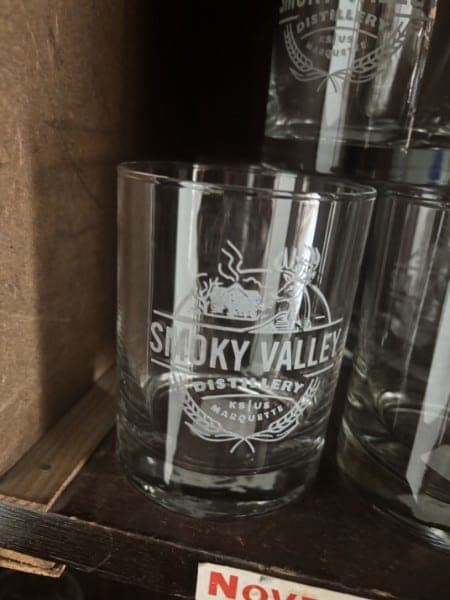
Old Fashioned Glass
$19.95A heavy-bottomed rocks glass etched with our crest — built for an Old Fashioned, a bourbon on the rocks, or a neat pour.
View in the shopOur etched rocks glass is the right vessel for the second serve — heavy-bottomed, wide enough for a two-inch cube, and the same glass we recommend for an Old Fashioned. We do not sell a coupe, so if you want this one up, use the stemmed glass you already own; stemware exists so that your hand is not touching the bowl. The logo tasting glass is the wrong tool here — it is a one-and-a-half-ounce nosing glass built for neat whiskey and it cannot hold three and a half ounces of cocktail. Which glass does what, and why, is laid out in our whiskey glassware guide.
The Orange Peel Is Doing Real Work
A Boulevardier garnished with a dry wedge of orange perched on the rim is a Boulevardier missing an ingredient.
What you are after is the oil in the peel, not the fruit. Published analyses of sweet orange peel oil put limonene at roughly 86 to 97 percent of the total, depending on cultivar and extraction method (Ndiaye et al., Journal of Essential Oil Bearing Plants, 2017), and limonene is the bright, sweet citrus-peel smell you notice when somebody opens an orange across the room. It sits in glands just under the surface of the skin, and squeezing a wide strip skin-side down over the glass sprays a layer of it across the surface of the drink.
That layer is the first thing you meet, and it arrives ahead of the bitterness. Against Campari it is not decoration — it is the element that keeps the drink from reading as flatly bitter on the nose.
Cut the peel wide and shallow, with as little white pith as you can manage. Pith is bitter in a dull way that adds nothing to a drink already carrying the interesting kind of bitterness. Squeeze once, an inch above the surface, then rub the peel around the rim and drop it in.
A cherry instead of orange is a legitimate variation and makes a sweeter, more Manhattan-like drink — but use a real cocktail cherry, not the neon kind. The gap between the two is wider than most people expect, and we wrote it up in maraschino versus cocktail cherries.
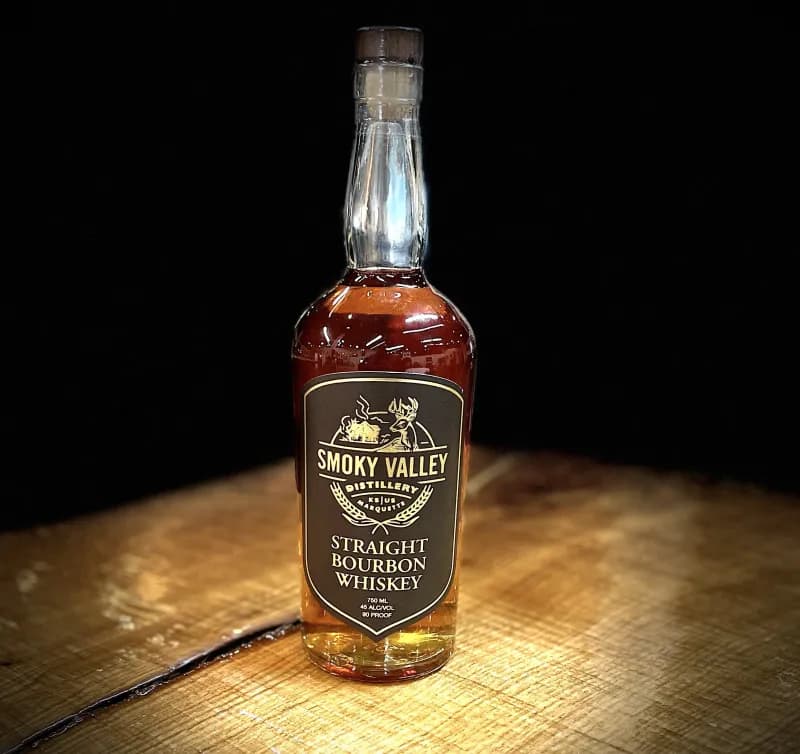
Which Smoky Valley Bottle to Use
A Boulevardier asks one thing of a bourbon: can it still be heard under an ounce of Campari? Proof and structure answer that question. Subtlety does not.
| Bottle | ABV | In a Boulevardier |
|---|---|---|
| Straight Bourbon | 45% | The house pick. Rye in the mash bill gives it a dry, peppery spine that meets Campari head-on instead of disappearing under it. |
| Rye Single Barrel Whiskey | 45% | Technically no longer a Boulevardier once you leave bourbon behind, and excellent anyway. An 82 percent rye mash bill against Campari is the driest, most bracing version our shelf can build. |
| Bud & Dewey's | 45% | Our best seller, and the right call if Campari is a stretch for you. Wheat instead of rye means a softer, rounder drink with the bitterness pulled back a notch. |
| Smoked Straight Bourbon | 45% | Hickory smoke and bitter orange is a real combination rather than a gimmick — the most interesting variant we make. Go to 2 oz; smoke needs the room. |
| High Wheat Single Barrel | 45% | Works, in the same soft direction as Bud & Dewey's. A single barrel's particular detail is partly spent against Campari, so pour it here only if the bottle is already open. |
| Kernza Whiskey | 45% | Its nutty, lightly honeyed character survives better than expected, and nobody else on earth is making this drink with Kernza. |
| High Rye Single Barrel | 35% | Skip it here. At 70 proof it is a sipping bottle, and an ounce of Campari goes straight over the top of it. |
The wheated-versus-rye split behind that table is worked out in high rye versus wheated bourbon, and why 70 proof behaves so differently from 90 is in what proof means on a whiskey label. The whole lineup sits on our bourbon page.
The Family Tree
Three cocktails share this one's skeleton, and knowing the map means one bottle of Campari makes all of them.
- Negroni — gin, Campari, sweet vermouth. The parent drink, and the one most bars pour by the hundred.
- Boulevardier — bourbon, Campari, sweet vermouth. What this page is about.
- Old Pal — rye, Campari, dry vermouth. Swapping sweet vermouth for dry takes the roundness out entirely and leaves something lean and very dry. Also from MacElhone's Paris bar, in the same era.
The pattern worth noticing is that the Campari stays fixed while the spirit and the vermouth move. Our perfect Manhattan splits sweet and dry vermouth down the middle for the same reason the Old Pal goes fully dry — vermouth choice is a dial, not a detail.
Batching for a Crowd
Unlike a julep, this drink batches perfectly, and for exactly the reason it has to be stirred: there is no citrus juice in it to go dull, and no ice built into the recipe.
For ten drinks, combine 15 oz bourbon, 10 oz Campari, and 10 oz sweet vermouth in a sealed bottle or pitcher. A 750 mL bottle holds 25.4 oz, so ten Boulevardiers at our spec take a little under two-thirds of a bottle of bourbon and well under half a bottle each of Campari and vermouth. Add 7 oz of water to stand in for the dilution that stirring would otherwise contribute, which brings the batch to 42 oz, then refrigerate it for at least three hours.
Pour about 4 oz per serving straight from the cold bottle into chilled glasses, and express a fresh orange peel over each one. The peel is the only part you cannot do in advance, and it takes four seconds. This is the drink we would build for a stirred-cocktail station at a private party; the general scaling rules are in our guide to batching bourbon cocktails for a crowd.
Batched Boulevardier keeps a week in the refrigerator. The limit is the vermouth, not the whiskey.
How Strong It Actually Is
This drink tastes like an aperitif. It is not one.
At our spec it carries 1 1/2 oz of 90-proof bourbon, 1 oz of 48-proof Campari, and 1 oz of vermouth at roughly 16 percent — a little over an ounce of pure alcohol all told. The NIAAA counts 0.6 fluid ounces of pure alcohol as one standard drink, which puts one Boulevardier just under 1.8 of them. Go up to the 2 oz bourbon version and it is closer to 2.2.
Two things make that easy to miss. Bitterness reads as sobriety to most palates, so the drink does not taste strong. And the whole pour arrives in a four-ounce glass with no soda, no juice, and no melting ice, which means nearly every ounce in front of you is cocktail. It is stronger than our whiskey sour and our cosmopolitan, and in the same range as a mint julep that looks three times the size.
Troubleshooting
Too bitter. Go up half an ounce on the bourbon before you touch anything else, and try the rocks serve rather than up. If it is still too much, wheated Bud & Dewey's in place of the Straight Bourbon is the biggest softening move available.
Flat, with a slightly sour edge. The vermouth is oxidized. A bottle open longer than a month at room temperature tastes stewed, and no amount of Campari hides it. Buy a fresh one and keep it cold.
Cloudy, with a thin texture. It got shaken. Stir this one.
Warm by the third sip. The glass was not chilled, or the stir was too short. Stir until you no longer want to hold the mixing glass.
Watery halfway down. Too many small cubes in the serving glass. One large cube, or serve it up.
The bourbon has vanished entirely. The bottle was too soft or too low in proof for the job. The table above sorts our shelf by exactly this question.
Take It Further
If the stirred, spirit-forward end of the bar is where you want to be, the two pages to read next are our Manhattan and our Old Fashioned — same technique, same glassware, no Campari. The whole collection is on the recipes page, and eight classic specs with the right bourbon called out for each are in bourbon cocktail recipes.
If the bitter part is what caught your attention, what cocktail bitters actually are explains the dash-bottle version of the same idea, and bourbon and food pairing covers where a bitter aperitivo fits around a meal.
Better still, taste the bourbon on its own before Campari gets a vote. We pour Thursday through Saturday in Marquette, Kansas — details on our tastings and tours page — and our bottles are stocked at retail locations across Kansas.