
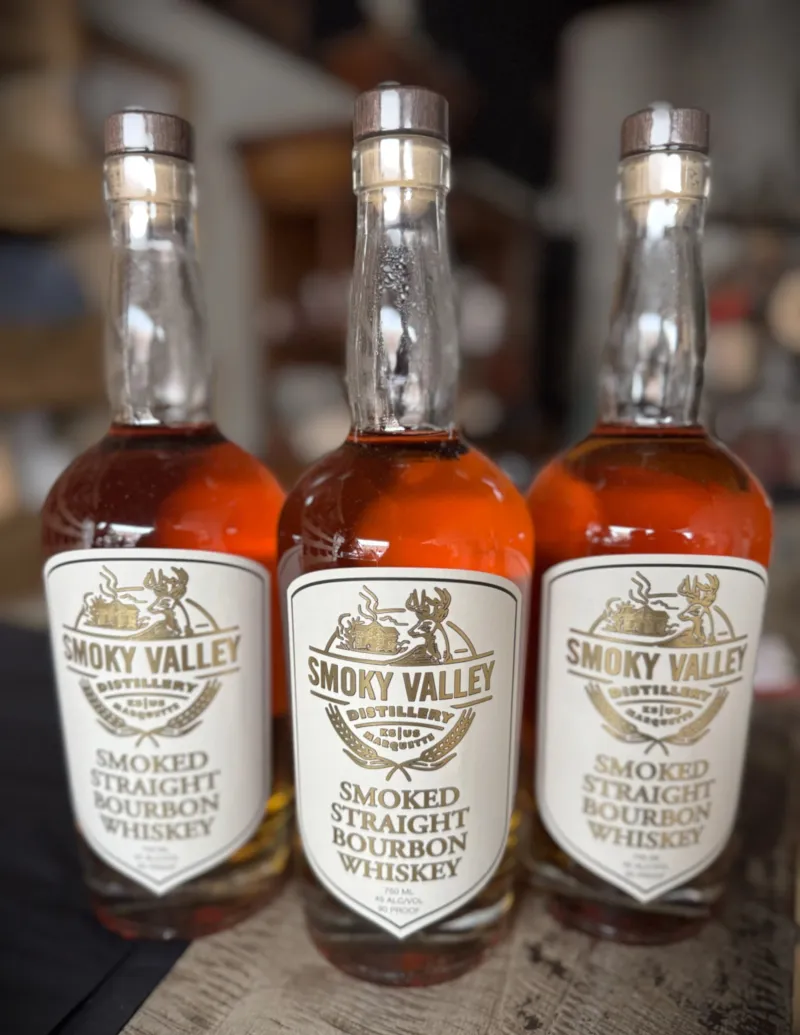
Somebody asks about this at the tasting room counter almost every Saturday. They see Smoked Straight Bourbon on the shelf, pick it up, and ask the same two questions in the same order: is it like Scotch, and did you add something to it?
No to both, and the reason why turns out to be the most interesting thing about the bottle.
"Smoked bourbon" is not a style with a definition behind it. It is a description of a method, and there are four completely different methods hiding under that one word on a label. Each puts the smoke in at a different point and tastes different as a result, so knowing which route a bottle took tells you most of what there is to know about how it will drink.
The Short Answer
Smoked bourbon is bourbon that carries a smoke character the barrel did not put there.
That caveat matters, because the barrel is already burned. Every bottle of bourbon is aged in charred new oak — that is federal law, not a style choice — and people reasonably assume the char is where smoky bourbons get their smoke. It isn't. Barrel char is a fire that is set and then extinguished before the whiskey goes in, which means there is no smoke present for the spirit to pick up.
So any bourbon that genuinely smells of smoke got it somewhere else. The federal standards of identity for whisky — 27 CFR 5.143, the section that spells out the 51% corn minimum, the 160 proof distillation ceiling, and the charred-new-oak-at-125-proof requirement — never mention smoke, peat, or smoking of any kind. There is no legal class called smoked bourbon. There is only a method, and the method is the whole story.
Four Places the Smoke Can Come From
1. The grain, before anything is fermented
The oldest route, and the one Scotland built an industry on. Malted barley has to be dried, and if you dry it over a smoky fire, the grain absorbs phenolic compounds that survive fermentation, survive distillation, and end up in the glass years later.
In Scotland the fuel is peat. In American craft distilling it is usually hardwood — cherry, mesquite, alder, hickory — bought as smoked malt from a maltster and run as part of the mash bill. Because the smoke rides in on a grain rather than being added to a finished spirit, this route is fully compatible with the bourbon rules: smoked malt is an ingredient in the mash bill, not an additive in the bottle. It is also the most committed version. Once the smoke is in the mash it is in every barrel of that run, permanently.
2. The barrel, which is the one that isn't smoke
Worth stating plainly because it is the most common misunderstanding we hear: char is not smoke. A heavy #4 "alligator" char will push a bourbon darker, drier, and almost spicy, and it leaves a faint ashy grip at the very back of the finish that people often read as smoke. But the mechanism is wood sugars caramelizing and lignin breaking down into vanillin, not smoke particles dissolving into spirit. Our page on what barrel char is walks through the four char levels and the red layer underneath them.
3. The vessel, after the whiskey is finished
This is the route we take, and it is the least known of the four. Instead of altering the grain or the barrel, you smoke the container the whiskey is going into. The glass holds the smoke aromatically; the whiskey picks up character from inside a smoked vessel rather than from anything stirred into it.
It is the most controllable of the four methods because the whiskey underneath is already finished and known. You are not gambling a two-year barrel on a smoke level you guessed at during milling.
4. The glass, at the moment of service
Not a production method at all, but it belongs on the list because it is what most people have actually tasted. A bartender with a smoking gun, a torched oak plank, or a cloche is doing the same job thirty seconds before serving: putting smoke in contact with the drink. A flamed orange peel over an Old Fashioned is the low-tech version.
The tell is how fast it fades. Smoke added in the glass is at its peak on the first sip and noticeably thinner by the last one. Smoke that came in through the grain or the vessel is still there at the bottom of the glass.
Why the Rules Push Smoke Outside the Whiskey
Here is the part that explains why American smoked whiskeys are made in such roundabout ways.
In the standards of identity table at 27 CFR 5.143, every whisky class has a column for whether harmless coloring, flavoring, or blending materials may be used. For bourbon whisky and for any straight whisky, the answer is no. You cannot dose bourbon with a flavoring material — smoke or otherwise — and still sell it as bourbon. The same prohibition is why a straight bourbon's color has to be earned from wood rather than poured in from a bottle of caramel.
A whiskey that does have smoke flavoring added to it is still a legitimate product. It just isn't bourbon anymore. It becomes a flavored spirit under 27 CFR 5.151, which requires bottling at not less than 30 percent alcohol by volume and a designation naming both the base spirit and the predominant flavor — the regulation's own example format is "Cherry Vanilla Flavored Bourbon Whisky." If a bottle says something like smoke flavored whiskey, the label is telling you exactly which route it took, and it is a different route from ours.
That leaves distillers who want smoke in a bourbon with the grain, the vessel, or the glass. Nothing else is open.
How We Make Ours
Our Smoked Straight Bourbon starts as our Straight Bourbon and nothing about that part changes. Same mash of Kansas corn, rye, and malt. Same sandstone-filtered water out of the Kiowa Aquifer. Same two to four years in 10-gallon charred new oak barrels — roughly a fifth the size of the industry-standard 53-gallon cask, and part of why our bourbon tastes older than it is. Same 45% ABV in the bottle.
The difference comes at the very last step. Each bottle is hand-smoked with hickory wood in a culinary smoker and then filled. Bottle by bottle, by hand, which is why it is a limited thing rather than a production line.
Two things follow from that. The first is restraint — the smoke is aromatic rather than heavy, and it sits on top of a bourbon that is otherwise completely intact. Nothing was reformulated to make room for it. The second is that this is the same technique behind our Smoked Jalapeno Vodka, where hickory smoke meets a jalapeno-infused corn vodka. Once you have tasted both, the house signature is obvious.
Smoked Bourbon Is Not Peated Scotch
This is the comparison everybody reaches for, and it is the one worth dismantling, because peat and hardwood are not the same smoke.
Peat is compressed bog vegetation, and what it produces when it burns depends on where it was cut. Barry Harrison and Fergus Priest analyzed peats from Islay, Orkney, St. Fergus, and Tomintoul by pyrolysis and found that the pyrolysates differ measurably by both geographic source and extraction depth — Islay and St. Fergus peats were rich in lignin derivatives, while Orkney and Tomintoul carried more carbohydrate derivatives (Journal of Agricultural and Food Chemistry, 2009). That variation is the chemistry underneath the medicinal, iodine-like, maritime descriptors people use for Islay whisky.
Hardwood smoke lands somewhere else entirely. A 2025 study in Molecules characterized the aroma of condensed hardwood smoke and reported the odorants with the highest flavor dilution values as 2,3-butanedione (buttery), guaiacol (clove, vanilla), 4-methylguaiacol (toasted, vanilla, ashy), 3-ethylphenol (ashy), 4-methylsyringol (burnt, clove), and butyric acid. Clove, vanilla, and toast — which is why hickory smoke flatters a bourbon that already tastes of vanilla and caramel, and why peat would fight it.
One more thing worth knowing: peat is not actually a requirement for Scotch. The Scotch Whisky Regulations 2009 specify where it is made, what it is made from, the cask, three years of maturation, and 40% ABV — and say nothing about peat at all. The smoke is a regional malting tradition, not a legal definition, which is exactly the same status it has here. For more on how those two rulebooks diverge, see whiskey vs whisky.
What It Actually Tastes Like
Ours noses as sweet corn, vanilla, and toasted oak with the hickory sitting behind it rather than in front. The palate is a little rounder and smoother than the unsmoked version — smoke reads as weight before it reads as flavor — and the finish carries the smokiness a beat longer than you expect, which is the part regulars tend to like most.
The honest description is subtle. If you are coming from a heavily peated Islay and expecting that intensity, this is not that bottle. If you want smoke that makes a bourbon feel older and rounder without taking it over, this is exactly that bottle.
To taste the smoke properly, pour both bourbons side by side in a glass with a narrowed opening, which concentrates the volatile aromatics instead of letting them off the surface. Our whiskey glassware guide covers why shape matters more than price, and how to taste whiskey walks the order we pour our own flight.
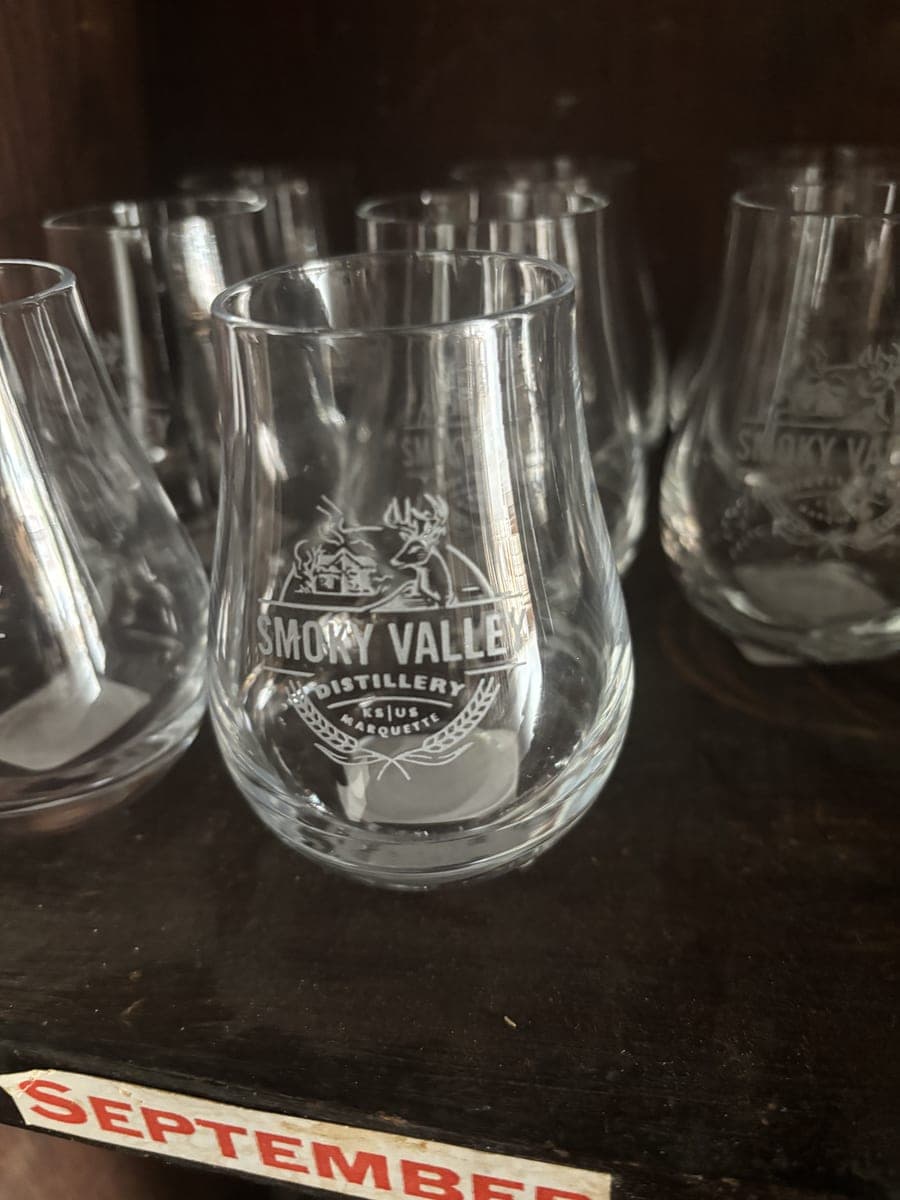
Logo Tasting Glass
$16.95A tulip-shaped nosing glass etched with the Smoky Valley Distillery crest — shaped to concentrate aroma for tasting our bourbon and whiskey neat.
View in the shop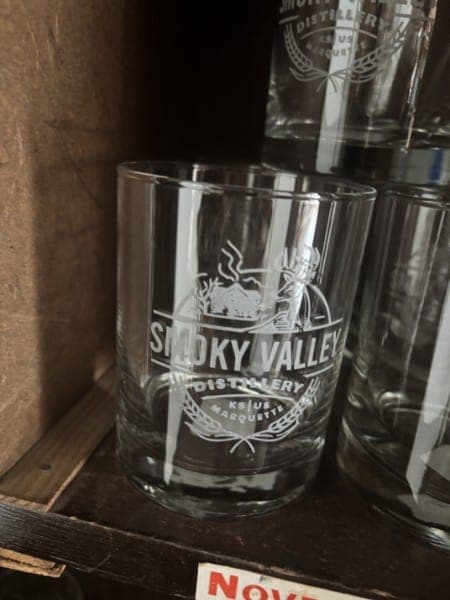
Old Fashioned Glass
$19.95A heavy-bottomed rocks glass etched with our crest — built for an Old Fashioned, a bourbon on the rocks, or a neat pour.
View in the shopHow to Drink It
Neat, first. One pour of Smoked Straight Bourbon, one pour of Straight Bourbon, same glass shape, no ice. Five minutes with those two will teach you more about smoke in whiskey than anything you can read, including this.
In a Smoked Old Fashioned. Sugar and bitters temper the smoke rather than competing with it, and a flamed orange peel adds a second smoke layer at service. All three of our smoked builds — Old Fashioned, Smoky Manhattan, Smoked Bourbon Sour — are in smoked bourbon cocktails. In a Manhattan, add a bar spoon of maple syrup: smoke, sweet vermouth, and maple sounds like too much and isn't.
Next to the grill. Hickory in the glass and char on the plate are the same flavor family, so this bottle handles brisket, ribs, and anything off a smoker better than the rest of our lineup. Our guide to bourbon and food pairing gives each of our five bourbons a plate.
Where to Find It
Kansas law does not allow a distillery to ship spirits, so bottles come from the tasting room here at 105 N. Washington in Marquette or from one of our retail partners across Kansas.
If you can make the drive, do the comparison with us instead of at home. A tasting and tour runs $10 per person, takes 30 to 45 minutes, and happens Thursday through Saturday by appointment — and pouring the smoked and unsmoked bourbons back to back is one of the stops.
The Short Version
Smoked bourbon is a method, not a category. Federal law defines bourbon by grain, proof, and charred new oak and says nothing about smoke, so distillers who want it have three legitimate ways in — smoke-dried grain in the mash, a smoked vessel, or smoke added in the glass at service — plus a fourth option that moves the bottle out of the bourbon class entirely and into flavored spirits.
The barrel is not one of the routes. Char is fire without smoke.
And hickory is not peat. One tastes like clove, vanilla, and a barbecue pit; the other tastes like a bonfire on a beach. Ours is the first kind, made one bottle at a time, sitting on top of a Kansas bourbon we did not change to make room for it.