
The Foam Is the Test
Everything that separates a good espresso martini from a brown drink in a cold glass happens in the top quarter inch.
That pale tan layer is not whipped cream and it is not luck. It starts as crema, and crema is a gas problem. Espresso is extracted under roughly nine atmospheres of pressure, which forces carbon dioxide — gas the coffee has been slowly giving off since it was roasted — into solution. The moment the shot leaves the machine and drops to room pressure, that CO2 comes back out as bubbles, and surface-active compounds in the coffee itself coat those bubbles and hold them.
The only detailed published study of the stuff, Illy and Navarini's "Neglected Food Bubbles: The Espresso Coffee Foam" in Food Biophysics (2011), describes crema as a metastable foam with bubbles measured across a 10 to 150 micrometer range, beginning as a wet, bubbly liquid foam and drying into a polyhedral one as it ages. Metastable is the operative word. It is falling apart from the second it forms.
Three consequences follow, and they are the entire technique:
Fresh matters more than good. An excellent shot that sat on the counter for two minutes has already released most of its gas. A mediocre one pulled thirty seconds ago has not. If you only fix one thing on this page, pull the coffee last.
Hot matters. Hot espresso is thinner and gives up gas more readily than cold, and the shaker's job is to whip that gas plus a lot of entrained air into a foam before the ice shuts the process down. Chilling the espresso first is a real technique with a real purpose — it controls dilution — but it trades away foam, and foam is what people are paying for.
Cold brew is a different drink. Cold brew concentrate was never under pressure, so it carries no dissolved CO2 to release. Shake it and you will still get foam, because the coffee's surfactants will stabilize air you beat in by hand, but it is thinner and it collapses sooner. The mechanism predicts it and the glass confirms it.
The Spec, in Measures You Actually Own
The International Bartenders Association lists the official build as 50 ml vodka, 30 ml Kahlúa, 10 ml sugar syrup and "1 strong espresso," shaken with ice, strained into a chilled cocktail glass, garnished with three coffee beans. That is the reference point, and it is a good one.
Converted to the jigger on your counter, 50 ml is a hair under 1 3/4 oz, 30 ml is 1 oz, and 10 ml is a third of an ounce. Our house build:
- 1 3/4 oz Premium Vodka
- 1 oz coffee liqueur
- 1 oz espresso, hot
- 1/4 oz simple syrup, conditional
The syrup is where we depart from the official spec, and it is not a rounding difference — it is a judgment about what is already in the bottle. Coffee liqueur is a heavily sweetened product running roughly half the strength of vodka, and the strength has been drifting down for twenty years: Difford's Guide records Kahlúa falling from 26.5% to 20% ABV in 2004, then to 16% in several markets including the UK and Canada in 2021. Pour an ounce of something that sweet and then add a full third of an ounce of syrup on top, and the coffee stops tasting like coffee.
So: with a standard sweet liqueur, skip the syrup entirely or use a bare quarter ounce. With one of the drier, higher-strength coffee liqueurs that have shown up in the last decade, use the quarter ounce and taste before you commit to more. The drink should finish dry enough that you want the next sip. If it finishes like dessert, the syrup was the problem, not the coffee.
Shake Harder Than You Think
A shaken sour gets 10 to 15 seconds. An espresso martini gets the same 10 to 15 seconds and twice the aggression.
The reason is that you are doing two unrelated jobs at once. Chilling is easy — hot liquid over ice loses heat fast. Aerating is the hard one, and it only happens when the liquid is slammed back and forth against the ice hard enough to tear air into it. A gentle shake chills perfectly well and produces almost no foam, which is why the most common failure on this drink is a correctly made cocktail with nothing on top.
Fill the shaker properly. More ice means a harder impact and less melt per shake, which sounds backwards until you watch a half-empty shaker turn a drink to water.
Then double strain. Pour through the shaker's strainer and a fine mesh sieve together: the shards and chips that a hard shake knocks off the ice will otherwise ride into the glass, float up into the foam, and melt pinholes through it while the drink sits in front of your guest.
Give it ten seconds to settle before you garnish. The foam rises and firms up on its own, and three beans dropped on a foam that has not set yet simply sink.
The Coffee Is Most of the Drink
An espresso machine is the easy answer. Here is what to do when there is not one in the kitchen, ranked by how close it gets:
Moka pot. The closest substitute. It brews under pressure — far less than an espresso machine, but real pressure — so it carries some dissolved gas and some crema-forming capacity. Brew it strong and use it hot.
Aeropress, pressed short and strong. Not pressurized in the espresso sense, but concentrated enough to stand up to an ounce of liqueur and nearly two of vodka. Expect less foam.
Instant espresso powder, mixed thick. Genuinely better in this drink than its reputation suggests, because the shake is doing the aerating and the liqueur is doing the sweetening. Use about half the water the tin recommends.
Cold brew concentrate. Works, tastes good, foams least. See above for why.
Drip coffee. The one to avoid. It is not concentrated enough, and an ounce of it just thins the cocktail.
Whatever you brew, brew it strong. The espresso is going up against 1 3/4 oz of 80-proof vodka and an ounce of sweet liqueur, and weak coffee loses that fight silently — you do not taste coffee that is too weak, you taste a sweet vodka drink and wonder why it is boring.
Decaf is a completely legitimate choice here and nobody will be able to tell. Decaffeinated beans still outgas CO2 after roasting, so a decaf shot pulled fresh still builds a crema and still foams. If the drink is going to be the last one of the night, this is the version to make.
The Glass We Do Not Sell
This drink wants a coupe or a small martini glass: stemmed, so your hand is not warming it, and wide enough to give the foam some surface to spread across. We do not sell one, which puts us in the awkward position of telling you to buy a glass somewhere else. Do that — a cheap coupe beats an expensive rocks glass for this.
There is one real exception, and it is a historically defensible one. Before the drink settled into its stemmed-and-straight-up form, Dick Bradsell served a version of it on the rocks under the name Pharmaceutical Stimulant. Built that way — same spec, shaken the same, poured over a single large cube in a heavy rocks glass — it is a slower, colder, more forgiving drink, and the foam sits on it just fine.
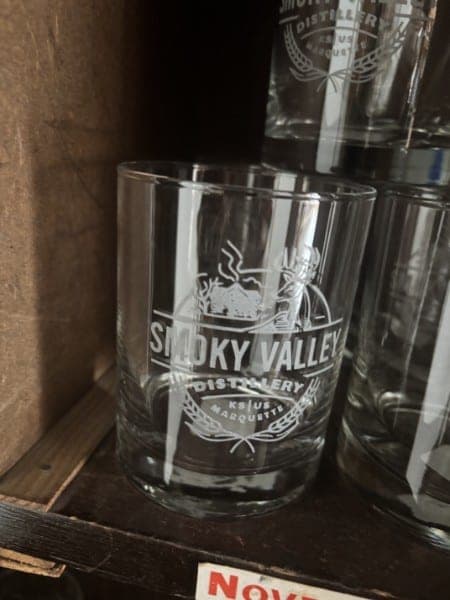
Old Fashioned Glass
$19.95A heavy-bottomed rocks glass etched with our crest — built for an Old Fashioned, a bourbon on the rocks, or a neat pour.
View in the shopThat is the one piece of glassware in our shop that belongs anywhere near this cocktail, and only for the on-the-rocks version. The logo tasting glass is a 1.5 oz nosing glass, which is the wrong tool twice over — too small for the drink, too narrow for the foam. Our whiskey glassware guide covers what each shape is actually for.
Which Smoky Valley Bottle to Pour
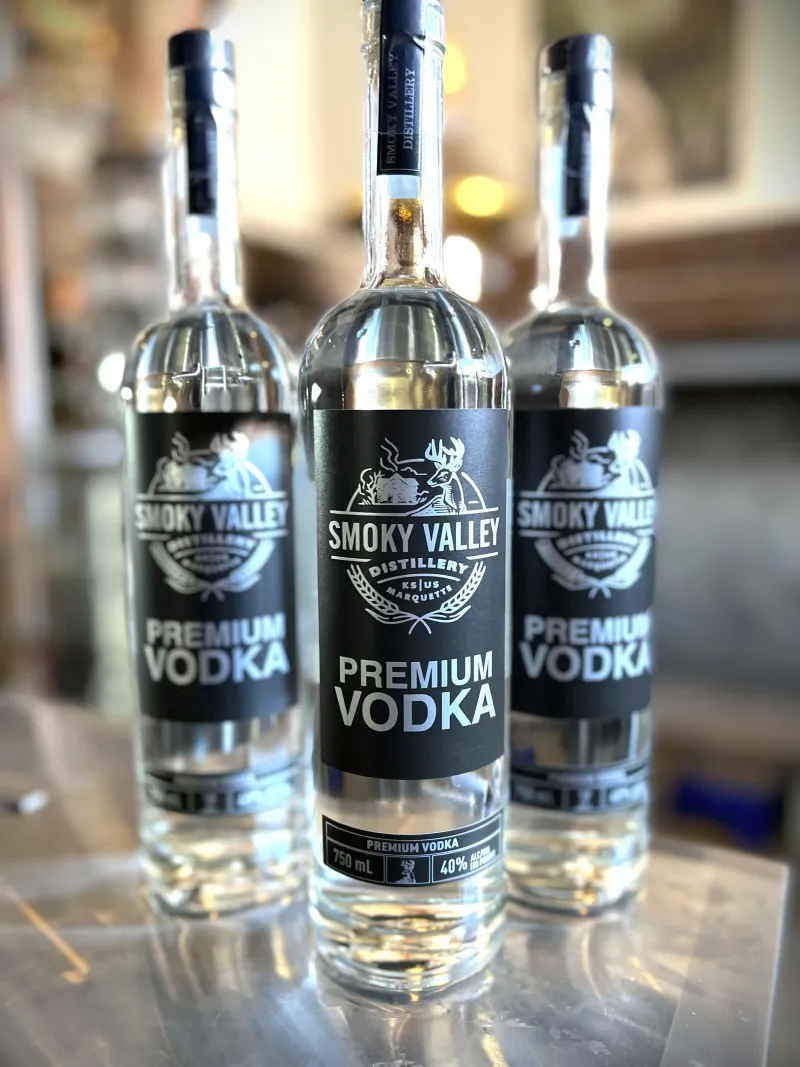
The standard advice is that an espresso martini needs a clean, neutral vodka so the coffee can do the talking. That is right as far as it goes, and our Premium Vodka is exactly that — 100% Kansas corn, proofed with sandstone-filtered Kiowa Aquifer water, with a faint sweet-corn and vanilla character that sits under dark coffee without arguing with it.
But we make five vodkas, and a few of them do interesting things here.
| Bottle | ABV | In an espresso martini |
|---|---|---|
| Premium Vodka | 40% | The house pick, and the one to start with. Corn-based, clean, with just enough residual sweetness to round the coffee's edges. |
| Smoked Jalapeno Vodka | 40% | The surprise of the lineup. Chile and chocolate is an old pairing, dark roast coffee sits in the same register as chocolate, and the smoke bridges them. Use half Premium and half jalapeno the first time. |
| Lingonberry Vodka | 40% | Tart red berry against bitter coffee, which is the same contrast a bright Ethiopian roast gives you on its own. Unusual, and better than it sounds. |
| Wild Plum Vodka | 40% | Softer and jammier. It rounds the drink off rather than sharpening it, and the plum mostly disappears under the espresso. Pleasant, not pointed. |
| Pickle Vodka | 40% | No. We have tried it so you do not have to. Dill and espresso are two strong aromas with nothing in common, and the drink tastes like both of them separately. Pour it in a Bloody Mary instead. |
Why the base spirit matters less here than in most cocktails is worth saying plainly: coffee is loud. A vodka's character shows up at the edges of this drink rather than in the middle of it. That is also why it is worth tasting the vodka neat first, which is the whole argument for a tasting flight — and why we go into what separates one vodka from another in corn vodka versus potato vodka and how vodka is made.
Caffeine, Alcohol, and the Thing Everyone Gets Wrong
This is the only cocktail on our site that is also a stimulant, so it is worth doing the arithmetic properly.
The alcohol. 1 3/4 oz of 80-proof vodka is 0.7 fl oz of pure alcohol, and an ounce of 20% liqueur adds another 0.2 — 0.9 fl oz in total. The NIAAA counts 0.6 fl oz of pure alcohol as one standard drink, which makes an espresso martini almost exactly one and a half of them: the same as our Whiskey Sour and slightly less than our Mint Julep. A 16% liqueur shaves a few hundredths off that and changes nothing about how to treat the drink.
The caffeine. USDA FoodData Central puts restaurant-prepared espresso at 212 mg of caffeine per 100 g, which works out to about 63 mg in a one-ounce shot. Pull a two-ounce double and the drink carries roughly 126 mg, in the neighborhood of a large mug of drip coffee. The liqueur adds a little more, and no label will tell you how much.
The thing everyone gets wrong is what those two numbers do to each other. The folk belief is that the caffeine cancels some of the alcohol — that you stay sharper, or sober up faster. It does not work that way, and the research is more interesting than the slogan.
Caffeine does nothing to blood alcohol concentration and nothing to the impairment that concentration causes. Your judgment, reaction time and coordination at 0.08% are the same whether or not there is coffee in the drink. The honest open question was always the subjective half — whether caffeine makes people feel less drunk than they are, and therefore drink more. Benson, Verster, Alford and Scholey tested exactly that in Neuroscience & Biobehavioral Reviews (2014), pooling nine studies across caffeine doses from 46 to 383 mg and blood alcohol levels from about 0.032% to 0.12%. They found no significant masking effect — p = 0.404 with the higher-dose studies included, p = 0.406 with the lower ones. Caffeine did not measurably change how drunk people judged themselves to be.
So the "wide awake drunk" story is weaker than it is usually told, and the practical advice survives it intact anyway: an espresso martini is one and a half drinks and a cup of coffee, it will keep you up if you have it late, and it will not make you safe to drive.
Worth noting what the famous regulatory fight was actually about, since it gets cited at bars: the FDA's November 2010 warning letters went to four makers of premixed caffeinated alcoholic malt beverages — Four Loko among them — on the grounds that caffeine added to those products was an unsafe food additive. The agency's own safety review leaned partly on the masking argument the meta-analysis above later failed to confirm, but the action itself turned on caffeine being added as an ingredient to an engineered single-serving can. Nothing in it concerned a bartender pulling a shot of espresso into a shaker, and that distinction is the whole of it.
Where the Drink Came From
It is a Dick Bradsell drink, made in London in the 1980s, and almost everything past that sentence is contested.
The story everyone tells is that a young woman walked up to Bradsell's station and asked for something that would wake her up and get her drunk, in blunter words than that. He had a coffee machine next to the bar, and he built her a Vodka Espresso. Difford's Guide dates it to around 1983 at the Soho Brasserie. Punch notes that Bradsell never named the customer, that the frequently repeated detail about her being a model may not be true, and that his daughter Beatrice places the drink closer to 1985, reasoning from what was being filmed in Soho at the time.
What is not contested is the arc afterward. The original was called Vodka Espresso. Bradsell later served a rocks version as the Pharmaceutical Stimulant. The drink was reworked at a London bar in the 1990s into the stemmed, straight-up form that took over the world under the name Espresso Martini — a name that is, strictly speaking, inaccurate, since there is no gin, no vermouth and no relation to a martini beyond the shape of the glass. The IBA added it to its official list anyway, which is the point at which an argument about nomenclature is over.
Making Them for a Crowd
You can batch most of this drink and you cannot batch all of it, and the dividing line is the coffee.
Mix the vodka, coffee liqueur and syrup ahead in a bottle — that part keeps for weeks in the refrigerator and loses nothing. At 1 3/4 oz vodka to 1 oz liqueur, a 750 mL bottle of Premium Vodka makes about fourteen drinks and needs roughly 420 mL of liqueur to go with it. Label the bottle with how many drinks are in it so you are not doing arithmetic at a party.
Then pull the coffee to order, two or three shots at a time, and shake in pairs. Espresso oxidizes and goes flat fast; a carafe of it brewed an hour early is the single most common reason a batch of these tastes dull. If you genuinely cannot brew to order, brew as late as you can, keep it covered, and accept that the foam will be thinner.
A shaker handles two drinks at once comfortably and three badly — there is not enough room left for the air you are trying to whip in. Our guide to batching cocktails for a crowd covers the general scaling rules, and this drink is the clearest exception to the "mix it all ahead" half of them.
For anyone not drinking, an ounce of espresso, half an ounce of simple syrup and three ounces of cold milk shaken hard over ice is a genuinely good drink and looks close enough from across the room.
Troubleshooting
No foam. Almost always the coffee sat. Pull it and shake it inside thirty seconds. After that: not enough ice, or too gentle a shake.
The foam collapsed in a minute. Ice shards from a hard shake, melting holes through it. Double strain through a fine mesh sieve.
Too sweet. Drop the syrup. An ounce of standard coffee liqueur already carries a great deal of sugar, and the official spec's 10 ml of syrup assumes you want a dessert-weight drink.
Bitter and thin. Weak or over-extracted coffee. Brew it stronger, or pull a shorter, sweeter shot — the first part of an espresso is the good part.
Watery. The hot espresso hit a half-empty shaker and melted everything. Fill the shaker, shake hard, and stop at fifteen seconds.
The beans sank. The foam had not set. Wait ten seconds after pouring before you garnish.
Take It Further
If this is the first thing you have made with our vodka, the obvious next stops are the Moscow Mule and the five builds in simple vodka cocktails — and for something that exists nowhere else, the Teardrop and the Kansas Cherry Limeade are both built on bottles we make ourselves. More ideas are in easy vodka cocktails, and the full set is on the recipes page.
For the stirred, no-foam end of the spectrum, our Old Fashioned and Manhattan are where to go next, and shaken versus stirred as a question gets settled by what you are trying to put into the glass — air, in this drink's case.
Better still, taste the vodka before the coffee gets to it. We pour Thursday through Saturday in Marquette, Kansas — details on our tastings and tours page — and our bottles are stocked at retail locations across Kansas. If espresso martinis for sixty sounds like your kind of evening, our private events room has the space and the bar to do it.