
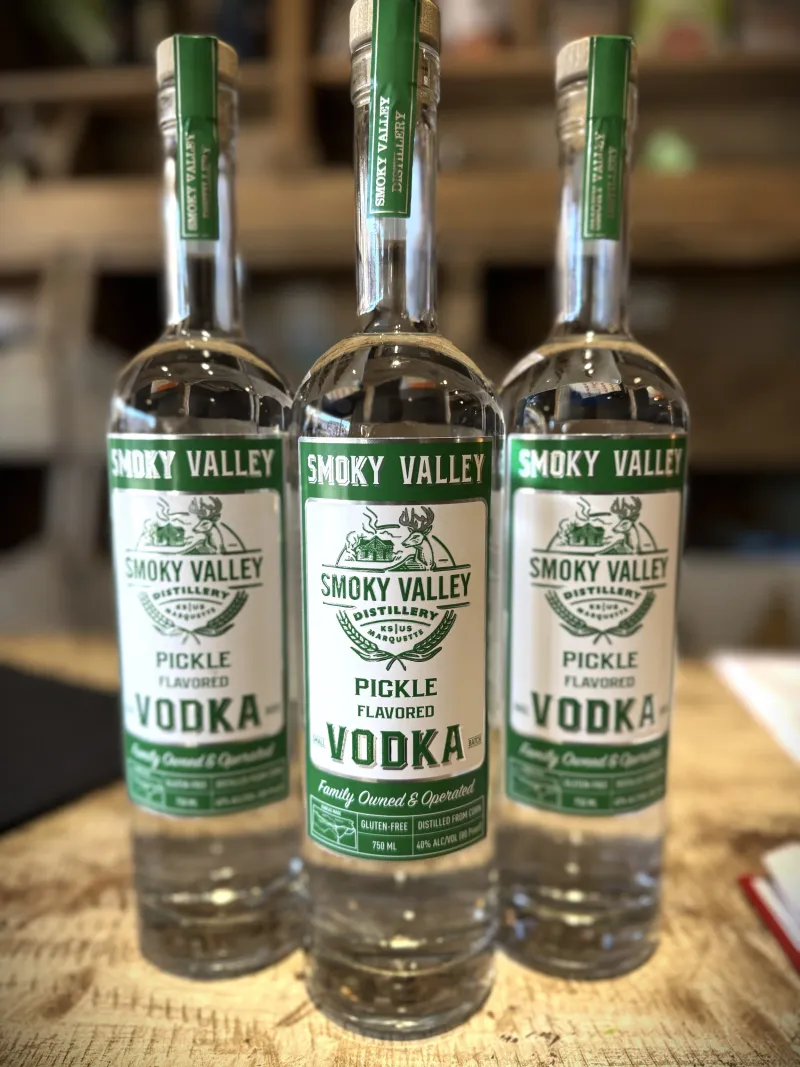
The question comes up at the counter more than you would think, usually from somebody looking at the Pickle Vodka and grinning: so can you do a pickleback with that?
Yes. But first, the straight answer to the question people are actually asking, because the word gets used for about four different things and only one of them is the drink.
The Short Answer
A pickleback is a shot of whiskey chased by a shot of pickle brine, drunk in that order, out of two separate glasses.
That is the whole drink. Difford's Guide specs it at 1 fl oz of whiskey and 1 fl oz of chilled pickle juice, brine, or gherkin vinegar, served as two shot glasses side by side. Nothing is stirred, shaken, mixed, or built over ice.
Three things it is not:
- Not a cocktail. Nothing is combined. If the brine goes into the glass with the spirit, you have made a different drink — a savory martini or a pickle sour, both of which are worth making and neither of which is a pickleback.
- Not a garnish. A pickle spear in a glass is a garnish. A separate glass of brine is a chaser.
- Not optional in its order. Whiskey, then brine. We will come back to why.
Where It Came From
For a drink this simple, the origin story is unusually well documented, and the documentation is a bar argument.
The account most people accept runs through the Bushwick Country Club, a bar in Brooklyn. Bob McClure of McClure's Pickles lived upstairs and, having no room in his apartment, asked the owner if he could store a pallet of pickles in the basement. In Punch's 2019 account, the owner dates the first one to "that fateful Sunday, March 12, 2006." A regular asked for a shot of Old Crow with brine on the side, bartender Reggie Cunningham poured it, and when the regulars tried to name it something else, Cunningham shut that down: "No! It's a Pickleback!"
Two details in that story are worth keeping.
The first pickleback was bourbon, not Irish whiskey. Jameson became the default later. Difford's credits the Ruotolo brothers, who ran Whiskey Town in Manhattan's East Village, with serving it there with Irish whiskey in place of bourbon, and Punch quotes a Jameson brand representative calling his own brand "the lucky benefactor of a trend that started with Old Crow." If you have been told the pickleback is an Irish whiskey drink, that is twelve-year-old bar habit, not a rule. Bourbon and rye were there first.
Cunningham does not claim he invented it. He told Punch that drinking pickle brine with liquor "has been going on forever," and that what started at the Bushwick Country Club was the version as it is ordered and served today. That is the honest version of almost every drink origin story, and it is the one we would give about half our own recipes.
Why the Brine Actually Works
This is the part worth understanding, because it explains why pickle brine works where a glass of water does not, and it is also the part where most writing on the subject guesses.
Nobody has put a pickleback through a laboratory. What exists is solid research on each piece of what is happening, and three mechanisms line up.
Salt suppresses bitterness more than it suppresses anything else. In a 1997 Nature paper, Salt enhances flavour by suppressing bitterness, Breslin and Beauchamp of the Monell Chemical Senses Center proposed that sodium acts as a selective filter — it cuts unpleasant tastes like bitterness harder than it cuts palatable ones like sweetness, which is why a pinch of salt makes food taste more of itself rather than just saltier. A shot of brine is a large, fast dose of exactly that. The bitter, drying tail end of a young whiskey is the thing it goes after first.
The burn is not a taste, and the brine interrupts it. Whiskey heat is not happening on your taste buds at all. It is a pain channel: TRPV1, the same receptor capsaicin uses. In Ethanol elicits and potentiates nociceptor responses via the vanilloid receptor-1 (Trevisani et al., Nature Neuroscience 2002;5(6):546-551), ethanol was shown to both activate that receptor and lower its heat-activation threshold from about 42°C to about 34°C — in other words, alcohol makes your own body temperature hot enough to set the channel off. That is the mechanism behind the word "burn." A cold, wet, aggressively flavored liquid arriving one second later gives the nervous system something much louder to report.
Acid and salt pull a rinse out of your own mouth. Vinegar brine is sour and salty in combination, which is about the most efficient salivary trigger in a kitchen. The rinse is physical. It is the reason the brine clears the palate rather than layering onto it, and the reason the whole thing resets inside a few seconds instead of lingering the way a sweet chaser does.
Put together: the chaser cuts bitterness, hijacks the burn, and washes the glass out. A sip of water does one of those three.
How to Pour One Properly
Six rules, and five of them are about order and temperature.
- Two glasses. One for the whiskey, one for the brine, poured and set down together before either is picked up. Fumbling for the second glass is how the gap gets too long.
- Match the pours. An ounce each is the published spec and it is the right call. Equal volumes keep the chaser proportional to what it is chasing.
- Chill the brine. Straight from the refrigerator. Cold brine is sharper, reads cleaner, and does more for the TRPV1 problem above than room-temperature brine does.
- Whiskey first, brine second, about a second apart. Long enough to swallow. Not long enough to consider your life.
- Do not mix them. If brine ends up in the whiskey glass you have made something else. Worth making — see the pickle martini on our pickle vodka cocktails page — but not this.
- Taste the whiskey before you chase it. This is the one step everybody skips, and it is the one that tells you whether the bottle was the right choice. Pour a half ounce into a nosing glass, nose it, taste it, and then run the shot. Otherwise you have no idea what the brine erased.
That last step is the only place in this drink where glassware does anything. We do not sell shot glasses, and a pickleback genuinely wants two cheap ones. What a tulip-shaped nosing glass is good for is the half-ounce you taste first:
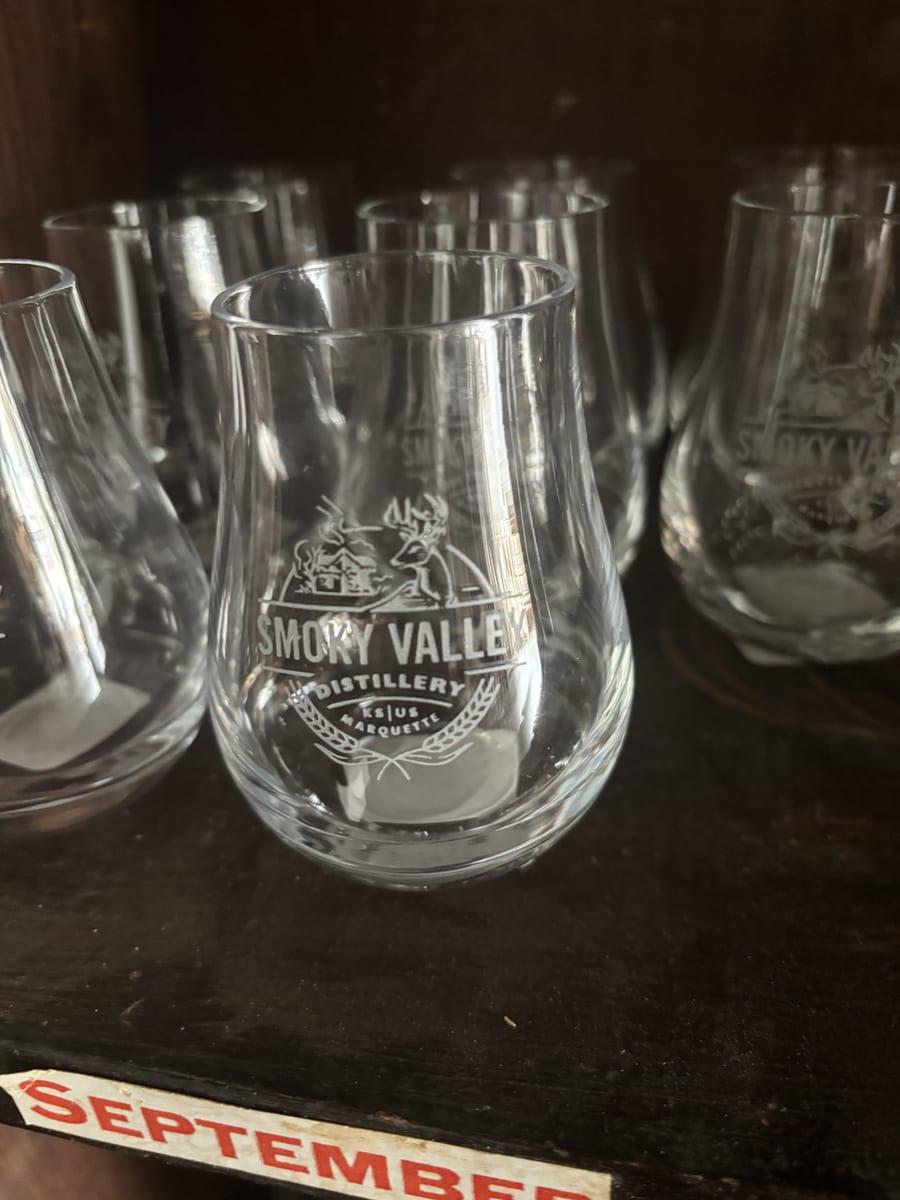
Logo Tasting Glass
$16.95A tulip-shaped nosing glass etched with the Smoky Valley Distillery crest — shaped to concentrate aroma for tasting our bourbon and whiskey neat.
View in the shopWhich shape does what, and why the tumbler is the wrong tool for assessment, is covered in the whiskey glassware guide. The full method for the half ounce you taste first is how to taste whiskey.
Which Brine
The brine is half the drink and it is the half people grab without looking.
Use dill or kosher dill. Salt, vinegar, garlic, dill, and usually a little heat. This is the brine the drink was built on.
Skip the sweet stuff. Bread-and-butter brine brings sugar to a job that wants salt and acid, and sugar is the one thing that will make the finish longer instead of shorter. USDA reference data puts sweet pickles — bread-and-butter included — at 457 mg of sodium per 100 g against 809 mg for dill, which tells you which direction that jar was built in. A sweet chaser lingers. That is the opposite of the point.
Spicy dill is closer to the original than plain is. Difford's describes the first pickleback as Old Crow with a shot of McClure's spicy brine. If you like the heat, you are being traditional, not fancy.
Olive brine is a different drink. Good drink. Not this one. That is a dirty martini, and our Dirty Pickle Martini is what happens when you commit to it.
Brine from a jar you have actually eaten out of is fine. This is not a drink with standards about provenance. It is a drink that got invented because there were pickles in the basement.
Which Whiskey to Put Behind It
Here is where we will be blunter than a distillery is supposed to be: a pickleback is not the place for your best bottle.
The format exists to shorten a finish. If you have spent money on a whiskey because of its finish, the chaser is working directly against the thing you paid for. Put the good one in a glass and drink it slowly. Put something honest and middle-of-the-road in the shot glass.
Across our own shelf, that sorts out like this:
| Bottle | ABV | In a pickleback |
|---|---|---|
| Straight Bourbon | 45% | Our first choice. Corn sweetness up front, rye spice behind it, enough structure to still be there after the brine. |
| Rye Single Barrel Whiskey | 45% | The other first choice, and the more interesting one. An 82% rye mash bill brings black pepper and baking spice, and pepper against dill and garlic is a genuinely good pairing rather than a tolerated one. |
| Bud & Dewey's | 45% | Works, but it is our softest, roundest, most vanilla-forward bourbon and the brine flattens exactly those notes. Better neat. |
| Smoked Straight Bourbon | 45% | Surprising and worth trying once. Hickory smoke and dill brine is a barbecue plate in two glasses. |
| Kernza Whiskey | 45% | We would rather you did not. There are two distilleries in the world working with this grain and the whole reason to drink it is to notice what the grain does. |
| High Rye Single Barrel Bourbon | 35% | Skip it here. It is the softest-proof bottle we make and a shot of brine simply runs over the top of it. |
The general rule travels past our shelf: a 90-proof whiskey with a little spine is the right category, and a delicate or expensive one is not. If the label matters to you, how to read a whiskey label covers which words on it are doing real work.
The Kansas Version
We make a dill Pickle Vodka, which gives us two routes nobody in Brooklyn had in 2006.
The double pickle. Shot of whiskey, chased by chilled Pickle Vodka instead of brine. The dill is there, the salt is not, and the chaser is now 40% ABV instead of near zero — which means this is two drinks arriving as fast as a pickleback does. Treat it accordingly.
The reverse. Shot of chilled Pickle Vodka, chased by a shot of actual brine. This is the one we would hand somebody who likes the idea of a pickleback but does not much like whiskey, and it is the better of the two.
Worth being precise about something on our own site: the "Pickleback Shot" listed on our pickle vodka cocktails page is chilled Pickle Vodka on its own, poured neat with a cornichon. It is a good pour and it is not a pickleback by the definition at the top of this page — there is no whiskey and no chaser. Both drinks are worth having. They are not the same drink.
If you want the heat without the brine, our Smoked Jalapeno Vodka does that job, and the two flavored bottles together are the backbone of the Bloody Mary bar we set out for groups. What separates a flavored vodka like ours from a jar of something steeping on a countertop is covered in flavored vodka vs. infused vodka.
Does a Pickleback Help a Hangover?
No. We get asked, and the answer is no.
The study people reach for is real and it is about something else. In Reflex Inhibition of Electrically Induced Muscle Cramps in Hypohydrated Humans (Miller et al., Medicine & Science in Sports & Exercise 2010;42(5):953-961), ten dehydrated subjects had cramps induced in a foot muscle by nerve stimulation and then drank either deionized water or pickle juice at 1 mL per kilogram of body weight — about 74 mL. Cramps after pickle juice were 49.1 seconds shorter than after water (84.6 vs 133.7 seconds).
Read the authors' own conclusion, though. They wrote that the effect "could not be explained by rapid restoration of body fluids or electrolytes," noted that plasma composition barely moved five minutes after ingestion, and suspected a reflex originating in the mouth and throat that inhibits the nerves firing at the cramping muscle. So: brine did something, it did not do it by replacing electrolytes, and a muscle cramp is not a hangover. Nothing in that paper is about alcohol.
Two things we would rather you heard from us than from a bar.
Brine is salty. USDA reference data lists dill pickles at 809 mg of sodium per 100 g, and the brine is where that salt came from. The FDA sets the Daily Value for sodium at less than 2,300 mg a day and notes Americans already average about 3,400. If you are watching your sodium, a round of picklebacks is not a neutral choice.
The pacing is the real issue. The NIAAA counts 0.6 fl oz of pure alcohol as one standard drink, so a 1 oz shot of a 90-proof whiskey is about three-quarters of a standard drink. That is a modest number on paper. What makes a pickleback go down easily is that the chaser removes the signal that normally slows a person down, which is exactly the mechanism that gets a round of four ordered in ten minutes. The brine is not making the alcohol gentler. It is making it quieter.
Come Try One the Right Way
The honest truth about the pickleback is that it is a bar drink, invented by accident, that happens to be built on real palate science — and the best way to understand it is to taste the whiskey first, straight, and then find out what the brine does to it.
That is most of what a tasting and tour is: $10 per person, 30 to 45 minutes, Thursday through Saturday by appointment at 105 N. Washington in Marquette. We pour the lineup neat, in order, and you can decide for yourself which bottle you would be willing to chase and which one you would not. Bring the pickleback question — it is a better conversation standing next to the still.
Our whole whiskey and vodka collections are on the shelf, where to buy has the sixteen Kansas retailers that carry us, and if the shot is going to be part of a longer evening, what to serve at a whiskey tasting party has the host math.